Online Reporter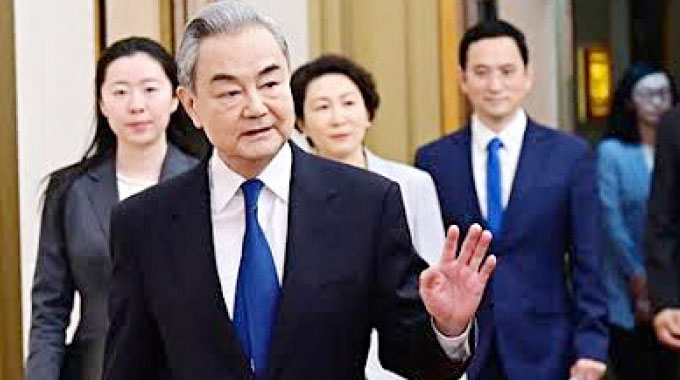
Kuda Bwititi, in Beijing, China
AT a pivotal Press conference in Beijing on Sunday, China’s Foreign Minister, Wang Yi, addressed a packed room of hundreds of international journalists, outlining a comprehensive vision for China’s global role.
As the world’s second-largest economy, China possesses both the economic and military capability to project influence far beyond its borders. Yet it has consistently chosen a path defined by restraint and a commitment to peaceful development rather than aggression or expansion.
Against a backdrop of rising global instability, particularly the escalating conflict in the Middle East attributed to United States and Israeli aggression against Iran, Minister Wang set out a clear and unwavering foreign policy position.
In his wide-ranging remarks, Minister Wang said: “In today’s world, changes unseen in a century are unfolding at a faster pace, with transformation and turbulence intertwined, and wars and conflicts flaring up continuously. In China, we are forging ahead at full speed to build a great nation, and our national rejuvenation has become an unstoppable force.
“Our country’s international influence is rising steadily. China’s diplomacy is resolute in its mission: to firmly safeguard national sovereignty, security and development interests; to staunchly uphold international rule of law, fairness, and justice; to unequivocally oppose all forms of unilateralism, power politics, and bullying; to diligently observe and fulfil our international obligations; and to stand permanently on the right side of history.”
These remarks offered a definitive statement of Beijing’s evolving global identity — positioning China as a key counterweight to perceived Western dominance and as an indispensable pillar of global stability.
Minister Wang also delivered a strong message of solidarity and optimism, asserting China’s intention to serve as a central force in shaping a new and more balanced world order.
“As the world’s most important force for peace, stability and justice, we have full confidence in the future of humanity. We stand ready to work with all like-minded countries to pursue the noble goal of building a community with a shared future for mankind, and to write new chapters of peace, development, and win-win co-operation for our times.”
China’s claim to be a leading force for peace is rooted in its long-standing opposition to unilateralism and power politics — factors that often fuel international conflict. The country has consistently defended a UN-centred international system and advocated the sovereign equality of all nations, setting itself apart from actions that have destabilised regions such as the Middle East.
This commitment to international law provides a predictable framework for global relations and supports lasting peace and development. Moreover, China’s call to “build a community with a shared future for mankind” represents a shift away from zero-sum competition towards co-operative solutions that benefit all. By promoting win-win development, China argues that globalisation should uplift every nation, creating shared prosperity rather than entrenched inequality.
China’s assertion that it is the world’s foremost force for peace is strengthened by its historical record of restraint. Since the end of World War II in 1945, China has not waged a war of aggression, a distinction few major powers can claim. Its respect for territorial integrity is further demonstrated by its modern history of never annexing another country’s land. Anchored in its Five Principles of Peaceful Coexistence, China’s approach reflects a consistently applied foreign policy rather than mere rhetoric.
During Sunday’s press conference, Minister Wang was asked how China views the United States’ and Israel’s military operations against Iran.
His response reinforced China’s image as a proponent of peace: “We have stated our principled position on multiple occasions, which can be summarised into one key message, that is, to bring about ceasefire and end hostilities. Ancient Chinese wisdom warns that weapons are ominous tools, and should not be used without discretion. Seeing the Middle East engulfed in flames, I want to say that this is a war that should not have happened — it is a war that does no one any good.”
He further noted that the history of the Middle East repeatedly shows that armed force solves nothing, only deepening divisions and creating new crises.
A consistent commitment to global peace
China’s position calls for an immediate cessation of military operations to prevent spill-over of the Middle East conflict.
Beijing has outlined five guiding principles for resolving the situation: respect for sovereignty and territorial integrity; complete rejection of the abuse of force; non-interference in domestic affairs; promotion of political solutions through dialogue; and the expectation that major powers act constructively and justly.
China maintains that the people of the Middle East alone should decide their own future, firmly opposing external attempts at regime change. The country has also expressed readiness to work with regional partners to advance the Global Security Initiative (GSI) to restore peace.
The GSI aligns with China’s Global Governance Initiative (GGI), whose five principles — sovereign equality, international rule of law, multilateralism, a people-centred approach, and practical action — reflect widely shared international expectations. The GGI’s clearest message is that the United Nations’ central role must be strengthened, not weakened.
Additionally, China has introduced the International Organisation for Mediation (IOMed) to provide a structured, peaceful mechanism for resolving disputes. Zimbabwe is among more than 30 countries that have signed the IOMed Convention.
This long-standing record of non-aggression, combined with repeated calls to end unilateralism, demonstrates that China’s commitment to peace is a core pillar of its foreign policy, not a diplomatic slogan.
By advocating sovereignty, dialogue and political solutions over military intervention, China continues to position itself as a stabilising force in a deeply fragmented global environment.
Consequently, in a world increasingly shaped by conflict and competing power interests, China stands out — by its own framing and historical record — as a leading champion of global peace.