

 admin
admin
Golden Sibanda and Happiness Zengeni—-
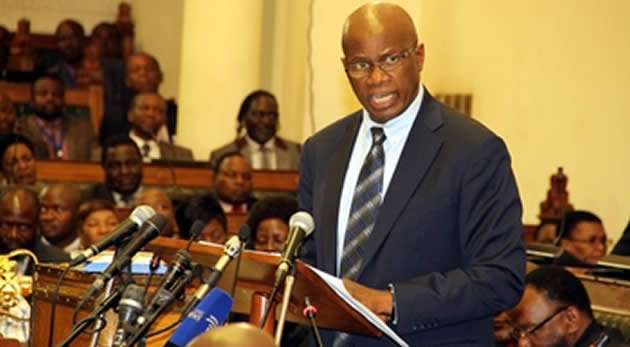
FINANCE Minister Patrick Chinamasa yesterday bravely ushered in a new economic dispensation when he gave Zimbabwe it’s first policy-driven National Budget in more than a decade. Set against the backdrop of a tightening liquidity situation which has manifested through a weak financial system, thinning tax base and low aggregate demand among other phenomena, Minister Chinamasa presented a fiscal plan that sets the tone for the creation of an enabling environment that will promote meaningful partnerships between Government, the private sector and international investors.
As projected by The Herald yesterday, the Budget was short on money and long on policy.
In the US$4,2 billion Budget proposal, Minister Chinamasa said policy consistency, credibility, certainty and transparency were critical blocks for confidence building in the domestic economy, over and above the prevailing stable macro-economic environment.
Referring to media inferences that the economy was “dead”, the minister said the assertion was true only to the extent it related to the old economy; pointing out that with the old economy “dead”, a new one was emerging.
To this end, Minister Chinamasa urged the banking sector to pay heed to structural changes that have taken place in the economy through financial support to a new clientele of farmers and indigenous enterprises.
Key policy areas which he said needed attention were isolated, but overall the minister recognised the importance of the agriculture and mining sectors.
In 2014, agriculture is projected to grow by 9 percent, largely driven by maize production.
The Minister gave mining a fresh look: firstly by reaffirming the 51-49 percent principle in terms of the indigenisation principle; and secondly by decriminalising artisinal miners and making available a US$100 million facility that could help provide the necessary capital to boost gold production.
He said the objective was to bring artisinal miners into the mainstream economy, while Fidelity Printers – which resumed operations last Tuesday – will be the sole buyer of gold in Zimbabwe with all other dealers only acting as agents.
In order to incentivise small-scale gold producers to sell through formal channels, the Finance Minister proposed to levy a lower rate of royalty of three percent on artisinal miners whose output does not exceed 0,5 kilogrammes per month, with effect from January 1, 2014.
Minister Chinamasa also clearly spelt out the “Use it or Lose it” principle, setting a limit of three years on claim holders.
To avoid the loss of potential revenue through exports of unprocessed minerals, Government will levy an export tax on unbeneficiated platinum and diamonds.
The export of raw chrome and chrome fines is already banned.
To restore confidence in financial markets, Minister Chinamasa proposed recapitalisation of the Reserve Bank of Zimbabwe to the tune of between US$150 million and US$200 million using a loan guaranteed by the Afreximbank.
The recapitalisation is expected to be complete by March 31, 2014.
This will allow the RBZ to intervene in the market by providing liquidity support to banks after Government assumed the central bank’s US$1,3 billion debt.
He said Treasury would issue the requisite debt instruments to local financial institutions and other players who were owed by RBZ, and this would be done by March 31, next year.
Similarly, US$100 million will be mobilised to restart the interbank market while US$20 million will be sought to demonitise Zimbabwe dollar bank balances.
This should see the RBZ resume the role of Banker to Government on April 1, 2014.
“In view of the above, I propose to introduce a US$100 million interbank programme supported by an international bank, the African Export-Import Bank, as a guarantor with effect from 1 April 2014,” Minister Chinamasa said.
With the Zim-Asset programme recognising the centrality of re-engaging with creditors for debt relief and new financing, Minister Chinamasa said Government remained committed to engaging the Bretton-Woods institutions and would do its best to abide by the Staff Monitored Programme.
HIGHLIGHTS:
- Focus on confidence-building
Multi-currency system to stay- Economy to grow by 6,4 percent
- Revenue collection projected at US$4,2 billion
- US$100 million inter-bank programme on cards
- Big taxes on unprocessed diamonds, platinum
- Unrefined gold exports banned
- Indigenisation policy to proceed
- Formalisation of artisinal mining
- RBZ to be recapitalised
- Infrastructure bonds proposed
Minister Chinamasa took bold steps to address misconceptions around indigenisation and empowerment, saying the challenge Zimbabwe faced related to perceptions and issues relating to interpretations of application of the policy.
“Confusion over indigenisation and economic empowerment seems to be emanating from the process rather than the law.
“The clarification I give is that implementation of our indigenisation and economic empowerment laws and regulations will be undertaken under a sector specific approach,” he said.
To build synergies between industries, he proposed excluding locally-produced capital equipment from rebate of duty under national project status.
Minister Chinamasa said the multi-currency regime would anchor all national economic programmes, consistent with provisions of the Zimbabwe Agenda for Socio-Economic Transformation, the ZANU-PF Government’s economic blueprint for 2013 to 2018.
He said Government had continued to reassure the market that the multi-currency regime is here to stay contrary to speculation that a return of the local unit was imminent.
“Consistent with pronouncements in Zim-Asset, let me categorically re-state that the economy will continue using the multiple currency regime,” he said.
The minister proposed, exempting tax receipts and accruals on mortgage finance by institutions other than building societies from income with effect from January 1, 2013 in recognition of their role in easing the housing backlog.
While seeking to reduce the huge import bill, which was US$3,7 billion between January and October 2013, Minister Chinamasa proposed incentives to promote value addition of exports while at the same time exploring the requisite incentives.
Import duty was either increased or reduced for various products ranging from aluminum and wire cables, copper wire, rubber products, edible oil raw materials, dairy products and inputs, biscuits, and paint, depending on the situation.
The period for rebates on clothing manufacturers was extended by 12 months, duty was increased on various finished products, while reviews were proposed to address challenges in sugar, blankets, cider, pharmaceuticals, banking, raw hides among other taxation and duty measures.
Minister Chinamasa also said the 1964 bilateral trade agreement between Zimbabwe and South Africa would be on a tit-for-tat basis as the latter was no longer observing the trade pact while Zimbabwe did, which brought about net economic benefits to South Africa at the expense of Zimbabwe.
He said the tight liquidity situation, retreating commodity prices, frequent power outages as well as unreliable water supply, among others, had a heavy toll on the economy although the 2013 projected growth remained favorable.
Mining is expected to grow 11,4 percent; manufacturing 3,2 percent; construction 11 percent; finance and insurance 6,3 percent; transport and communication four percent; and water and electricity 4,5 percent.
Minister Chinamasa tried and succeeded in his quest for non-resource driven measures to carry the economy in 2014 cognisant of the fact that 73 percent of the US$4,2 billion budget is recurrent expenditure.
This comes on the back of poor revenue performance with cumulative expenditures to November 2013 amounting to US$3,526 billion against a target of US$3,396 billion, resulting in expenditure overrun of US$130 million.
Total revenue collections up to November amounted to US$3,360 billion, against a target of US$3,395 billion, resulting in a negative variance of US$35 million.
With obvious resource constraints, the minister turned to his wit for policy initiatives that should inspire economic confidence and drive the economy going forward, while proposing a number of new taxation initiatives to widen a shrinking tax base.


 Online Reporter
 Bongani Ndlovu