

 Online Reporter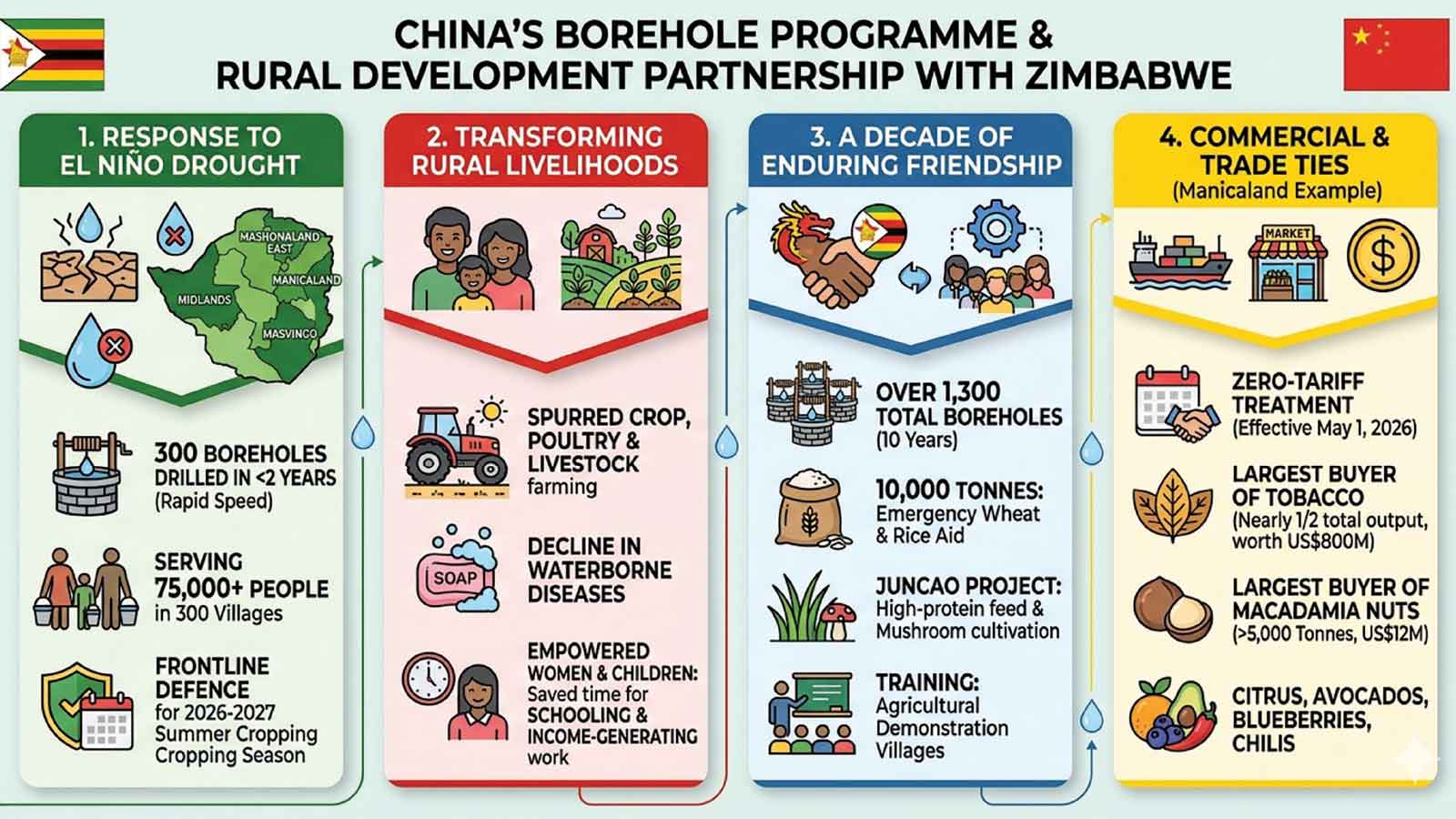
Kuda Bwititi
Politics, Foreign Affairs and Opinions Editor
WHEN the El Niño-induced drought swept across Zimbabwe in 2024, leaving fields bare and rural families walking kilometres for muddy water, the crisis demanded more than sympathy.
It demanded action. And for 300 villages in four provinces, that action came from Beijing — not in the form of pledges, but drills.
Since April 2024, when President Mnangagwa declared the drought a national disaster, China has moved with notable speed. In less than two years, the 300 boreholes have been completed across Mashonaland East, Manicaland, Masvingo, and Midlands — bringing clean water to over 75 000 people in 300 villages, 21 districts, and four provinces.
With forecasters warning of yet another El Niño-induced drought bearing down on the 2026–2027 summer cropping season, these boreholes will stand as a frontline defence — transforming what could have been a catastrophe into a manageable challenge, and offering families and farmers alike a reliable buffer against the dry spell.
In a handover ceremony of the boreholes in Chimanimani last week that could have been just another diplomatic formality, China’s Ambassador to Zimbabwe, Zhou Ding, offered a rare glimpse into the sheer grit behind the China-aid 300 Boreholes Project.
The envoy revealed that Chinese and local engineers sometimes slept in leaking tents or in their vehicles, worked through fevers from tick bites, and laboured until two or three in the morning to bring clean water to some of Zimbabwe’s most parched communities.
“For them, the sight of clean, running water and the joyful smiles of the local people made every hardship truly worthwhile,” Ambassador Zhou said.
That testimony, delivered in Manicaland, speaks to a deeper story: China’s borehole programme is not a one-off gesture, but a strategic, enduring partnership that is quietly reshaping rural livelihoods across Zimbabwe.
But the impact goes far beyond the tap. Ambassador Zhou outlined how reliable water access has spurred crop farming, livestock rearing, poultry production, and vegetable cultivation in surrounding communities. Waterborne diseases have declined.
And for thousands of women and children — traditionally tasked with fetching water — the boreholes have returned hours once lost to daily survival, now redirected to schooling and income-generating work.
This is not China’s first well-digging mission. Over the past decade, Beijing has helped drill more than 1 300 boreholes across Zimbabwe, serving an estimated half a million people. The latest 300, the ambassador noted, are “yet another testament to the enduring, profound friendship between our two nations.”
What makes China’s approach stand out is the breadth of its rural development package. Alongside the water projects, Harare and Beijing have rolled out a suite of complementary initiatives.
To ease last year’s food shortages, China delivered 10 000 tonnes of wheat and rice in three batches. The Juncao Technical Assistance Project — introduced to Zimbabwe — now provides fast-growing grass for mushroom cultivation, high-protein animal feed, and ecological restoration.
Chinese agricultural experts have also set up Agricultural Cooperation Demonstration Villages, offering hands-on training in crop farming, vegetable production, poultry rearing, and irrigation management.
By year’s end, nine irrigation schemes will be upgraded with Chinese grant funding.
“Together with robust private-sector investment and thriving bilateral trade,” Ambassador Zhou said, “these efforts sustain the livelihood of more than one million people across Zimbabwe.”
There is also a commercial logic to the friendship. Starting May 1 2026, China extended zero-tariff treatment to all products imported from 53 African countries, including Zimbabwe. For Manicaland — a key producer of tobacco, avocados, citrus, and macadamia nuts — this is game-changing.
China is already the largest buyer of Zimbabwean tobacco and macadamia nuts. Last year, nearly half of Zimbabwe’s tobacco output — worth about US$800 million — was exported to China. Beijing also imported over 5 000 tonnes of macadamia nuts valued at US$12 million.
Citrus, blueberries, dried chillies, and soon sesame seeds from Manicaland are all finding their way onto Chinese shelves.
For farmers in Chimanimani and Chipinge, the boreholes help them grow; the zero-tariff policy helps them sell.
Ambassador Zhou’s address was more than a project handover. It was a statement of intent. As Zimbabwe marches towards National Development Strategy 2 (NDS2) and Vision 2030, China is positioning itself not as a distant donor but as an all-weather partner — one that drills wells when the rains fail, trains farmers when soils weaken, and opens markets when goods are ready.
The boreholes will keep flowing, but the deeper current is diplomatic. In a world where aid often comes with strings attached, Beijing’s model — practical, visible, and community-centred — is earning quiet but solid credibility in Zimbabwe’s rural heartlands.
As Ambassador Zhou put it: “May these water boreholes keep bringing clean water, good health, hope, and lasting prosperity to local communities for generations to come.”
For the 75 000 Zimbabweans now drawing from China-drilled wells, that hope is no longer a speech. It is a bucket of clean water.


