Online Reporter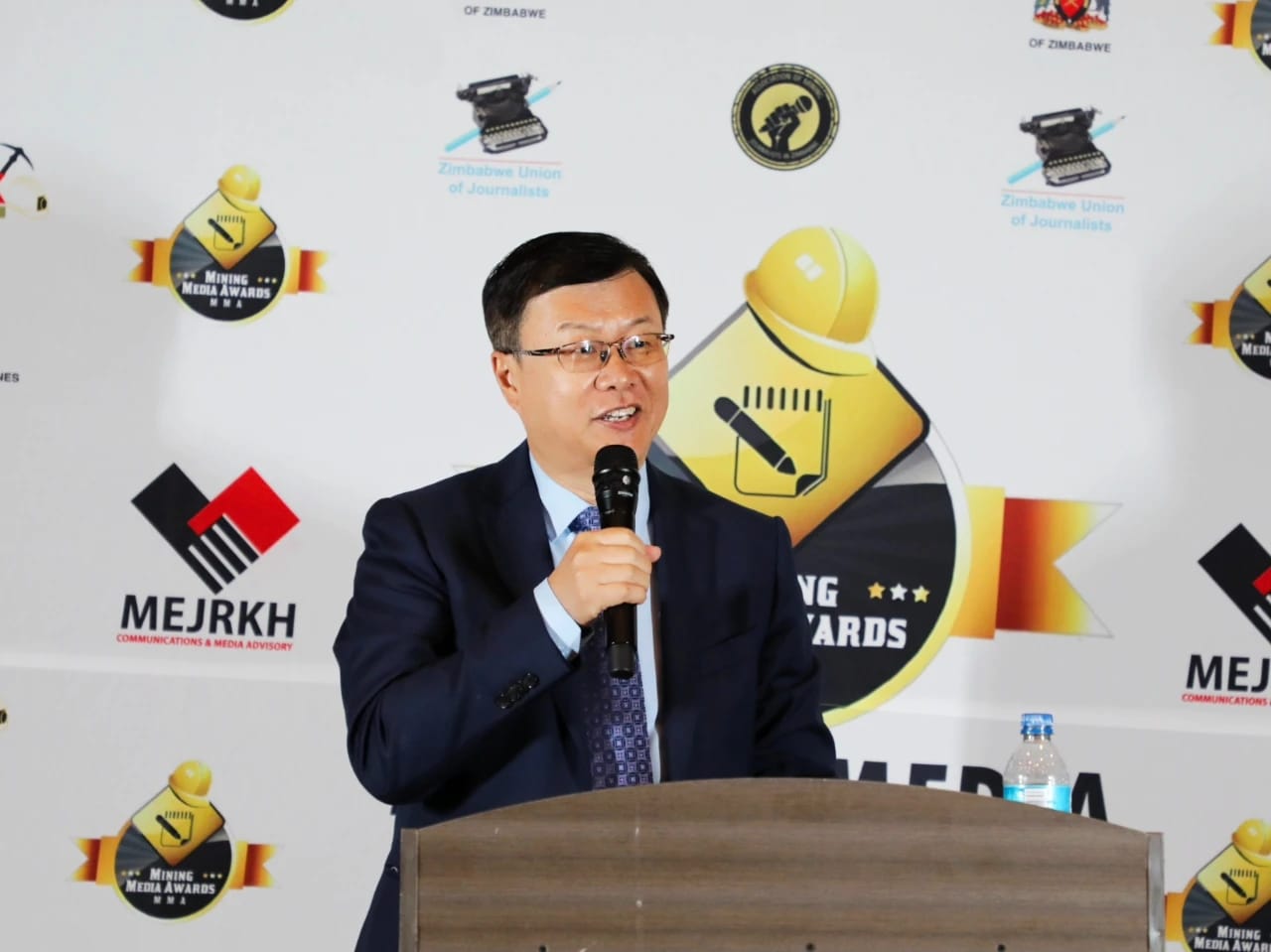
It’s an honour to join you at this year’s Mining Media Awards. I warmly congratulate the organizers and winners for highlighting mining development and China-Zimbabwe cooperation.
Mining is Zimbabwe’s economic backbone and a testament to our mutually beneficial cooperation. As Zimbabwe’s largest investor and trading partner, China stood with Zimbabwe for decades through thick and then. Contrary to false claims of “resource plundering,” our partnership is lawful, voluntary, and win-win.
The facts are clear:
First, Chinese mining creates jobs and fuels growth. Over 80% of employees are local, with wages above average. Dinson Steel will employ 3,000 Zimbabweans, while Huayou Cobalt’s $300 million investment creates 1,000 jobs. These companies pay over $300 million in annual taxes, funding public services.
Second, we share technology and build infrastructure. Chinese hammer mills achieve 35% gold recovery versus traditional 25%, significantly boosting efficiency for small-scale miners who produce over 60% of Zimbabwe’s gold. We’ve invested nearly $100 million in community projects, building schools, clinics, bridges, power lines and roads that benefit local communities.
Third, we’re revitalizing mines and promoting sustainability. Yahua Group reopened the Kamativi mine with 2.3 million-ton annual lithium capacity, while Dinson produces 600,000 tons of steel yearly for regional markets. Chinese companies lead in environmental protection, implementing waste treatment, water recycling, and 1,000 megawatts of solar projects to support Zimbabwe’s energy transition.
This is our shared commitment: mining that leaves the land better than we found it.
Ladies and Gentlemen,
No partnership is perfect. But the overwhelming majority of Chinese mining companies contribute positively to Zimbabwe’s growth and sustainability. When discussing or reporting on China-Zimbabwe mining cooperation, we need not sing only praises, nor should we focus only on problems and deficiencies. What troubles me is the double standard. Some NGOs and individuals are spreading unverified videos and reports to smear Chinese enterprises. Many Chinese companies often complain, “The more we do, the more criticism we face”. “Bad news travels fast, while good deeds stay behind closed doors.” Their corporate social responsibility projects often go unnoticed, while fabricated, baseless accusations subject them to immense pressure and severely dampen investor confidence. Spreading a rumour takes seconds; debunking it takes weeks or even months. We have found that over 80% of allegations are exaggerated or fabricated, aimed at inciting xenophobic anti-China sentiments. Such tactics harm Zimbabwe’s business climate. They don’t build a single factory, drill a single borehole, or create a single job.
We hope that the achievements and progress in China-Zimbabwe mining cooperation will receive the recognition and affirmation they deserve. At the same time, we ask mining-related reporting to be based on facts and truth. We welcome fact-based, constructive criticism, and specific, solution-oriented feedback that helps us do better. Such feedback would contribute to the steady advancement of China-Zimbabwe relations. Let’s judge cooperation by the facts, not fiction. Let’s reject baseless smears that threaten to divide us.
Ladies and Gentlemen,
While mining is a powerful engine of our cooperation, it is firmly rooted in a friendship forged over decades. To truly understand our partnership, we must see the bigger picture, and gain a deeper understanding of our bilateral ties. In early September, I accompanied President E.D. Mnangagwa on his trip to China, and our leaders jointly announced the elevation of China-Zimbabwe relations to an “all-weather community with a shared future”—a significant milestone built on our comprehensive strategic partnership of cooperation. This isn’t just a title – it’s a promise, built upon shared struggle against colonialism and imperialism. Our brotherly relationship isn’t transactional. It is a bond tempered in blood and fire, unbreakable and enduring.
This year marks the 45th anniversary of China-Zimbabwe diplomatic relations. The fruits of our cooperation are woven into the daily lives of the Zimbabwean people. Upgraded power stations, world-class airports, the New Parliament Building, the National Pharmaceutical Warehouse, and 1,300 boreholes, the High-Performance Computing Centre. Since 2022, over 1,400 new Chinese-invested enterprises have been registered in Zimbabwe, according to ZIDA, with a projected investment value exceeding 10 billion dollars. China’s trade and investments are supporting the livelihoods of more than one million Zimbabweans. Our people-to-people exchanges are also flourishing: Chinese medical teams, having been dispatched continuously for 40 years with over 200 doctors having served here, have treated nearly 100,000 patients in all of the ten provinces. In the past five years, more than 3,000 Zimbabwean students have pursued academic studies in China, while over 2,000 government and Party officials and professionals have honed their skills through specialized seminars, workshops, and capacity-building programmes in China. In the past two years, nearly 20,000 Zimbabweans have visited China as tourists, and visa applications to China are steadily increasing. China-Zimbabwe friendship and cooperation are proven through actions, not empty words.
Ladies and Gentlemen,
Last month, the Fourth Plenary Session of the 20th Central Committee of the Communist Party of China (CPC) adopted “Recommendations for Formulating the 15th Five-Year Plan”, outlining a development roadmap for China from2026 – 2030, setting key objectives across critical domains: advancing science and technology, promoting ecological progress, fostering cultural development, strengthening national security, and above all, enhancing people’s wellbeing. Notably, the 15th Five-Year Plan also reaffirms China’s commitment to high-standard opening-up and win-win cooperation. China will continue to unlock opportunities for African partners, Zimbabwe included, through frameworks and initiatives such as the Belt and Road Initiative, the Global Development Initiative, the Global Security Initiative, the Global Civilization Initiative, the Global Governance Initiative, and the Forum on China-Africa Cooperation (FOCAC).
Zimbabwe’s National Development Strategy 2 (NDS2) will soon to be launched. I’m confident that China’s 15th Five-Year Plan and NDS2 will unlock fresh opportunities for win-win cooperation. Together, they open new avenues for collaboration:
First, Trade and Investment. In June this year, H.E. President Xi Jinping announced that the Chinese Government would grant zero-tariff treatment to 53 African countries, including Zimbabwe. This strategic policy is specifically designed to facilitate African nations’ exports to the vast Chinese market. For Zimbabwe, this will increase exports and catalyze the development of stronger regional value chains in manufacturing. Ultimately, this will create more jobs and raise incomes. At the recently concluded 8th China International Import Expo, the number of participating African enterprises surged by 80 percent year-on-year—a testament to the immense appeal of China’s vast market. I look forward to the signing of a bilateral agreement to turn this new policy into reality.
Second, Green Energy. China is a global leader in renewable technologies—including solar power, hydropower, and energy storage. Zimbabwe is blessed with immense solar potential. This makes our collaboration a natural fit. Our joint efforts will be instrumental in tackling Zimbabwe’s energy challenges, paving the way for a greener, more sustainable, and energy-secure future.
Third, Infrastructure: Zimbabwe’s ambitious national goals for highways and railways, digital network expansion, and smart city development align perfectly with Chinese companies’ extensive expertise. These aspirations will connect communities, facilitate trade and investment, and boost economic activity nationwide.
Fourth, Human Capital: We will continue to offer scholarships, professional training, and vocational education programmes, to nurture Zimbabwean talents — the key drivers of its national development.
Distinguished Guests, Ladies and Gentlemen,
The Chinese Embassy in Zimbabwe remains your steadfast partner. We are here to build bridges for dialogue, facilitate access to firsthand information on China-Zimbabwe mining projects, and support fact-based reporting. Should you encounter unverified rumors regarding Chinese enterprises, we will assist in clarifying facts and fostering constructive communication.
To the journalists with us tonight: you are the chroniclers of our time. In this era of social media and widespread misinformation, your role is more vital than ever. It demands patience, professionalism, and a firm commitment to ethics and truth. As a Shona proverb wisely reminds us, “Matsotsi anorova anoparara, chokwadi chinosara”—falsehoods may stir chaos, but truth endures.
Strive to inform, not inflame; to unite, not divide. Verify your facts rigorously. Tell stories that are objective, comprehensive, and constructive—stories that build consensus and uphold justice.
In closing, I extend my warm congratulations to tonight’s award winners and salute all the dedicated media professionals you represent.
Thank you.