Online Reporter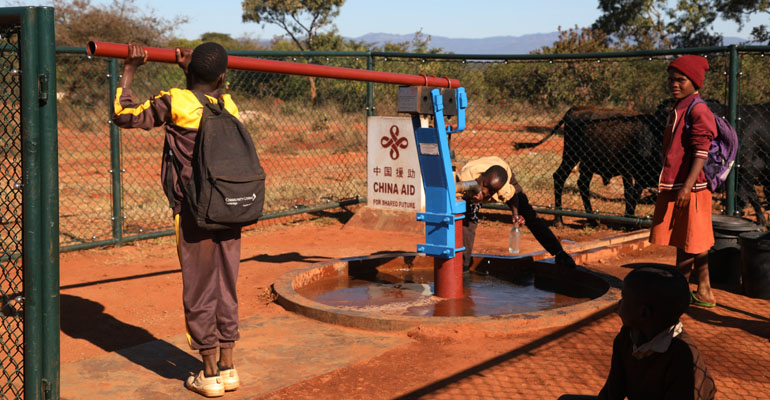
Lovemore Kadzura
Post Reporter
FOR years, women in many rural communities across Zimbabwe have walked long distances carrying heavy buckets in search of clean water.
The daily journey often meant waking before dawn, spending hours at distant water sources, and returning home exhausted before attending to household chores and farming activities.
That burden is gradually easing as hundreds of boreholes drilled under Chinese-supported development initiatives bring safe and reliable water supplies directly to villages.
The drilling of 300 boreholes across various parts of Zimbabwe has become a lifeline for rural communities, improving access to clean drinking water, and reducing the hardships traditionally borne by women and girls.
In villages where the new boreholes have been installed, the community say the impact has been immediate and life-changing.
In Manicaland Province, where 100 boreholes have been drilled, the water situation was worsened by Cyclone Idai, which damaged water infrastructure and left people relying on unsafe sources.
A village health worker under Chayamiti Clinic, Mrs Agnes Chafanza, said the drilling of boreholes in Chimanimani is a welcome development as it has vastly improved water, sanitation and hygiene in an area that had perennial water challenges, worsened by the creation of Runyararo, a settlement of people relocated from Cyclone Idai-hit areas.
This resulted in demand for water rising.
“I came to this village in 1993 through marriage. This area has been experiencing water challenges. Villagers used to travel up to 8km in search of clean water. We would wake up very early in the morning around 3am to join the queue for water. It was quite a painful experience for us.
“The situation was more complicated for expecting mothers as they would also be moving around in search of water. When they give birth, they require lots of water to properly look after their babies. It was not something pleasant to endure. The water used to wash dishes and clothes was not thrown away as it was left for livestock to drink. This has come to an end through the intervention of the Chinese government, which has drilled boreholes in our area. The water situation has vastly improved. There were constant outbreaks of cholera and other water-borne diseases in this area due to scarcity of water. However, we request for more boreholes and piped water schemes where water can be provided door-to-door,” said Mrs Chafanza.
Mbuya Racheal Makamanzi, of Chayamiti said: “We used to walk several kilometres to fetch water from boreholes. Now we can do gardening, as the water is now close by. This area is so hot and rivers dry up quickly, leaving us with no water for agricultural activities,” she said.
Mrs Memory Nemakonde, of Village 5A, Bumba, said the borehole has brought huge relief for them as the whole village was relying on the Bumba Clinic borehole, which would dry up mid-morning as it struggled to cope with demand. “We used to rely on the borehole at the clinic, which was failing to serve the entire community. The borehole would run out of water by mid-morning, leading to us fetching water from unsafe sources. The stampede for water also created friction among community members. This borehole is serving the local business centre and the village,” she said.
Women, who are traditionally responsible for collecting water for their families, have been among the biggest beneficiaries of the initiative.
Many say the time saved can now be devoted to income-generating activities, farming, childcare and other productive work.
Mr Strike Chisiya said the area is suitable for livestock rearing, but its potential was being held back by the non-availability of reliable water.
“Reliable water has been the missing link in this area. We used to apply ashes as an improvised way of treating water from unprotected wells and ponds. Livestock can thrive very well here, but we were being limited by water scarcity. The coming of the boreholes is going to change our agricultural system,” he said.
Chinese Ambassador to Zimbabwe, Ambassador Zhou Ding said his country has drilled over 1 300 boreholes across the country in the past decades as a way to strengthen resilience and improve access to clean water.
He added that China always stands by Zimbabwe, hence the decision to donate the 300 boreholes in response to an appeal by President Emmerson Mnangagwa for help after the devastating Cyclone Idai that left a trail of destruction, including on water infrastructure.
“In less than two years, the project team reached 300 villages across four provinces, amid countless challenges. They sometimes slept in leaky temporary camps or in their vehicles.
“They fell ill with fevers from tick bites, some worked at borehole drilling sites for five consecutive days, while battling fevers, and sometimes even laboured until two or three in the morning. Working side-by-side as one united team, Chinese and Zimbabwean staff drove the project to final completion. For them, the sight of clean, running water and joyful smiles of the local people made every hardship truly worthwhile. Back in April 2024, severe drought triggered by El Niño prompted President Emmerson Mnangagwa to declare a national state of disaster across Zimbabwe. As Zimbabwe’s all-weather friend, China swiftly responded to the President’s call by rolling out the 300 boreholes project in the drought-stricken areas of Mashonaland East, Manicaland, Masvingo and Midlands to help local people cope with the acute water shortages.
“This project has brought clean water to more than 75 000 community members across 300 villages, 21 districts and four provinces. These boreholes do not just supply safe water for daily use and farming. They also help reduce water-borne diseases and strengthen agricultural resilience. With reliable water access, crop farming, livestock rearing, poultry raising and vegetable cultivation have all thrived in the local communities. This project has also empowered tens of thousands of women and children, freeing up their time for schooling and other meaningful work to build better livelihoods. This is by no means China’s first effort to help Zimbabwe drill water boreholes. As a long-standing and trusted friend, China has been engaged in such efforts for decades. Over the past ten years, we have drilled more than 1 300 boreholes across Zimbabwe, delivering clean water and agricultural irrigation to approximately half a million people,” said Ambassador Zhou.
Local Government and Public Works Minister, Honourable Daniel Garwe, said beyond safe drinking water, the intervention will boost agriculture, livestock survival and improved learning conditions in local schools.
“This project was conceived in response to the devastating impacts of Tropical Cyclone Idai in 2019, which left many communities without access to safe and reliable water. Following the declaration of a State of Disaster by President Mnangagwa, an international appeal was made. In true solidarity and friendship, the People’s Republic of China responded generously through the provision of 300 boreholes. The boreholes were distributed in affected provinces as follows: Manicaland Province (100), Masvingo Province (68), Mashonaland East Province (66) and Midlands (66). Six solarised boreholes were drilled in Bindura, Tsholotsho, Harare, Mberengwa, Murehwa and Masvingo districts. This milestone directly contributes to the aspirations of our national blueprints, the National Development Strategy (NDS2) and Vision 2030, which seek to transform Zimbabwe into an upper middle-income economy.
“Central to these frameworks is the provision of inclusive, climate-resilient infrastructure and improved access to basic services such as clean and safe water. Beyond water provision, the project has generated wide-ranging socio-economic benefits. It has enhanced agricultural productivity, supported livestock survival, improved sanitation and public health and contributed to better learning conditions in schools,” said Minister Garwe.