Chronicle Editor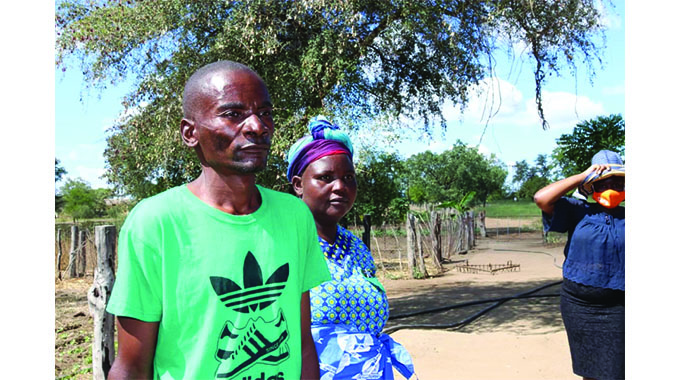
Vusumuzi Dube recently in Chiredzi
A STORY is told of Colonel Harland David Sanders the founder of popular fast food chicken restaurant chain, Kentucky Fried Chicken’s rise to popularity.
He went through a lot of failures in life and when at the brink of giving up, he struck gold. Among his many documented failures was having his chicken recipe rejected 1 009 times. However, when he finally struck the right tune, he never looked back and decades later the fast food outlet has become one of the most popular brands worldwide.
Col Sanders’ story is almost a carbon copy to that of 52-year-old Clever Dumela from Bandama Village in Chiredzi. His was a story of many trials and errors. Ten years ago he began his steps towards the life he has built today, with a hammer and chisel he started hammering at a rocky area in his homestead, only reaching a water source a few years later. With the little water, he ventured into small-scale fish farming digging a few makeshift ponds in his homestead.

However, like the Col Sanders story he was to experience a lot of bumps along the way, which saw him gradually becoming the subject of ridicule among other villagers. His lowest point was last year, when his makeshift ponds burst and he lost the majority of his fingerlings.
Despite the huge loss, the dejected Dumela did not allow this to break his spirit but this actually marked his turnaround. A year later, Dumela has not only turned his homestead into a pseudo-factory through the number of self-sufficient projects he has embarked on, but has fast become the inspiration of many villagers through the resilience he has since exhibited.
His is a success story of the resilience concept being preached by most development practitioners. According to the Zimbabwe Resilience Building Fund the definition of resilience agreed for Zimbabwe is “the ability of at-risk individuals, households, communities and systems to anticipate, cushion, adapt, bounce back better and move on from the effects of shocks and hazards in a manner that protects livelihoods and recovery gains, and supports sustainable transformation.”
With most parts rural Chiredzi’s crops performing badly after they were ravaged by locusts (Madhumbudya), to tell a tale of success such as that of Dumela is quite inspiring. The (edible) locust caused serious damage to sorghum, millet, maize and pastures.
However, for the Dumela homestead, theirs was not a cry of loss but of joy as their fortunes turned around over the past year. They managed to have a host of other projects which complimented each other to ensure that the family did not experience a famine.

Not only does the family have a thriving fish pond with over 100 000 fingerlings but they also have an irrigated maize and beans plantation, a chicken breeding project and a biogas project. The fish farming project is a typical rag to riches story as the area, which falls under natural Region 5, which is characterized by little rainfall, hence villagers rely mainly on underground water, which fishery experts were initially doubtful would sustain fish projects.
However, with the support of the Zimbabwe Resilience Building Fund which is worth US$100 million, Dumela became one of the pioneering farmers to venture into fish farming. The fund is a long-term development initiative with an overall objective to cushion communities from the recurrent shocks and stresses caused by natural disasters and other unforeseen occurrences.
The fund is supported by the Ministry of Lands, Agriculture, Fisheries, Water and Rural Resettlement, the European Union, the Swedish Embassy, UNDP and the Foreign, Commonwealth Development Office.
The ZRBF-ECRAS which is being implemented by Care International, Plan International and ICRISAT in Chiredzi and Mwenezi is funded to the tune of US$9, 7 million.
“When I lost most of my fish last year after my ponds burst, I realised the potential of this project changing the lives of my family and myself, because from the little I managed to serve I managed to get 10 000 Rand. That is when I began to work closely with ZRBF-ECRAS and through their guidance I have transformed this project to the level it is today. With the over 100 000 tilapia fish I have in this pond I am sure I will become a millionaire in South African Rand terms,” said Mr Dumela.
As part of his turnaround, Dumela manually dug a larger 26×55 metre weir which holds more water and accommodates more fish. He also constructed an irrigation system where he was harvesting water from the fish pond, with fish droppings acting as manure which he used to water a thriving maize and bean plantation.
“I don’t throw away any waste or by-products, everything here is useful that is the beauty of having resilient knowledge, everything compliments each other.
“Organic fertilizers are also not a problem for me, I use water from the fish pond for drip irrigation. The water contains all the nutrients. I process leftovers from my harvest into animal feeds, so everything here is put to good use. Cow dung is fed into bio-gas,” said Dumela.
He revealed that he had also been capacitated with the skills of producing feed for his fish using various crops he was planting within his homestead which he said vastly reduced the cost factor in his business. A visit to the Dumela’s kitchen showed the beauty of their biogas project where they have even purchased a four-plate gas stove making their cooking much easier.
“Our children no longer have the burden of waking up early before going to school to look for firewood because of this gas stove, what is even more exciting is that all this is just from our homestead, there are no external products that we have to purchase. We have come up with a facility where if one project fails, we have another one already in full production. I am even training my children on such projects so that they also grow up knowing the skills of being self-sufficient,” said Dumela.

Just a stone throws away from the Dumelas is another family that is following on their footsteps- the Moyos.
Mr Benson Moyo (61) and his wife Mavis have also established their own factory-like homestead. For the family, they have gone an extra mile from the fishery and irrigation project but are also cross breeding native chickens with exotic broiler breeds. As a result, they now have a thriving chicken breeding project focusing on these unique cross breeds with a sizable egg output and sumptuous meat quality.
“These started off as an experiment, where I took a native cockerel and mixed it with some broiler egg laying chickens in a fowl-run. When they lay eggs, I take them away and place them on some native hens to hatch chicks.
My experiment paid out because the cross-breed output was bigger and they could lay more eggs, produce more meat and resistant to diseases and could easily eat locally made feed,” said Mr Moyo.
He further paid tribute to the resilience projects noting that before they used to be continuous between him and his wife which was caused by the hunger which was now a perennial failure because of the low rainfall patterns.
“The trick is just to work together and know the importance of creating a functional homestead, one can never expect someone to come feed them from nowhere it is all about empowering oneself,” said Mr Moyo.


 Online Reporter