admin
admin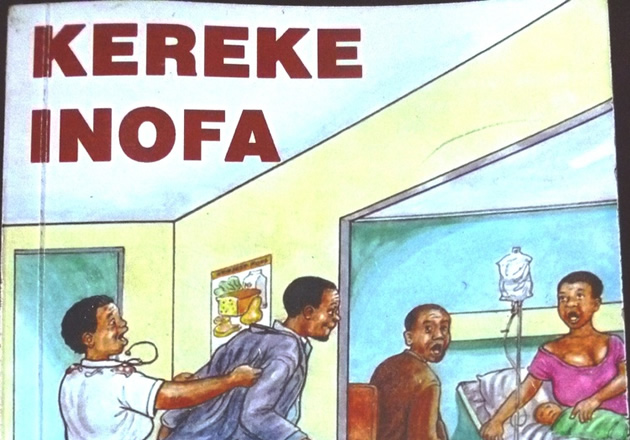
Beaven Tapureta Bookshelf
Veteran artist Aaron Chiundura Moyo has once again published a play sensitive to the new “power” wielded by some rich, modern church leaders and its effects on the home or a city family.
This is the second time Chiundura Moyo has produced a work that looks into the social problems regarding the church. The first time it was in his television drama “Madhunamutuna”.
“Kereke Inofa” (Booklove Publishers, Gweru, 2014) is a suspenseful three-act play set in the city of Harare and also in the United Kingdom.
The play reflects a society in the jaws of a new, notorious power but this unreligious power is based on lust and the result is chaos.
There are churches in Zimbabwe genuinely embodying the work of God but there are also individuals, particularly church leaders, who have diverted from their call.
Author of more than 15 creative works of various genres, Chiundura Moyo has, in “Kereke Inofa”, showed his witty tackle of the current problem of unscrupulous men of the cloth.
He makes the reader hate some church leaders who have lost focus. Religious leaders are people expected to lead a highly regarded spiritual path yet the sanctity that used to guide these clergymen has been hammered into disgrace.
The play is realist in the way it presents the nature of the social problem and is driven by dramatic probing of actors’ behaviours, using a simple but intelligent language that reflects the genius of the playwright in manipulating time, place and action.
Chiundura Moyo’s portrayal of Revelations Church’s founder Gift Mwenje’s secret love affair with Sarah, wife of one of his followers with whom he fathers a child, draws emotions of pity and anger.
The reader pities innocent Zebra and is likely to direct anger at Sarah and Gift. As this is a drama of concealment, most of Gift’s manoeuvres are hidden from others in the drama such as Gift’s UK-based wife Mary, Sarah’s husband Zebra, relatives, the whole church, or community.
As one is taken back and forth in this play, a painful question arises: Are churches owned by man or God?
Pastor Gift says in one of the scenes when he is talking with Sarah that he founded Revelations Church and therefore owns the church and is free to do what he wants with it. Such power is dangerous to the meek followers. Although Gift is the focus, Chiundura Moyo establishes a subplot to address the extension of the main conflict.
At times, the ‘side-story’ help cheer the reader on.
For instance, there are also Zebra’s children who are already trapped in the obsessive force of social media and the risk of AIDS.
Beauty, Zebra’s twenty one year old daughter and a university student, brags about her romance with lecturers in exchange for favours in her written assignments.
She is also in a risky relationship with a man who conceals his HIV status. Chiundura Moyo’s plea, through his play “Kereke Inofa”, is to Zimbabweans to ask themselves what will the future be like in the absence of a strong cultural and spiritual base.
Apart from the respected leaders’ failure to uphold hunhu/ubuntuism, traditional aunties who used to advise the youths and/or children of their relatives, have also been initiated into this “drama of concealment”.
For instance, Susan, instead of helping Beauty, takes over her boyfriend and she also contracts AIDS.
Zebra is a man who understands that a woman deserves equal opportunities as much as a man does but he suffers for his understanding. There is also Mary, Gift’s wife in the UK, who suspects nothing and suffers devastating betrayal.
Chiundura Moyo’s tactical use of cellphones and the internet in the play makes it appealing and relevant today.
However, there have been difficulties in terms of how to present some of these new inventions in our mother languages like Shona. Chiundura Moyo, in “Kereke Inofa”, at times resort to direct, phonetic translation, a habit he has always been known to be calling for among writers in indigenous languages.
He says this way of translation is better than using the English name of the gadget in one’s purely Shona or Ndebele work.
Another writer Ignatius Mabasa has incorporated these modern gadgets into his stories for children but he maintains the folklore in some of them. I remember Mabasa saying to me in an interview, “We need to find a clever way of also claiming a stake in the space offered by technology. Tsuro naGudo must also be available on Whatsapp as audio books. Besides that, I strongly believe that our curriculum should respond to social change so that Tsuro naGudo and the other aspects of learning remain relevant.”
While this is indeed true, Mabasa and other mother languages writers should create words that name the modern gadgets like cellphone or other such things.
This shows growth of a language.
In “Kereke Inofa”, for instance, “cement” is translated as “semende”, “cellphone” as “serufoni” and the actors sometimes do the same.
It is clear that the absence of creative Shona equivalents of these English words poses another linguistic gray area.
Have our writers not yet come up with words that mean “cellphone”, “internet”, or “headphone”? What are these things called in Ndebele or Tonga?
The title “Kereke Inofa” is repeated in the conversations in different scenes and each time it is used, it has a dramatic effect upon the whole story.
The rest of the congregants are left out of the drama and therefore are innocent but the reader will always wonder how will the church receive the truth when it outs?
Academic Samuel Ravengai has described Chiundura Moyo’s plays alongside those of Stephen Chifunyise as social drama because they are that type of drama “that follow the Victor Turner four-phase schema of breach, crisis, redress and reintegration.” Many people may not know that Aaron Chiundura Moyo has one of the most impressive and multi-various oeuvre in Shona literature to date. These include “Uchandifungawo”, a novel (1975, Mambo Press), “Ziva Kwawakabva”, a novel (1976, Longman), “Nhamo Ine Nharo”, a novel(1978, Rhodesia Literature Bureau), “Wakandicheka Nerakagomara”, a novel (1982, Mambo Press), “Chenga Ose”, a play (1982, Mambo Press), “Kuridza Ngoma Nedemo”, a play (1983, ZPH), “Matekenyapfungwa”, a quiz book, (1984, Books for Africa), “Nguwo Dzeuswa”, a novel (1985, Mambo Press), “Yaive Hondo”, a novel (1985, Mambo Press), “Wandibaya Panyama Nhete”, a play (1986, Longman), “Ndabvazera”, a novel (1992, Mercury Press), “Chemera Mudundundu”, a novel, (2002, Priority Publishing Project), “Pane Nyaya”, a play ( 2004, Priority Publishing Project), “The Other Side of The River”, a short story collection ( 2012, Lion Press), and the following television dramas which were screened on local ZTV: “Chiwokomuhomwe”, “Ziva Kwawakabva”, “Zviri Mudendere”, “Madhunamutuna”, “Masimba”, “Zevezeve”, “Chihwerure”, and “Tiriparwendo”.
Aaron was born in 1950 near Gweru, Zimbabwe and he is elder brother to musician Jonah Moyo.


 Online Reporter