Online Reporter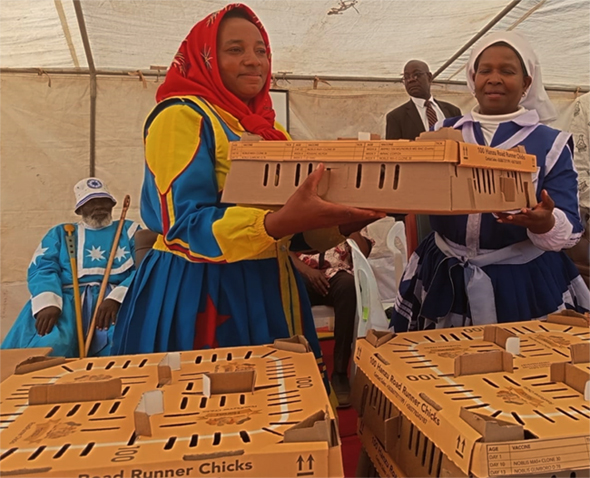
Tendai Gukutikwa
Post Reporter
CHURCHES have been challenged to move beyond their traditional spiritual role and become active partners in rural development by spearheading practical programmes that uplift communities and improve livelihoods.
Speaking on behalf of the First Lady, Dr Auxillia Mnangagwa at the Apostolic Ejuwel Jekenisheni Church’s annual Passover Conference held recently at Mabiya Shrine, Public Service, Labour and Social Welfare Deputy Minister, Honourable Mercy Maruva Dinha, said faith-based organisations have a critical role to play in complementing Government efforts to achieve inclusive and sustainable national development.
The First Lady said churches occupy a unique position within communities and can effectively mobilise people around initiatives aimed at improving food security, access to clean water, skills development and household incomes.
“The Government alone cannot achieve every developmental aspiration of our people. Likewise, churches cannot fulfil every social and economic need on their own. However, when the Government, churches, traditional leaders, educational institutions, development partners and communities unite around a common purpose, remarkable transformation becomes possible,” she said.
She said Zimbabwe’s development agenda requires the participation of every citizen and institution.
“Our national philosophy reminds us that every Zimbabwean has a role to play in building our country. The church has a role, the Government has a role, traditional leaders have a role, women have a role, young people have a role, farmers have a role, teachers have a role and business people have a role. When each of us contributes according to our abilities, we create stronger families, stronger communities and ultimately a stronger Zimbabwe,” she said.
Dr Mnangagwa commended the Apostolic Ejuwel Jekenisheni Church for demonstrating that faith should be accompanied by practical actions that transform lives.
Drawing from James 2:17, she urged churches to become centres of service, compassion and economic empowerment.
“The Apostolic Ejuwel Jekenisheni Church has demonstrated that genuine faith extends beyond the walls of the sanctuary. It is expressed through service, compassion, hard work and genuine concern for the well-being of others. This is the kind of faith that builds communities. This is the kind of faith that transforms lives,” she said.
Dr Mnangagwa reflected on her initial visit to Mabiya Shrine in 2022, saying the progress achieved since then is proof that churches can be powerful catalysts for sustainable development when communities embrace ownership of projects.
“When I first visited this shrine in 2022, I met a congregation whose faith was unwavering and whose vision for a better future was inspiring. During that visit, we shared a common conviction that prayer and faith should be accompanied by practical action that uplifts people’s lives.
“Today, I am deeply encouraged to witness the fruits of our collective commitment. This transformation is not the achievement of one individual or one institution. It is the result of partnership, commitment and the willingness of this church and the community to embrace development with open hearts and hardworking hands,” she said.
Dr Mnangagwa emphasised that true development should not be measured solely by infrastructure, but by its impact on people’s lives.
“Development is measured by the child who can now study under proper lighting, by the mother who no longer walks long distances in search of clean water, by the farmer who harvests enough food to feed the family and generate income, and by the young people who acquire practical skills and find hope for the future. Ultimately, development is about restoring dignity to our people,” she said.
She highlighted six community projects established at the shrine since 2022 as tangible examples of what can be achieved through partnerships between the Government, churches and local communities.
The projects include rural electrification, which has extended electricity to the shrine and nearby schools, a solar-powered borehole providing clean water to congregants and surrounding villages, irrigation infrastructure supporting a four-hectare church farm, a goat-rearing programme, a women’s sewing project, and the construction of modern sanitation facilities.
These initiatives are helping to boost household incomes, strengthen food security and enhance communities’ resilience to climate change.
She urged churches across the country to champion climate-smart agriculture and empower women and youth with practical skills that promote self-reliance.
“Every family should strive to produce something. Even a small garden can provide nutritious vegetables. Even a few fruit trees can improve household nutrition. Every church can become a centre of hope, productivity and self-reliance,” she said.
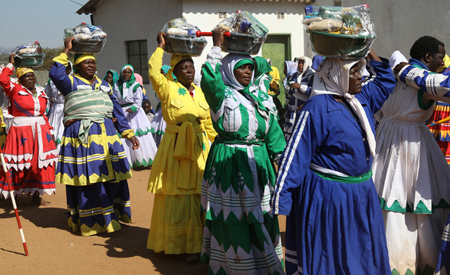
Dr Mnangagwa donated 100 food hampers for elderly women, 10 tonnes of wheat, with five tonnes allocated to the church and five tonnes to the wider community, as well as goats and day-old chicks to strengthen income-generating projects.
The church’s vice chairperson for women’s affairs, Mrs Angeline Nyangani, said the First Lady’s empowerment philosophy inspired the congregation to pursue sustainable livelihood initiatives.
“Following her visit in 2022, we have witnessed meaningful transformation through the development projects that have been implemented. These interventions have brought hope, dignity and improved livelihoods to our church and surrounding communities.
“As women, we have learnt that empowerment is, not about creating dependence, but equipping people to build sustainable livelihoods. We remain committed to projects that promote self-reliance and preserve our cultural heritage,” she said.
Church secretary-general, Mr Aram Gwiza said the congregation is now looking to scale up its projects through a partnership with Marondera University of Agricultural Sciences and Technology (MUAST).
“We have signed a Memorandum of Understanding that will provide technical training and support for our agricultural and science-related projects. Our vision is to transform these initiatives from simple income-generating activities into sustainable enterprises that will benefit future generations,” he said.
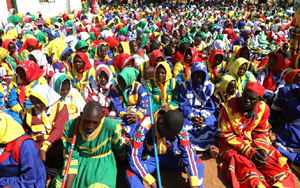
The annual Passover Conference attracted thousands of congregants from Zimbabwe, Mozambique and South Africa, with church leaders pledging to continue supporting the Government-led rural transformation efforts through community empowerment, sustainable agriculture and livelihood development programmes.