Online Reporter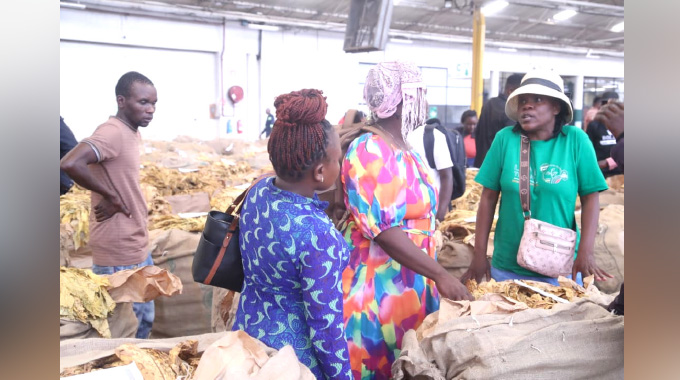
Theseus Shambare, Features Writer
THE auctioneer’s rhythmic chant bounced across the cavernous tobacco auction floors on Wednesday as buyers inspected bale after bale of Zimbabwe’s prized golden leaf.
Farmers stood quietly beside their stacks of tobacco, waiting for the moment a buyer’s raised finger translated into the price that would determine a year’s worth of labour.
Among them are women whose presence in this traditionally male-dominated space is steadily becoming impossible to ignore.
Some stood confidently beside bales registered under their own grower numbers.
Others watched closely as buyers assessed the crop they planted, weeded, cured and delivered to the auction floors themselves.
Across Zimbabwe’s tobacco sector, women are increasingly moving from the background of agricultural labour to the frontlines of production and marketing.
For Ms Loice Mapfurira, standing on the auction floors represented the continuation of a journey that began more than three decades ago.
“I started learning tobacco farming in 1991 when I was helping my parents in Rusape,” she said. Ms Mapfurira carried that experience into her marriage when she started a new household in 2005.
“My husband grew up in Masvingo where tobacco farming was not common, so I convinced him that we should try it because I knew what tobacco could do for a family,” she said.
What convinced her husband most was the economic promise that the golden leaf carries.
“With tobacco, you can get a large amount of money at once instead of waiting for a monthly salary,” Ms Mapfurira said.
That decision would later transform the family’s livelihood.
“We have managed to do many things because of tobacco farming,” she said.
Zimbabwe’s tobacco industry has grown into one of the country’s most important agricultural export sectors.
Data from the Tobacco Industry and Marketing Board (TIMB) shows that the country produced more than 355 million kilogrammes of tobacco in the 2024-2025 season, surpassing the 300 million kilogramme target, generating over US$1,2 billion in export earnings.
The sector has also seen a steady increase in the number of smallholder farmers joining the crop.
Statistics from the tobacco regulator indicate that more than 147 162 growers are now registered to produce tobacco in Zimbabwe.
Many of these farmers are smallholders operating in communal and resettlement areas.
Increasingly, women are becoming visible within this growing community of farmers.
Ms Siphunyiziwe Svondo is among the women redefining what it means to be a tobacco farmer.
Unlike many rural women who farm under their husbands’ identities, Ms Svondo holds her own grower number.
“My husband has his own grower number and I also have mine,” she said proudly.
While her husband runs the main family crop, Ms Svondo manages her own tobacco field.
“I work on my own plot and I sell my own tobacco,” she said.
For Ms Svondo, the significance of this independence extends far beyond agriculture.
“I feel empowered because I do not have to beg my husband for money for everything,” she said.
She believes financial independence allows women to address household priorities that are sometimes overlooked.
“There are things that women see as important in a home which men may not always prioritise,” she said.
Last season, her crop produced impressive results.
“I managed to get about US$3 500 after all expenses,” she said.
The income has enabled her to support her children’s education.
“My children are now going to boarding school because of the tobacco I grow,” she said.
Her farming activities also create employment within her community.
“I employ at least 10 workers during the farming season,” she said.
Stories like Ms Svondo’s reflect a broader pattern of women’s growing contribution to agriculture across Africa.
According to the Food and Agriculture Organisation, women make up about 43 percent of the global agricultural workforce and play a critical role in food systems.
Research by the same organisation indicates that women produce more than half of the world’s food and supply between 60 and 80 percent of food production in many developing countries.
Yet despite this enormous contribution, women farmers often face structural barriers that limit their full participation in agricultural markets.
Studies have shown that women frequently have less access to land ownership, credit facilities, agricultural inputs and extension services than men.
Experts say closing this gender gap in agriculture could significantly boost productivity and rural incomes.
For widows like Ms Taizivei Chatadza, tobacco farming has become a source of resilience and survival. Ms Chatadza has been growing tobacco for 15 years.
When her husband died seven years ago, she chose to continue farming alone.
“I decided that I was not going to stop because this crop is what feeds my family,” she said.
Running the farm alone has come with its challenges.
“But tobacco has helped me keep my children in school and continue with life,” she said.
Another widow Ms Pedzisai Mazise, has also managed to sustain her household through tobacco farming.
“Tobacco is the crop that helped me raise my children after my husband passed away,” she said.
Their experiences reflect a wider trend where agriculture is increasingly becoming a pathway for women’s economic survival and independence.
Across many rural communities, women provide a significant share of the labour required in farming systems.
Research by the Food and Agriculture Organisation in its landmark report “The State of Food and Agriculture 2010-2011: Women in Agriculture — Closing the Gender Gap for Development” shows that nearly two-thirds of economically active women in developing economies are engaged in agriculture.
The report found that if women had the same access to productive resources as men, farm yields could rise by 20–30 percent and significantly reduce global hunger.
Despite this reality, their role in the production cycle often remains under-recognised.
International human rights frameworks also acknowledge the importance of women’s participation in economic production.
The Universal Declaration of Human Rights affirms the right of every person to work and to participate in economic life without discrimination.
Article 23 of the declaration states that everyone has the right to work, to free choice of employment and to just and favourable conditions of work.
Gender equality advocates say recognising women’s role in agriculture is critical for achieving these rights in practice.
Women’s growing presence in Zimbabwe’s tobacco sector is also visible at leadership level.
Mrs Monica Chinamasa, a veteran tobacco farmer with more than two decades of experience, now leads the Zimbabwe National Farmers Union.
Her rise reflects a gradual shift in the agricultural sector where women are increasingly influencing decision-making processes.
But even as women celebrate their achievements in the tobacco sector, concerns remain about market conditions.
Several farmers expressed worry about the pricing trends observed during the opening day of the 2026 tobacco selling season.
“What we saw on the first day of selling is not very encouraging,” said Mrs Chinamasa.
“The quality is good for the lemon cures which are favourites of our Chinese market but I wonder why they offered such low prices.”
The first bale went for US$4,60 per kilogramme while some went as low as US$0,35 per kilogramme.
For farmers whose livelihoods depend heavily on the crop, price fluctuations can determine whether the season ends in profit or loss.
“If the prices are low, it affects everything because this is the money we use for school fees and household needs,” one farmer said while observing buyers assess her bales.
Yet despite the uncertainties surrounding the market, one reality is becoming increasingly clear.
Across Zimbabwe’s tobacco auction floors, more women are arriving with their own bales and their own ambitions.
Women are no longer standing behind the crop.
They are standing beside it as farmers, employers and decision makers in their own right.
And in Zimbabwe’s golden leaf sector, women are increasingly running with the baton.