Online Reporter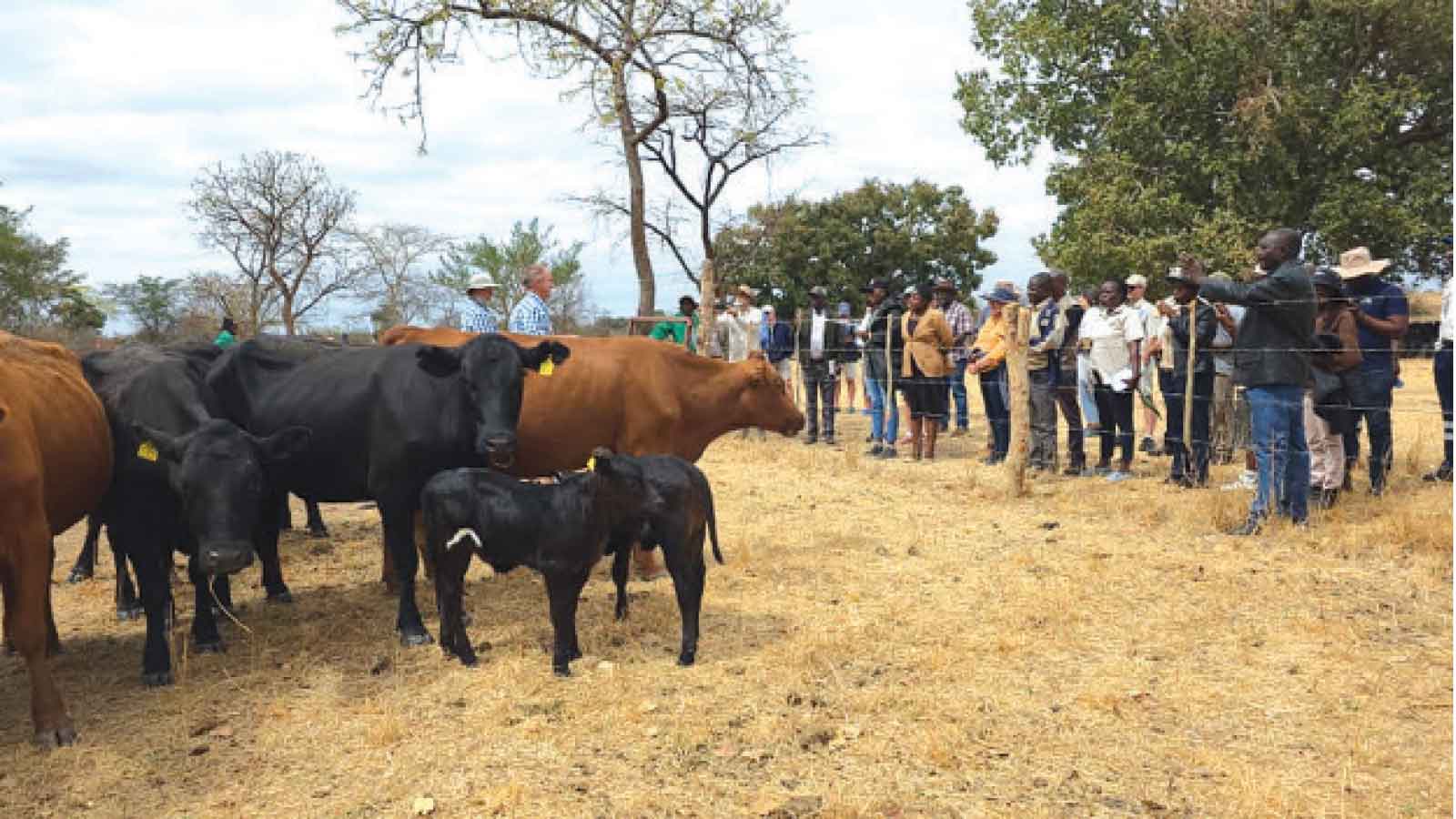
Conrad Mupesa
FOR decades, Zimbabwean farmers looked to Europe and Britain for their cattle genetics. Bigger bodies, more milk, faster growth — exotic breeds seemed the obvious choice for anyone serious about production.
Now, with another potentially devastating El Niño-induced drought on the horizon, the pendulum is swinging back. And it is swinging towards an animal that has quietly endured on this land for centuries: The Mashona.
At Portlet Estates in Makonde District, Mashonaland West, breeders, Government officials, livestock specialists and smallholder farmers gathered recently for a Mashona Cattle Field Day.
The mood was less nostalgic than pragmatic. With grazing and fodder already under pressure from poor rainfall, the conversation kept returning to a single question: what survives when the rains fail?
For Dr Milton Makumbe, Director of Livestock and Fisheries Production in the Ministry of Agriculture, Mechanisation and Water Development, the answer is rooted in local genetics.
“Our position is that indigenous livestock must form the base breeds for livestock production in the smallholder sector,” he told the gathering.
Mashona cattle, he said, “have evolved under Zimbabwe’s harsh production conditions and possess qualities including drought tolerance, resistance to local parasites, heat tolerance and the ability to maintain productivity under low-input systems.”
His message was not one of purity for its own sake. Crossbreeding, he said, must not be excluded. But indigenous breeds must remain the cornerstone of the national breeding strategy.
“We must improve productivity while retaining the hardy characteristics that make our indigenous breeds suitable for local environments,” he said.
“Our goal is to combine genetic improvement with environmental adaptation and climate resilience.”
The Mashona’s credentials are not anecdotal. Over more than five decades, scientists at Matopos Research Institute have conducted rigorous trials demonstrating the breed’s potential as a highly productive beef animal under local conditions.
That work is now being scaled up. Dr Makumbe said Government was developing the Zimbabwe IndiGene Programme, which seeks to place indigenous genetics at the centre of national livestock development. The programme will strengthen the national gene bank at Matopos, promote artificial insemination, and identify superior indigenous bulls from both commercial and communal herds for semen collection.
Government, he added, is working with the private sector to make improved indigenous genetics accessible to smallholder farmers.
“Improving our national herd is a shared responsibility,” he said, urging farmers to preserve indigenous genetics while using controlled crossbreeding to improve productivity.
If anyone embodies the shift, it is Mr John Crawford, a veteran livestock farmer and breeder at Portlet Estates.
“I think my father actually started with Mashona and 50 years later I’m back to Mashona again,” he said, with the wry humour of a man who has seen the full circle. “Maybe we’ve found our senses.”
Mr Crawford keeps about 600 cattle, maintaining a pure Mashona herd to produce breeding stock — bulls and semen — for distribution to farmers across the country.
“I do believe that the indigenous breed is the best thing for our local climate, particularly with the predicted drought that is coming up ahead of us,” he said.
His experience speaks to the economics of scarcity. Mashona cattle, he noted, require less nutrition than imported British and European breeds. They have also performed well when crossed with Angus, Brahman, Simmental and dairy breeds — offering a path to improved productivity without abandoning hardiness.
For many smallholder farmers, the shift is not ideological but survival-driven.
Mr Walter Chidharara and Mr David Manasa Makasi were candid about the trade-offs they had made.
“We adopted exotic breeds for mass and milk production, but with fodder becoming scarce, we are now feeling the burden,” they said. “We need cattle that can survive on what is available locally.”
It is a familiar story across Zimbabwe’s communal lands. Exotic breeds may perform spectacularly in good years, but they demand feed, water and veterinary care that become unaffordable when drought bites. Indigenous breeds, by contrast, have been shaped by precisely these conditions.
Livestock specialist and Mashona Cattle Society inspector Mr Godfrey Mupfugami urged farmers to embrace the breed, saying its ability to adapt to local environments made it particularly relevant as climate change intensified.
The field day also addressed the practical realities of livestock management. Mr Othiniel Nyoni, a sales associate with Steel Warehouse, urged farmers to secure their farms and improve livestock management to prevent cattle from straying onto roads, where they can cause fatal accidents.
It was a reminder that resilience is not only about genetics. It is also about fences, water points, grazing plans and the everyday decisions that determine whether a herd — and a household — makes it through a dry season.
As Zimbabwe braces for another El Niño season, the Mashona is emerging not as a relic of the past but as a blueprint for the future. Hardy, productive under low inputs, and uniquely adapted to local conditions, it offers something exotic breeds cannot: a track record of survival.
The challenge now, as Dr Makumbe framed it, is to improve productivity without losing that hardiness — to combine genetic gain with climate resilience.
For farmers like Mr Crawford, the calculation is simpler.
“We’ve found our senses,” he said.
With the rains uncertain and the pastures thinning, that rediscovery may prove to be one of Zimbabwean agriculture’s most important corrections.