Vusumuzi Dube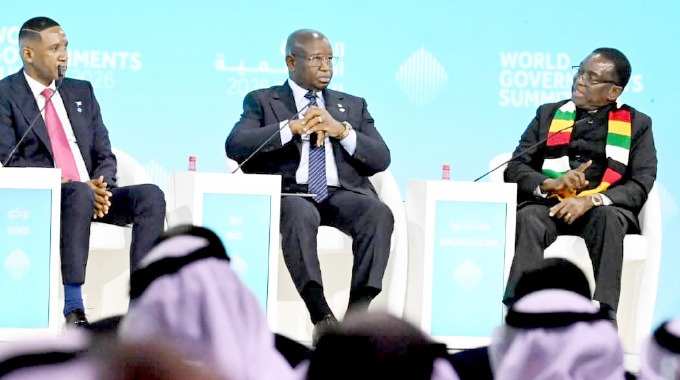
Richard Muponde, [email protected]
PRESIDENT Mnangagwa’s recent participation at the World Governments Summit (WGS) in Dubai, United Arab Emirates, marked a decisive stride in Zimbabwe’s engagement and re-engagement agenda, cementing the nation’s presence on the global stage of innovative governance. In joining world leaders to deliberate on future-ready models, the President not only amplified Zimbabwe’s voice in the discourse on technological and geopolitical shifts but strategically positioned the country to harness emerging opportunities within the Global South and other parts of the world.
The high-level WGS forum aimed to shape new models suited to an era of rapid technological and geopolitical change.
His immediate return to international duty at the WGS in Dubai underscores a leadership style anchored in urgency, economic diplomacy and global engagement as the country marvels in an economic development trajectory which has seen it record single-digit inflation in over two decades.
Just after concluding his annual leave, the President was back on the global stage, signalling that Zimbabwe’s development agenda does not pause. His arrival in the United Arab Emirates, where he was received at Al Maktoum International Airport by senior UAE officials alongside Foreign Affairs and International Trade Minister Professor Amon Murwira and Ambassador Isaac Moyo, was more than protocol, but it symbolised the country’s continued reintegration into high-level global governance platforms.
This moment reflects a deliberate posture that Zimbabwe is actively repositioning itself as an open, competitive and reform-oriented investment destination in line with Vision 2030.
Founded in 2013 in Dubai, the World Governments Summit emerged as a response to the growing complexity of governance in a rapidly changing world. Initially launched as the “Government Summit”, it was rebranded in 2015 to reflect its global ambition of serving over 150 governments. Its evolution mirrors a broader global recognition that traditional governance models are insufficient to address contemporary challenges driven by technology, climate change, demographic shifts and geopolitical realignments.
The WGS convenes Heads of State and Government, ministers, policymakers, private sector leaders, scientists and futurists. Its sittings focus on technology and futurism, societal well-being, global governance and sustainable development. The summit has entrenched itself as a premier platform where emerging and established democracies exchange ideas on shaping future governments.
For emerging democracies like Zimbabwe, the summit offers more than dialogue; it provides space to challenge dominant governance narratives and articulate alternative development pathways rooted in sovereignty, inclusivity and innovation.
Historically, global governance platforms have been dominated by the Global North, where democratic models are often presented as universal templates rather than context-specific systems. The WGS differs in that it foregrounds pragmatism, innovation and adaptability rather than ideological conformity.
This makes it particularly relevant for Global South nations that have endured externally imposed political prescriptions, economic conditionality and, in extreme cases, regime change. The Summit’s emphasis on collaboration and future-oriented governance allows countries like Zimbabwe to assert their agency and present home-grown solutions aligned with national realities.
President Mnangagwa’s participation comes at a critical juncture as Zimbabwe implements National Development Strategy Two (NDS2), the final acceleration phase towards Vision 2030’s goal of becoming an upper middle-income economy. Guided by the philosophy, “Nyika inovakwa nevene vayo / Ilizwe lakhiwa ngabanikazi balo”, NDS2 places citizens at the centre of development while ensuring no one and no place is left behind.
The World Governments Summit provides an ideal platform for Zimbabwe to market its reform trajectory, currency stabilisation, infrastructure expansion, value addition and export growth to a global audience of investors and policymakers. Bilateral engagements on the sidelines of the summit further amplify this opportunity, allowing Zimbabwe to translate policy into partnerships.
A critical analysis of global governance cannot ignore the asymmetrical power relations between the Global North and South. Countries such as Iraq, Libya and Afghanistan have witnessed regime change justified under the banner of democracy promotion, often leaving devastation in their wake. Leaders like Libya’s Muammar Gaddafi were forcibly removed with catastrophic consequences for national stability.
Zimbabwe’s own experience reflects this pattern. Following the fast-track Land Reform Programme designed to correct colonial land imbalances where about 4 500 white commercial farmers controlled the bulk of arable land at the expense of nearly eight million indigenous people, the country was branded a pariah state. Sanctions, isolation and even threats of invasion by Britain under former Prime Minister Tony Blair followed, demonstrating how sovereignty assertions in the Global South are often punished.
Upon assuming office in 2017, President Mnangagwa initiated a decisive break from isolation through a policy of engagement and re-engagement. Addressing global leaders at the World Economic Forum in Davos on his inaugural visit, he declared: “Zimbabwe is open for business . . . a friend to all and an enemy to none.”
This marked a strategic recalibration of Zimbabwe’s foreign and economic policy.
The results have been tangible. Exports grew from approximately US$2 billion in 2017 to over US$16 billion, according to Professor Murwira.
Currency reforms, fiscal discipline, infrastructure development and energy projects have stabilised the economy, culminating in the country achieving single-digit inflation for the first time in 27 years.
These reforms have restored investor confidence. Global and regional investors in mining, energy, agriculture and manufacturing have signed multi-million-dollar agreements with the Government.
Investments in lithium, platinum, steel and renewable energy reflect confidence in policy consistency and long-term planning.
Such inflows validate the Second Republic’s thesis that political stability, sound economic management and international engagement are prerequisites for sustainable development.
While international engagement is crucial, Vision 2030 ultimately rests on citizen participation. The philosophy that the country is built by its owners calls upon Zimbabweans to complement Government efforts through productivity, innovation and patriotism. Development is not outsourced; it is co-created.
President Mnangagwa’s swift transition from annual leave to high-level global engagement encapsulates a leadership ethos defined by momentum and purpose. His presence at the World Governments Summit reinforces Zimbabwe’s message to the world: the country is reforming, open for business and ready to shape its own future within the global community.


 Online Reporter