Chronicle Editor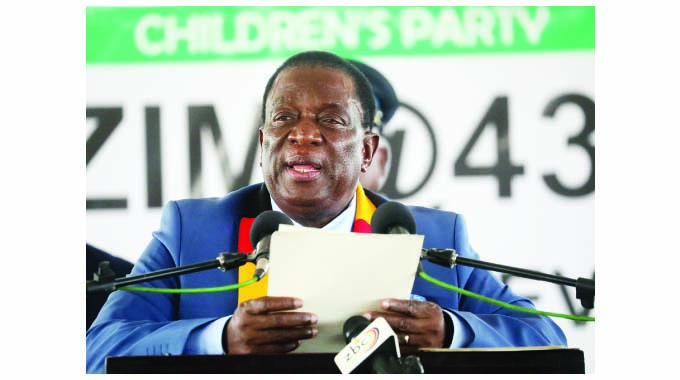
THE historic hosting of the 43rd Independence Day celebrations, for the first time in a rural province, was a befitting honour to the rural communities that not only suffered the longest but also endured some of the worst atrocities before freedom was achieved.
The celebrations were held in Mt Darwin, Mashonaland Central last Tuesday under the theme, “Zim@43 Nyika inovakwa nevene vayo/iIizwe lakhiwa ngabanikazi balo.”
The gallant sons and daughters of the soil embarked on a number of glorious operations in different parts of the country, mostly in the rural communities, which forced the enemy to surrender and Zimbabwe gained Independence on April 18, 1980.
By holding the celebrations in rural communities, the Government is not only honouring the communities for their contribution to the liberation war but also illuminates the history of the operations conducted in the efforts to liberate the country.
It also reminds Zimbabweans of the ruthlessness of the colonial regime in their attempt to thwart the liberation struggle but because of the unwavering spirit of the masses, the freedom train could not be derailed.
Reflecting on the Independence Day Celebrations and the Children’s party held a day before, President Mnangagwa, writing in his weekly column in the Sunday Mail and Sunday News, said:
“Over those two happy days, we took commemorations of our hard-won Independence back to the province and to communities that had suffered longest and endured some of the worst atrocities for that glorious day to come.
“We owed it to them, and I am happy that this troubling debt has finally been symbolically paid, so many years into our Independence.
“Except it is a debt that remains partly paid until all rural communities which make up our nation, and which, thus, played a direct role in the national struggle as it took its protracted, tortuous and bloody course, have had a chance to concretely own and physically host our Independence Day. And until development reaches every nook and cranny of the remotest of our rural areas, themselves theatres of the War of Liberation.”
The President said the country devolved the holding of national events, emulating Uganda after he was invited by his counterpart President Yoweri Museveni in 2019 to the country’s 57th Independence Day celebrations held in the Sironko district.
“Unlike what had become a tradition for us here in Zimbabwe, the Ugandans, under President Yoweri Museveni and the governing National Resistance Movement, whose history of armed struggle echoes our own history, decided long before to decentralise and devolve commemorations of their National Day, thus yearly taking them to different communities, including the remotest and the least developed.
“We thought this was a noble idea worth emulating. As a result, we began moving commemorations of our Independence away from the capital last year, when, for the first time, we held them in Bulawayo, our second largest city,” said President Mnangagwa.
“Except this was still in an urban setting, where basic amenities are available. How were we to take our Independence festivities to rural centres, whose limited infrastructure could not support a national gathering? While it was quite easy to determine the next host province for our National Day, we pondered long and hard the best venue which would send a clear statement of gratitude to communities that had sacrificed incomparably in the execution of the armed phase of our Liberation Struggle, itself largely a countryside affair. It was then that a decision was taken to move the celebrations to Mt Pfura/Darwin Centre, which lay painfully close to Chibondo, itself a harrowing site of Rhodesian atrocities during our Struggle.”
The President reiterated that the country’s Independence did not come cheap.
“Like I indicated in previous articles, we sought to make a strong statement of reconnection with the painful story of the birth of our nation, thus reminding all and sundry that this day did not come cheap at all,” he said.
“Above all, we wanted the rest of our people to stay reminded of the role rural communities played towards the birth of our Independence, and, thus, on how, in spite of their modest and often unspoken expectations, they merit special, nay even preferential attention, in national development. These rural communities are, after all, home to the majority of our people.”


 Online Reporter