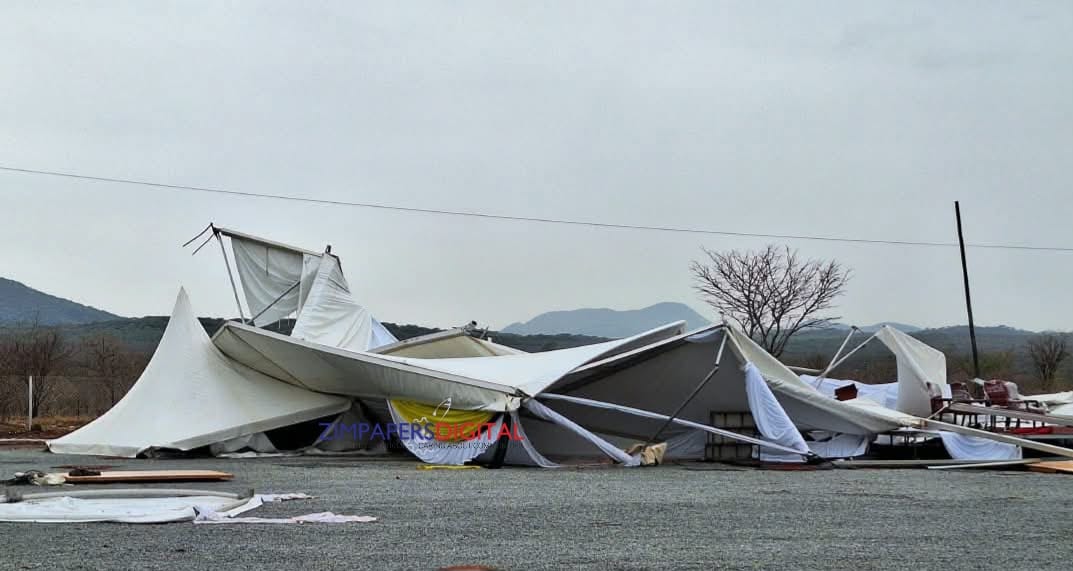
The hailstorm that hit Masvingo city, leaving a trail of destruction on Monday night should serve as a warning of disasters the country is likely to experience after weather experts predicted a Super El Nino this coming summer season.
A super El Nino causes severe global weather extremes resulting in droughts, flooding and high temperatures.
The Masvingo hailstorm which has been described as the worst in living memory, damaged more than 17 000 households and inflicted structural damage to critical public utilities that include education and health facilities.
According to preliminary reports, about 8 500 households had their roofs completely blown off and out of the 17 000 households assessed, 90 percent had windowpanes and roofs damaged, leaving families exposed to harsh weather elements.
Business operations across the city were disrupted as buildings were also damaged and in some cases roofs were completely blown off.
President Mnangagwa has declared a State of Disaster for areas that were affected by the catastrophic hailstorm to enable Government to mobilise the required resources to assist the affected families.
Government, which through the Civil Protection Unit (CPU) has activated disaster response systems, has made a commitment to compensate the affected families.
A number of families were left homeless after their houses were destroyed by the hailstorm, and Government has since established temporary shelters to accommodate the affected families.
The Government is obviously overwhelmed by the extent of the damages in Masvingo hence it is appealing to the private sector to also assist in repairing or rebuilding houses and other damaged infrastructure in the city.
Companies in and around Masvingo should therefore complement Government efforts to mobilise the required resources so that normalcy in the city can be restored in the shortest possible time.
Now that the rains are around the corner, the CPU and communities should be on alert for possible disasters.
Citizens should brace for disasters similar to the 2020 Cyclone Idai, which claimed more than 300 lives and affected more than 17 000 households, mostly in Manicaland province.
At the onset of the rains, CPU structures must be activated from village to national level so that communities receive alerts quickly to enable them to act swiftly and mitigate the impact of disasters.
Cyclone Idai’s high death toll was blamed on communities’ unpreparedness which we should avoid this season.
Zimbabwe has been warned by what happened in Masvingo, and it is therefore incumbent upon communities, guided by the CPU, to prepare for likely disasters this coming summer season.