Chronicle Editor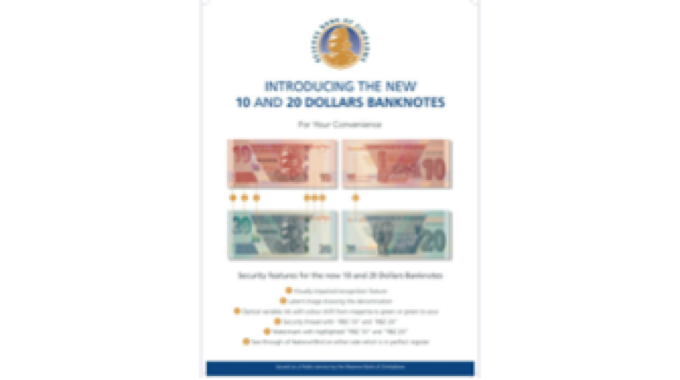
To ease transactions and reduce transaction costs, the Reserve Bank of Zimbabwe (RBZ) will on Tuesday next week introduce new higher denomination notes.
Since the Government re-introduced the local currency in June last year, only $1 coins as well as $2 coins and notes and $5 notes are circulating.
However, because of rising inflation the small denominations have failed to keep pace with prices. As a result, one needs bunches of notes or fistfuls of coins to be able to buy a few things.
In addition to the existing denominations being too small to match prices, the money in circulation remains too little to meet demand. As a result, queues at banking halls are persisting. Some unscrupulous people who have access to cash are capitalising on that shortage by actually selling cash to those who are desperate for it. For example, for one to be given $100 in cash, they have to transfer something like $150 to the cash baron’s bank account or mobile wallet.
A third challenge arising from limited cash circulating in the economy has been the multi-tier pricing system, where prices of a single product differ depending on the customer’s mode of payment. Because there is not much cash in the economy, most people are being forced to pay higher prices when transacting on alternative platforms such as swiping or using mobile money. In other words, the few who have access to cash are paying lower prices while the majority who have no physical cash are paying higher prices for the same goods and services.
It, indeed, has been a nightmare for the transacting majority.
The RBZ is aware of that, so it has been working to get more cash, not only cash, but higher denomination notes into circulation, while paying utmost regard to the need to keep money supply growth in check.
New $10 bank notes, as we report elsewhere today, will start circulating on Tuesday while the $20 bank note will start circulating by the first week of next month.
According to recent RBZ statements, about $1,4 billion in cash is circulating in the economy. When the new higher denomination notes are fully issued, the economy would have $2 billion in circulation. This means that the new $10 and $20 notes amount to $600 million.
The issuance of more money is a very important development that will indeed ease the burden that the public has been facing. They must be delighted that a solution to that challenge is being put in place. They must expect the cash shortage to ease over the next three weeks or so.
However, as the RBZ has indicated, the currency shortage will only be fully resolved — if circumstances remain the same — when money in circulation rises to $3 billion. Considering the nuanced manner in which the central bank has been handling the cash issue, we are likely to go for a little longer before we reach the $3 billion mark. The RBZ is aware that simply pumping more cash into the economy will create more problems. Too much printed money will stoke inflation. No serious central bank wants to be the source of hyperinflation in an economy whose well-being it is mandated to safeguard.
In that respect, the central bank will take a responsible approach, easing transactions on one hand while on the other keeping the amount of money in circulation in check.
We therefore urge the public to continue being patient as the RBZ does its best.
As they remain patient, the public are urged to continue performing cashless transactions, swiping for goods and services as well as using EcoCash, OneMoney and TeleCash.
These payment options have multiple advantages. The public don’t need to carry wads of cash around, but just their debit card or mobile phone. If they don’t have cash on them, the risk of them being mugged is smaller than when they have a bagful of it.
In addition to limiting the risk of them being targeted by criminals, they can transact securely using their debit card or mobile phone as it is only they who know the pin code for their card or their mobile wallet. If they happen to lose their cards and mobile phone, they simply have to get in touch with their bank and mobile communication operator to get a new debit card or sim card to be able to transact again.
Going forward, the RBZ must continue with that balancing act, drip-feeding cash into the economy to ease the burden on the transacting public in a way that maintains the health of the economy.


 Online Reporter