Online Reporter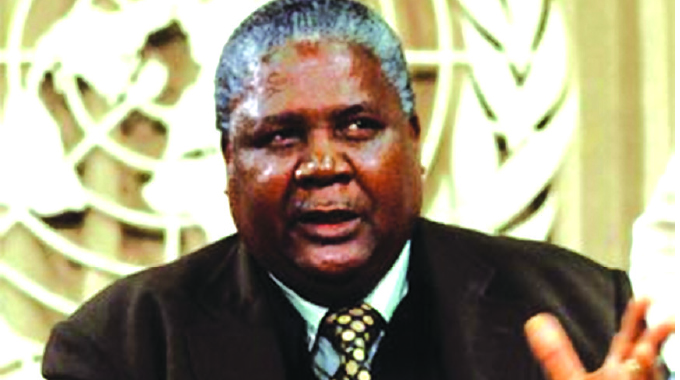
DURING the colonial land grab, the largest single property transferred into private hands was Nuanetsi Ranch, with its owners claiming it was the second largest ranch in the entire world.
Spanning the arid Mwenezi district and spreading into Chiredzi district, the cattle ranch did not produce much for its well over 300 000 ha.
While large in area, it was too close to semi-desert to be much use for farming.
That is now changing dramatically in one of the most ambitious development programmes involving the private sector and the Government.
In 1989, then Vice President Joshua Nkomo managed to achieve a long-held ambition, dating from his days in the Gonakudzingwa detention camp, to see the South African owners of this large block of land transferring ownership to the Zimbabwe Development Trust.
This at least brought the land into ownership by Zimbabweans.
Several schemes were put in place to see what was possible, including a major game conservation area and some modest irrigation that at least proved that once irrigated, the ranch would move from marginal land to something rather special.
The obvious source of water was a dam near the confluence of the Tokwe and Mukosi Rivers. Initial work, thanks to sanctions disrupting finance, was intermittent but with the arrival of the Second Republic, the Government of President Mnangagwa committed local resources to completing the Tokwe-Mukosi Dam.
This, as it filled, became the largest interior lake in the country, catching not just the ordinary modest rainfall in its catchment but storing the flood rainfall that came in some years and had in the past not just caused destruction but also gone to total waste.
The lake was big enough for long-term as well as seasonal storage, important with the climate changes being seen in the Lowveld.
The next stage has been to start making full use of this major infrastructure development by the Government.
Here a decision was made to bring in responsible private companies who were prepared to invest in the land and put in the required irrigation infrastructure and then buy the bulk water from Tokwe-Mukosi to convert once marginal cattle pasture into some of the richest farmland in Zimbabwe.
In the carefully planned and implemented first phase, seven private concerns have between them taken on a combined 25 000 ha, a large area but well under 10 percent of the ranch.
They are developing commercial sugarcane, citrus, and lucerne, plus a pair of solar power stations totalling 90 MW in output, along with the third giant sugar mill in Zimbabwe.
The eventual Government plan is a major 200 000 ha irrigated greenbelt using the huge storage capacity of Masvingo province and stretching from Rutenga to Chiredzi, and so incorporating large areas of the old Nuanetsi Ranch.
The present 25 000 ha being developed this year and next year will prove that this sort of high-level development is possible and profitable, and will provide the nucleus of future development.
Already 500 direct jobs have been created by the seven companies, with thousands more expected and most of this labour force coming from the surrounding areas in line with Government policy and the enlightened common sense of investors who find that local people are almost always the best workers in any project, having family ties to the area and being used to the climate and other conditions.
We would hope that as the greenbelt is developed, the financing will allow a mix of land users, from small-scale irrigation farmers to large investors.
Already the eastern parts of the Lowveld have shown this to be possible and desirable, with contract farming by the agro-industrial sugar companies providing the economic glue holding everything together.
We see no reason why a similar multi-user programme cannot create on the old barren acres of the colonial ranch one of the most fruitful, productive, and exciting farming areas of Zimbabwe, with all that we have learned about the positive side of Lowveld irrigation farming applied and the negatives that have come to light over the decades being eliminated as we apply experience.
A very important part of this first phase is that once again the Second Republic has, within a very few years, started converting the rhetoric of decades into practical programmes.
Plans and dreams in the past filled long metres of shelving but did not really produce much in the way of any results outside some disputes over the little trial schemes.
This time, getting it done right from the start has seen the Second Republic not just exhibiting that high level of practical development that has become its hallmark, but doing so in a way that appears to have avoided dispute and got everyone working together to create something effective and wonderful.