Online Reporter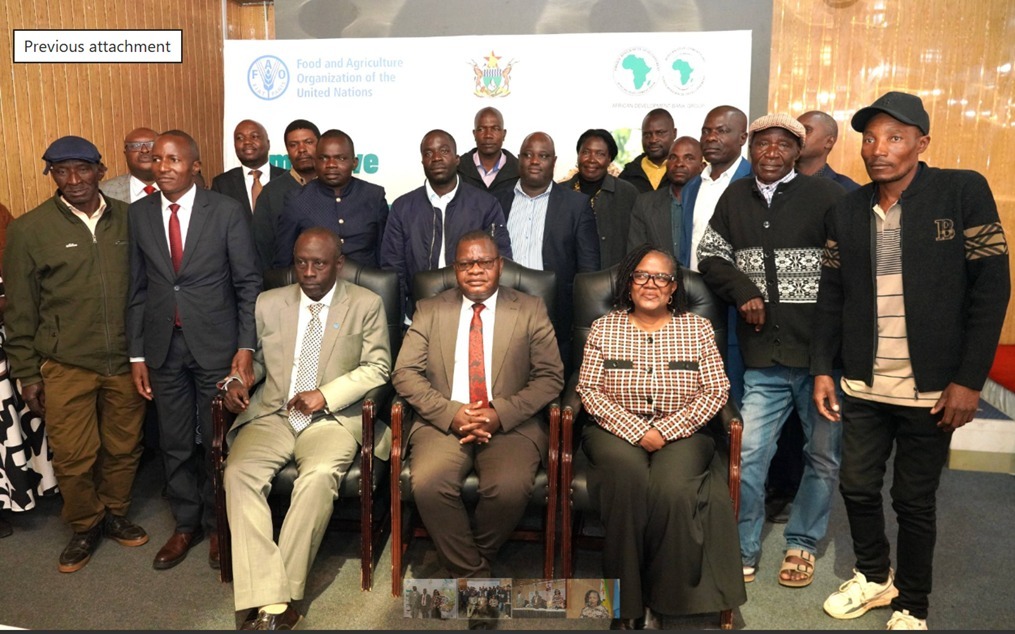
MORE than 188 000 farming households across Zimbabwe have strengthened their food production and resilience through a four-year emergency agricultural programme that has helped drive record wheat harvests, expand climate-smart farming, and unlock millions of dollars in private-sector financing for agricultural inputs.
The Zimbabwe Emergency Food Production Project, funded by the African Development Bank with $25 million from its Transitional Support Facility, has provided quality agricultural inputs, improved farming technologies and extension services while promoting climate-smart agriculture across 153 000 hectares.
The project has also increased production of drought-tolerant maize and sunflower seeds and contributed to average wheat yields of five tonnes per hectare.
The Government, the African Development Bank and implementing partner, the Food and Agriculture Organisation of the United Nations (FAO), last week marked the successful completion of the initiative, which turned an emergency response to global food shocks into a long-term investment in agricultural resilience and food sovereignty.
Launched in 2022 in response to the combined impacts of the COVID-19 pandemic, the Russia-Ukraine conflict, and global supply chain disruptions, the project was designed to help safeguard Zimbabwe’s food production while strengthening the country’s agrifood systems.
As concluded on 30 June 2026, its results highlighted the benefits of coordinated investment and strong partnerships.
One of the project’s flagship initiatives, the Seed Revolving Fund, implemented through AFC Land and Development Bank, supported more than 90,957 farmers, including about 33 108 women, in irrigation schemes and recorded a loan repayment rate above 90 percent, demonstrating the creditworthiness of smallholder farmers.
“The Seed Revolving Fund is the blueprint for breaking the cycle of dependency and fostering genuine farmer ownership,” said Prof Obert Jiri, permanent secretary in the Ministry of Agriculture, Mechanisation and Water Resources Development, during the project’s close-out workshop.
“This is not merely the conclusion of a $25 million project — it is a celebration of resilience, a testament to the power of strategic partnerships, and a foundational milestone on our transformative journey towards Vision 2030.”
Unlike many emergency response programmes that focus primarily on distributing agricultural inputs, the project adopted an integrated approach that strengthened access to finance, digital services, post-harvest management, and institutional capacity.
“Against a target of 180 000 farmers, this project reached over 188 000, with women making up 60 percent of beneficiaries, well above our 40 percent target,” said Eyerusalem Fasika, the AfDB Goup’s country manager for Zimbabwe.
“These are not just numbers on a page — they represent farming families who adopted new practices, accessed financing, and are now reaping the rewards in their harvests.”
The project also modernised agricultural service delivery through the IDEA farmer registry platform, creating a digital foundation for extension services and agricultural data management.
To reduce post-harvest losses — a persistent drain on farmers’ incomes — it supplied metal grain silos, threshers, moisture meters, and oil-processing equipment, while supporting the Seed Services Institute and the Crop Breeding Institute strengthened domestic seed production and reduced reliance on imports.
The programme further expanded access to agricultural finance through a partial credit guarantee scheme administered by the Africa Fertiliser Financing Mechanism (AFFM) in partnership with Fertiliser and Seeds Group (FSG).
The facility exceeded its original $15 million target by more than $44 million in fertiliser sales, moving over 80 000 tonnes of fertiliser through 23 private-sector agents and AFC.
“For FAO, this project evolved from a rapid response into a transformative initiative with impacts extending well beyond emergency support,” said Patrice Talla, FAO Subregional Coordinator for Southern Africa and Representative to Zimbabwe.
“The project made a significant contribution to building more resilient, inclusive and market-oriented agrifood systems while laying a strong foundation for sustainable agricultural transformation and food security in Zimbabwe.”
Lessons and financing models developed under the project are now shaping Zimbabwe’s Agriculture, Food Systems and Rural Transformation Strategy 2 (2026–2030), which aims to build a $15.8 billion agriculture sector by 2030 and raise agriculture’s contribution to GDP to between 12 and 15 percent.
The African Development Bank reaffirmed its commitment to the next phase of transformation, noting that the close-out provided an opportunity to take stock of what four years of partnership had made possible, and to carry lessons forward.