Online Reporter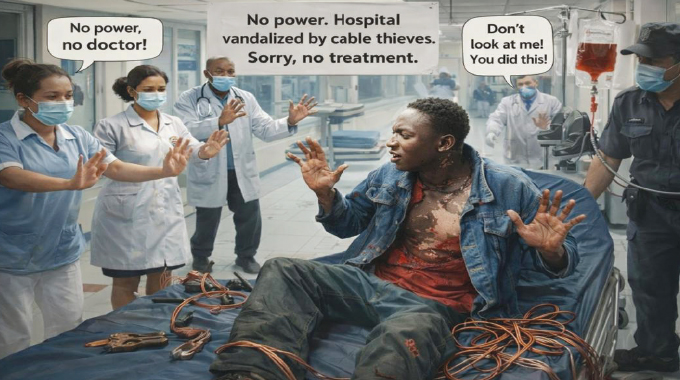
THERE is a haunting image that lingers from 2021: a young man, Ishmael Mpofu, lying in a hospital bed at Mpilo Central Hospital, his body horrifically burned while attempting to steal a high-voltage transformer from the very same institution.
For three agonising days, doctors could not fully treat him. Not because medicine was lacking, but because of the stolen electricity cables needed to power his life-saving equipment. The would-be saboteur became a victim of his own sabotage.
That was 2021. The story was titled “Electric shock: No power to treat transformer ‘thief’.” It was tragic, ironic, and we hoped — a cautionary tale.
Four years later, nothing has changed. Except now, it is worse.
Last week, life-saving surgical operations were temporarily suspended at Zimbabwe’s second-largest referral health institution. The Intensive Care Unit, renal units, and X-ray department were also crippled. The culprit? The same relentless, remorseless theft of electricity cables that has become a national scourge.
According to Mr Phineas Sithole, the hospital’s acting director of operations, the theft and vandalism of power infrastructure at Mpilo has now reached “unprecedented levels”. A 30-metre cable was stolen, crippling laundry services. Another cable feeding the kitchen was taken, leaving patients with minimal means to be fed. Then came the most devastating blow: criminals broke into an on-site sub-station and stole more cables, plunging operating theatres into darkness.
“It puts the lives of patients at risk,” Mr Sithole said. That is not an administrative complaint. It is a death sentence delivered by faceless criminals.
Let us be brutally clear: When a hospital loses power, people die. Not metaphorically. Not hypothetically. A mother needing a Caesarean section. A child with renal failure. A trauma patient bleeding out on a table while doctors wait for a generator to cough to life. These are the real consequences of cable theft.
And the cost is staggering. Mpilo now relies on 10 diesel-powered generators, each consuming 300 litres of fuel per day. That is 3 000 litres daily, costing nearly US$4 800 every single day. Money that should buy drugs, bandages, and pay salaries. Instead, it buys smoke and noise because criminals value copper more than compassion.
Professor Solwayo Ngwenya, Mpilo’s acting chief executive, summed it up painfully: “We need the money to buy drugs and other hospital consumables, but these are the things that end up contributing to patients being told to buy this and that, because these are unforeseeable and unnecessary costs.”
Unnecessary costs. That phrase should haunt every Zimbabwean.
Yet here we are, four years after a burned thief lay helpless in a blacked-out hospital, and the same hospital is once again suspending surgeries because cables have been stolen.
What will it take? A death? A public outcry? A presidential intervention?
The Government must treat cable theft at hospitals as what it is: attempted murder. Not vandalism. Not petty crime. Attempted murder. The Zimbabwe Republic Police must deploy dedicated units to protect Mpilo and every other referral hospital. Zesa must prioritise securing its sub-stations at medical facilities. And the Ministry of Health must integrate existing solar systems into hospital main grids immediately.
As for the thieves: let them remember Ishmael Mpofu. He survived his burns, but he also survived three days of no electricity in a hospital he helped cripple. If that is not a warning, nothing is.
Because the next time cables are stolen at Mpilo, the person who dies on the operating table may not be a thief.
It may be your mother. Your child. Your friend.
And there will be nothing ironic about that. Only tragic.