Online Reporter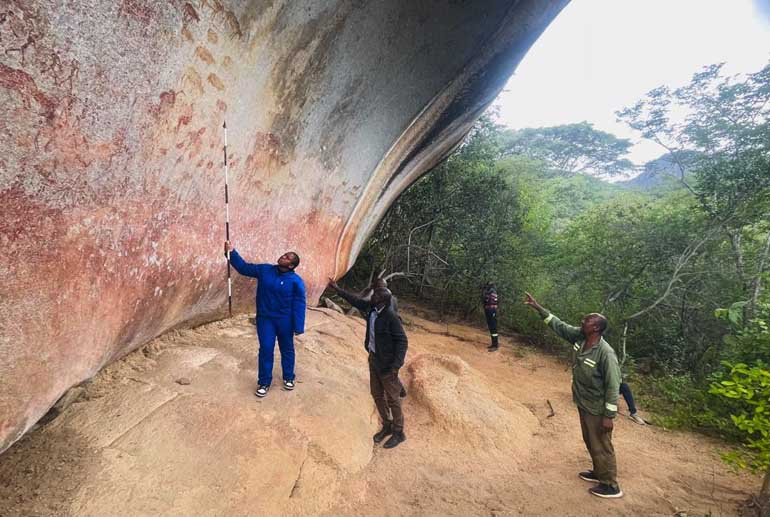
Lloyd Makonya
Correspondent
BENEATH a towering granite rock shelter in the Manjowe Hills of Zimunya, centuries-old paintings continue to cling to the stone surface, silently narrating stories of Zimbabwe’s distant past.
Protected, not by fences or security systems, but by generations of local custodians, the Manjowe Rock Art Site stands today as a powerful reminder that communities remain at the heart of heritage conservation.
Recently, a team of archaeologists from the National Museums and Monuments of Zimbabwe (NMMZ) based at Mutare Museum embarked on a field visit to Manjowe and surrounding heritage sites in Zimunya communal lands to strengthen collaboration with local communities in safeguarding cultural heritage.
The visit, led by Headman Hazvinandawa Muzarawetu under Chief Zimunya, highlighted the growing recognition that successful heritage management depends, not only on experts and institutions, but also on the people who live alongside these cultural treasures.
The team first visited Muromo Rock Art Site, a proclaimed National Monument renowned for its rich collection of prehistoric paintings. From there, they travelled approximately seven kilometres west to Manjowe, where another remarkable gallery of rock art remains preserved beneath a massive rock overhang.
What struck the archaeologists was, not only the quality of the paintings, but the pristine condition of the surrounding environment.
Indigenous trees continue to flourish around the site while the artwork itself remains largely intact, thanks to traditional systems of protection that have endured for generations.
For Headman Muzarawetu, safeguarding heritage is both a cultural obligation and a responsibility to future generations.
“These sites are part of our identity. They connect us to our ancestors and remind us where we come from. As traditional leaders, we encourage our communities to protect them. We have local rules and penalties for anyone who damages these places because once heritage is destroyed, it cannot be replaced,” he said.
His sentiments were echoed by local villager, Mr Itai Muranda, who has spent his entire life in the area.
“We were taught from childhood that these sites are important and must be respected. Nobody is allowed to interfere with them. Even today, people understand that protecting these places is protecting our history,” he said.
Mr Muranda said there are several other heritage features scattered across the landscape, including caves containing ancient granaries and pathways that point to past human occupation.
The continued preservation of such sites demonstrates the effectiveness of traditional knowledge systems that have long governed interactions between communities and their cultural landscapes.
For archaeologists, Manjowe provides an important lesson in community-centred conservation.
NMMZ archaeologist, Ms Nomsa Chivende, said local communities possess invaluable knowledge about the sites they have protected for generations.
“Community participation remains fundamental to heritage conservation. Many of these places are not simply archaeological sites, they are living heritage landscapes that continue to hold cultural, historical and spiritual significance for local communities. Sustainable conservation can only be achieved when heritage institutions and communities work together as partners,” she said.
She said the Manjowe experience demonstrates how indigenous knowledge systems and traditional leadership structures can complement modern heritage management practices.
Across Zimbabwe, heritage professionals are increasingly recognising the role of communities as custodians of cultural resources.
Long before formal heritage legislation was introduced, local communities had already developed systems for protecting sacred places, archaeological sites and culturally significant landscapes.
In Zimunya, that responsibility is being carried proudly by a community that understands that heritage is not merely about history, it is about identity, memory and legacy.