Chronicle Editor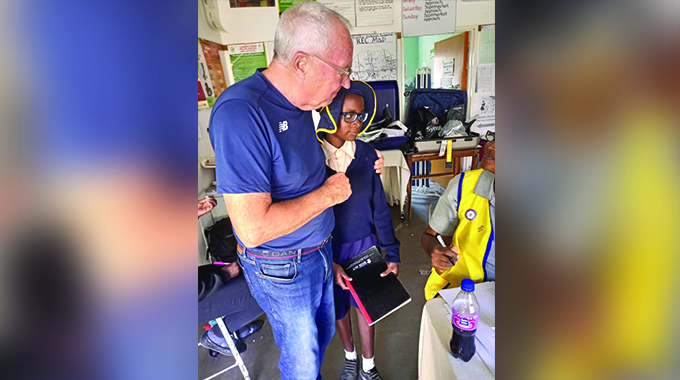
Michael Magoronga, [email protected]
OVER 400 people in Zhombe District who had optical ailments received free eye treatment during an eye camp held at Zhombe Mission Hospital last week Thursday.
Organised by Lions Club in partnership with Denmark based optician, Dr Finn Junker, the programme saw people receiving blood pressure and diabetes checks, eye screening services and spectacles among other healthcare services for free.
Of the treated, about 90 were children under the age of 12 a majority of whom were said to be having eye problems.
Programme coordinator, Mr Lion Forget Chekure said the number of children who had eye problems was a cause for concern.
“We attended to more than 400 people from the community and there was an overwhelming response from children who came from a nearby school, St Martin Deporis Primary,” he said.
“What was worrying, however, was that the majority of them had eyesight problems, which is a major cause for concern.”
Of the treated children, only five received spectacles while more than 30 had eye problems, which required that they receive spectacles.
“This situation came as a surprise and we were not prepared to have such a huge number of children with eye challenges.
“We, therefore, could not give about 30 or so children spectacles but we will make arrangements that the children and other elderly people also receive their spectacles.
“We had a limited number of spectacles but we are working hard to recover some that were confiscated at the border,” said Mr Chekure.
“We once held the same programme in Kwekwe and Redcliff.
“This time we chose to take it to Zhombe because most of the people cannot afford to access healthcare services.
“I can safely say that in the urban setup there are no such cases involving children as compared to the rural setup.
“Maybe it boils down to the issue of diet and what they eat.”
He said the issue was brought to the attention of Zhombe Mission Hospital staff who promised to investigate as to what could be causing the eye problems of minors with malnutrition not being ruled out.
Dr Kudakwashe Magogo who was part of the team said although malnutrition could be a farfetched cause, it could not be ruled out.
“Generally, the lack of essential nutrients during the critical growth periods in children can definitely affect the development of the eye. This would definitely make the kids have bad eyesight.
“Also for kids, there’s definitely a number of unidentified environmental and lifestyle factors that could have significantly contributed to a huge turnout of kids with bad eyesight,” explained Dr Magogo.
He encouraged families to commit to a conventional balanced diet to avoid such cases.
This comes as Government has resumed school feeding programmes to combat malnutrition and prevent children from dropping out of school due to hunger caused by the El-Nino induced drought.
According to the United Nations Children Fund (Unicef) Nearly 600 000 children in Zimbabwe are at risk of experiencing life-wasting, a form of malnutrition due to severe child food poverty that has been worsened by the El Niño-induced drought.
Dr Nicholas Alipui, Unicef Representative in Zimbabwe, expressed concern that thousands of Zimbabwean children, especially those aged between six months and two years lack access to the minimum nutritious foods required for their growth and development.



 Online Reporter