Online Reporter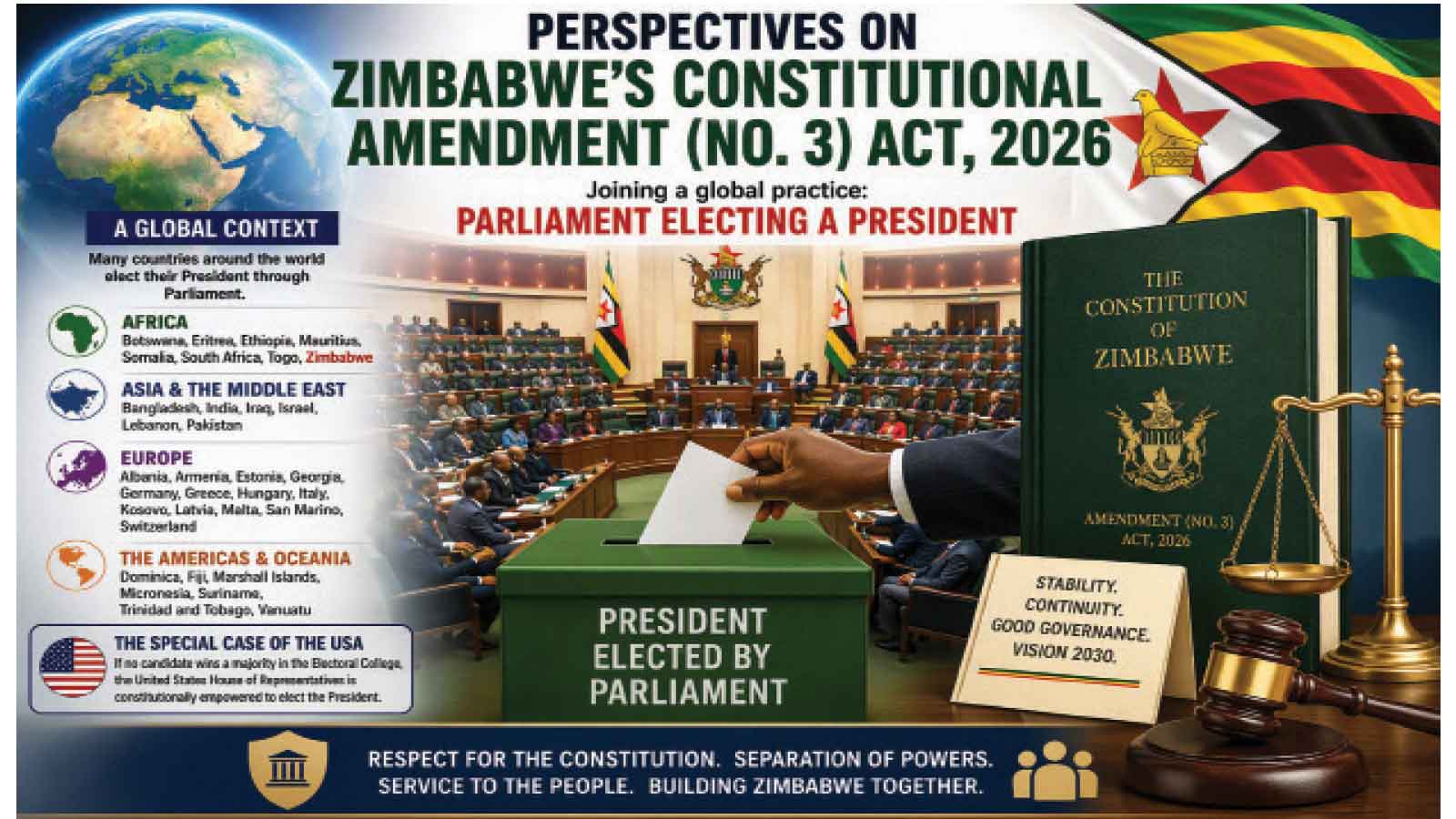
Dr Munyaradzi Kereke
PERSPECTIVES ON ZIMBABWE’S CONSTITUTIONAL AMENDMENT (NO. 3) ACT, 2026
Authority Reference No. JF_CAA032026
24 July 2026, Harare
This is a fact-based publication that brings together key materials to equip readers with relevant information concerning Zimbabwe’s recent Constitutional Amendment (No. 3) Act, 2026.
There have been waves of misinformation on this subject, much of which has at times been intended only to stir emotions and encourage blind activism without any lawful cause.
THE GLOBAL CONTEXT: PARLIAMENT ELECTING A PRESIDENT
Through Constitutional Amendment (No. 3) Act, 2026, Zimbabwe’s Parliament is now mandated to elect the President of the country.
In doing so, Zimbabwe has joined a number of countries around the world where Parliament elects the President.
IN AFRICA
In the following African countries, the President is elected by Parliament, as is now the case in Zimbabwe:
(a) Botswana, (b) Eritrea, (c) Ethiopia
(d) Mauritius, (e) Somalia, (f) South Africa, (g) Togo, (h) Zimbabwe
ASIA AND THE MIDDLE EAST
In the following Asian and Middle Eastern countries, the President is elected by Parliament, as is now the case in Zimbabwe:
(a) Bangladesh, (b) India, (c) Iraq
(d) Israel, (e) Lebanon, (f) Pakistan
EUROPE
In the following European countries, the President is elected by Parliament, as is now the case in Zimbabwe:
(a) Albania
(b) Armenia
(c) Estonia
(d) Georgia
(e) Germany
(f) Greece
(g) Hungary
(h) Italy
(i) Kosovo
(j) Latvia
(k) Malta
(l) San Marino
(m) Switzerland
THE AMERICAS AND OCEANIA
In the following countries in the Americas and Oceania, the President is elected by Parliament, as is now the case in Zimbabwe:
(a) Dominica
(b) Fiji
(c) Marshall Islands
(d) Micronesia
(e) Suriname
(f) Trinidad and Tobago
(g) Vanuatu
THE SPECIAL CASE OF THE UNITED STATES OF AMERICA (USA)
Citizens in the USA typically vote in elections to elect a President. However, the United States House of Representatives is constitutionally empowered to elect the President if no candidate wins a majority in the Electoral College.
MISGUIDED ACTIVISM IN ZIMBABWE
10.1 A lack of the above facts has often resulted in ideological zealotry in Zimbabwe, expressed through opposition to Zimbabwe’s Constitutional Amendment (No. 3) Act, 2026 without a robust factual basis sufficient to constitute a valid cause of action.
10.2 Others have publicly opposed Zimbabwe’s constitutional amendments purely for self-validation and performative allyship, seeking social credit without any substantive basis for their actions.
Such misguided crusades and uninformed advocacy should not be allowed to derail Zimbabwe’s trajectory of socio-economic growth and industrialisation under Vision 2030.
There is nothing amiss in the manner in which Zimbabwe’s Executive and Legislative arms of Government lawfully effected the recent constitutional amendments.
Under Section 162 of the Constitution of Zimbabwe, judicial authority is derived from the people and vested in the courts.
The courts are strongly discouraged from venturing into the realm of constitutional drafting and amendment.
The courts do not possess the authority to rewrite, amend or structurally interfere with the core provisions of the Constitution once they have been enacted into law.
The role of the courts is one of constitutional interpretation and enforcement.
SEPARATION OF POWERS AND THE ENROLLED BILL RULE
Courts generally cannot interfere with the internal constitutional law-making processes of a legislature if the Constitution explicitly assigns those functions to Parliament.
In Field v Clark (1892), the United States Supreme Court established the “Enrolled Bill Rule”, which stipulates that once an Act of Congress has been signed by the leadership of both Houses and the President, the judiciary must accept that it was passed in accordance with constitutional procedures.
The court must resist looking behind the legislative process to question how the text was handled.
In Zimbabwe, Constitutional Amendment (No. 3) Act, 2026 followed all the procedures prescribed by the Constitution of Zimbabwe before being enacted into law. The Judiciary’s role now is to interpret and enforce that law.
Dr Munyaradzi Kereke
Founding Chairperson
The Justice Foundation
23 July 2026, Harare