admin
admin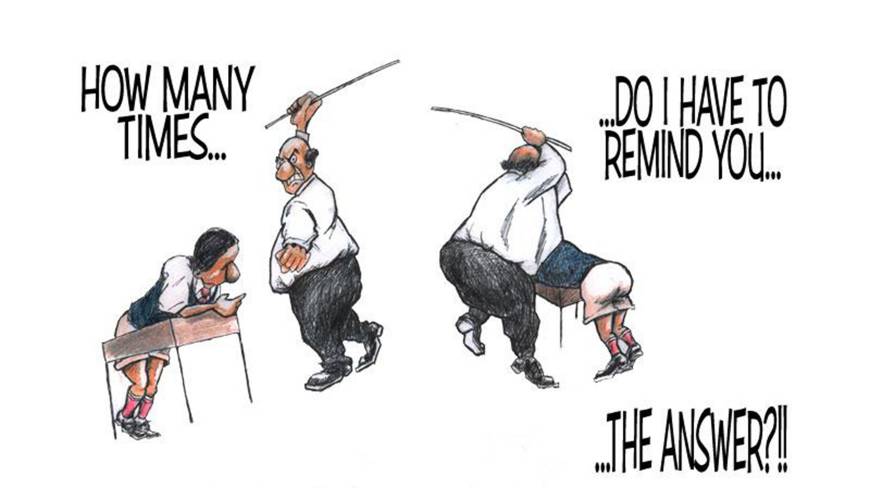
Cuthbert Mavheko
HIGH Court Judge Esther Muremba recently ruled that the canning of juvenile offenders was unconstitutional and had no place in Zimbabwe’s statutes because it was inhuman and degrading. She uttered these sentiments while upholding the conviction of a 15-year-old boy who had been sentenced to three strokes with a rattan cane by a magistrate, but had appealed the sentence at the High Court.
As I pen this piece, many have joined the growing queue of people casting aspersions on the learned judge’s landmark ruling to ban corporal punishment and calling on the Zimbabwean government to revisit this form of punishment with a view to unbanning it.
Recently, teachers wrote a letter to President Robert Mugabe seeking the re-introduction of corporal punishment in schools. They argued that its outright removal affects the moulding of pupils into good citizens and their attainment of higher pass rates.
With the debate for and against corporal punishment getting heated, many Zimbabweans, this scribe included, are, no doubt, rubbing their hands in expectation that something positive is going to come out of this protracted debate.
It should be stated at the very onset that the issue of corporal punishment is not a simple and straight-forward problem. It (corporal punishment) should not be viewed from a layman’s stand-point and we should not be myopic lest in our haste to have it banned we leap from the frying pan into the fire.
Let me repeat for the sake of emphasis that this is not a simple and straight-forward problem like theft or rape, for example, but is a complex and convoluted issue that merits a lot of circumspection.
The debate on whether or not corporal punishment should be banned has been going on for many years now. One scribe wrote “. . . corporal punishment is violent and unnecessary. It is a cruel and degrading form of punishment and should be banned in our schools.” The views and perceptions advanced in this write-up are, in my own view, hare-brained, neurotic and highly misleading.
To be brutally frank, the entire article is poorly researched and fails the test of critical, in-depth analysis of the issue of corporal punishment as arguments raised therein are primarily based on appeals to raise emotions and are sugar-coated with lynch-mob psychology as opposed to hard palpable facts.
As I personally see it, banning corporal punishment is retrogressive and will actually do more harm than good to our children. The simple unfaltering truth is that corporal punishment is necessary and effective in inculcating respect and discipline in children. The Oxford Dictionary describes discipline in its simplest forms as mental and moral training.
Thus it can be seen that discipline of itself is not negative as some have been led to believe. And yet today discipline is often associated with negative concepts of strictness, brute force and rigid rules and regulations.
It is pertinent to state that respect for authority is the most fundamentally important principle that a parent or teacher can teach a child. Without respect for authority a child is direly handicapped and grows up to be a social deviant.
And so, contrary to what critics of corporal punishment say, at times it is necessary to use the rod to discipline children. In respect of this priceless truism the inspired word of God says: “The rod and reproof give wisdom, but a child left to himself brings his mother to shame.” (Proverbs29:25).
Having advanced the foregoing, one should state that in disciplining children, parents or teachers should always act with restraint, wisdom, love and compassion.
On no account should they let their emotions run riot and cloud their judgment. Any punishment meted out to a child should always be consistent with the misdemeanour.
In other words, it is wrong to over-discipline a child for a minor infraction and to under-discipline for a major one. Be that as it may, the shocking irony is that today hordes of children, particularly minors, are being brought to the attention of law-enforcement agents and health officers, having been battered, stabbed or smashed against walls by parents or other adults in charge of them.
Fractured skulls, broken limbs, blackened eyes and whip-lashed backs have become so prevalent that even hardened law officers sometimes break down emotionally after seeing these children.
No wonder why critics of corporal punishment are chuckling with glee as they clamour for a total ban of this form of punishment.
Research into the causes of child battering has discovered that most incidents of child battering stem from improper attempts at disciplining children.
Parents and teachers become provoked by a child’s apparent inability or reluctance to obey instructions. They lose their tempers and in violent fits of rage discipline the child, resulting in them inflicting serious injury on children.
Parents, guardians or teachers who give in to fits of rage and lash out at children in uncontrollable outbursts of hostility are not, by any stretch of the imagination, disciplining children but unwittingly disseminating seeds of great future problems.
Psychologists the world over subscribe to the understanding that child battering produces disastrous mental and physical effects on the child. Many physically abused children are permanently damaged, both physically and emotionally. They suffer handicapping emotional traumas and many flee their homes to become street kids, child prostitutes or common criminals.
It is such children who are today transforming our cities and suburbs into zones of crime, prostitution and gang violence. The scourge of moral decadence that is raging in our country like an uncontrollable conflagration is so frightening in what it portends and ought to shake every concerned citizen of this country out of complacency into desperate action to reverse the ominous tide. In our day, we feared and respected our teachers and parents – they were, in our eyes, ideals to be followed and emulated. Today, the utter lack of respect for constituted authority, either that of teachers or parents among today’s youths is mind-boggling to say the very least.
One cannot be totally incorrect to conjecture that one of the major reasons why children lack respect for their own parents and teachers is due to the fact that corporal punishment has been outlawed in our homes and schools.
Resultantly, out of fear of prosecution, parents and teachers are abstaining from using this very effective tool of correcting wayward behaviour.



 Online Reporter