admin
admin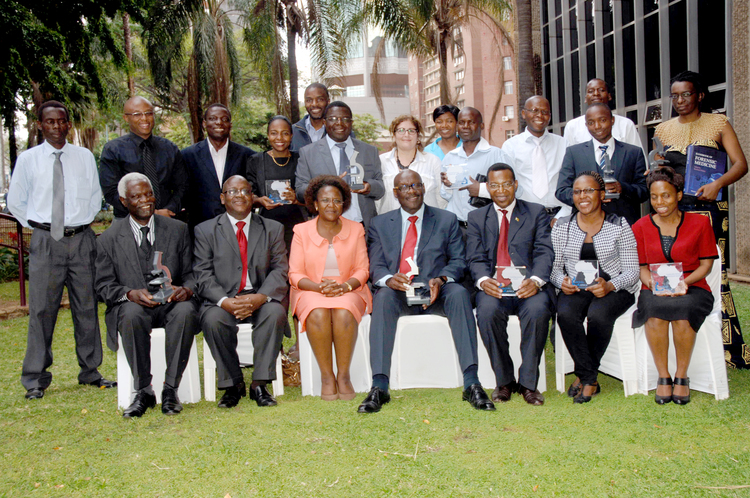
Sharon Kavhu
Despite economic challenges, Zimbabwe has proved to the world that resources permitting, it is capable of providing quality laboratory and diagnostics services.
Last year, Zimbabwe joined the LabSkills Africa project in which five countries were given different assignments to enhance quality laboratory and diagnostics services.
For two years, Zimbabwe, Kenya, Uganda, Tanzania and Zambia worked flat out to pass periodic inspections and assessments by international health experts.
Each country was expected to work with four hospitals in the assigned area.
Working in a determined and innovative manner, Zimbabwe scooped the 2015 LabSkills Africa Recognition Award (Lara).
Health and Child Care Minister Dr David Parirenyatwa said, “To Zimbabweans, we say the medical expertise is available in this country and we urge you to look for care in Zimbabwe first before spending a lot of resources on foreign medical travel.
“The LabSkills Africa Awards we are celebrating are clear testimony of the high quality of service by our diagnostic services. I am also aware that we are one of the only four countries in Sub-Saharan Africa that have capacity to provide molecular immunohistochemistry diagnostic service that is crucial in the diagnosis, characterisation of cancer and in deciding the mode of treatment.
“These awards are an acclamation of the positive dividends of Zimbabwe’s sound educational policies and we wish to pay tribute to His Excellency for such a vision.”
Dr Parirenyatwa said there was need to provide an enabling environment for scientifically and technologically-talented individuals to develop Zimbabwe.
Lara had 11 categories: Laboratory Improvement Projects, Leadership, Personal Development Plan, Scientific Writing, Learning Journal, Leadership Retreat Workbook, LabSkills Game Changer Innovation, Laboratory Strategic Plan, Most improved Laboratory, LabSkills Rising Star Future Leaders, and the LabSkills EQA Award.
Zimbabwe won two awards outside the overall Lara.
The team included four pathologists, 14 laboratory scientists, Mutare Provincial Hospital, Chinhoyi Provincial Hospital, Mpilo Central and Parirenyatwa Group of Hospitals.
“Each country had to come up with a laboratory improvement project which was to be implemented in the same country to improve a scoop and quality of services.
“As Zimbabweans, we came up with a project title ‘Standardisation of Testing Method and Equipment Validation’. The project was implemented in four Zimbabwean hospitals,” said director of pathology services in the Health Ministry Dr Maxwell Hove.
Dr Hove was one of the five pathologists who participated, and also represented Zimbabwe as acting director of curative services in the Health Ministry at the LabSkills end-of-programme in Uganda.
“During the two-year course we had mentors who worked with our lab scientists and pathologists to facilitate the improvement of quality service. The results of their assessment were announced in September during the LabSkills Conference,” explained Dr Hove.
Judges assessed project outcomes and considered findings and comments from international inspectors.
Dr Hove said: “Whilst we won the overall awards at country level, there were also other categories for the hospitals and Chinhoyi was selected as the most improved laboratory in the provision of diagnosis services.
“Zimbabwe also developed an innovative method of making in-house urinalysis diagnostics controls.
“Normally whenever you are doing a test, there is a parallel test which carries results you already know.
“The one carrying results you already know is also known as the control and it will be used to compare the unknown results.
“In Zimbabwe we do not manufacture these controls, presently, we are buying them from Canada and Australia. As such, the controls reach us as they near their expiring dates.
“However, to counter this, and also as part of our LabSkills project, we came up with our own controls and this led to us scooping the “The Game Changer Award” which went to Mutare General Hospital.”
He said prior to the project, LabSkills Africa provided basic equipment to each hospital, such as diagnostic microscopes, desk-top publishing capacity and a date-time stand machine worth about £10 000.
LabSkills Africa is supported by the East, Central and Southern Africa Health Community (ECSA-HC) in which the College of Pathologists for East and Southern Africa is a constituent member, in collaboration with the Royal College of Pathologists (UK) and the Health Ministry.
According to the Health Ministry, an MoU was signed between the three parties in April 2014 with the aim of improving capacity and quality of pathology diagnosis in management of health conditions related to Millennium Development Goals 4, 5 and 6.
These MDGs relate to improvement of child health, maternal health, HIV, malaria and tuberculosis.



 Online Reporter