Online Reporter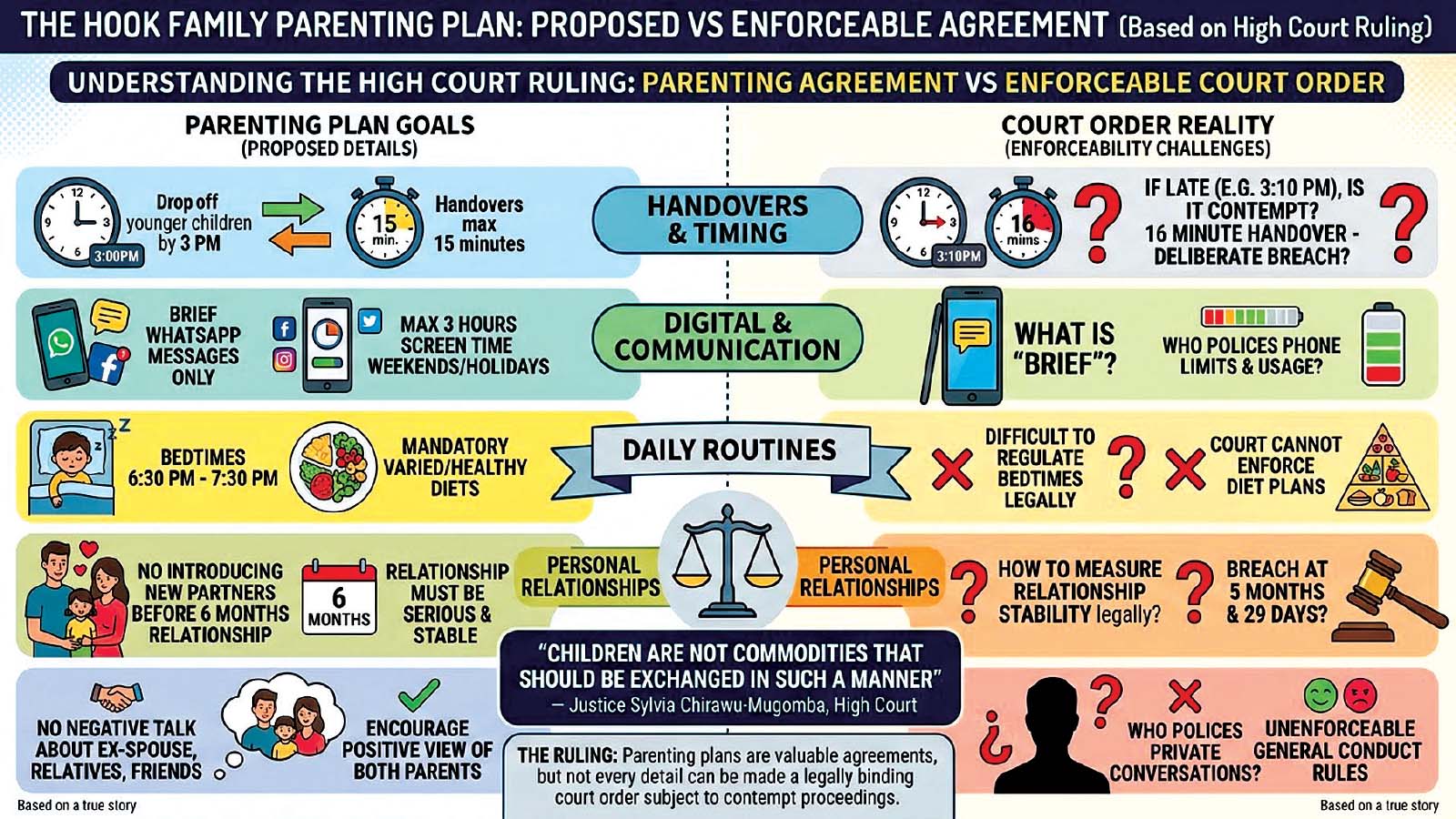
Fidelis Munyoro
Chief Court Reporter
A PARENT arrives 10 minutes late to collect the children.
Another sends a WhatsApp message that is too long.
A new romantic partner is introduced before a six-month relationship has run its course.
The children spend four hours on their phones instead of the permitted three.
In ordinary family life, these might be nothing more than disagreements between separated parents.
But put them into a court order and they can take on a very different meaning.
That is the legal dilemma the High Court in Harare recently confronted after refusing to turn a 10-page parenting plan agreed by a divorcing couple into an enforceable court order.
The ruling by Justice Sylvia Chirawu-Mugomba has drawn an important line between parents agreeing on how to raise their children and a court ordering them to do so under threat of contempt proceedings.
At the centre of the case were Ceileigh Hook, formerly McKersie, and Nathan King Hook, who were going through divorce proceedings.
After initially contesting the divorce, the couple eventually reached agreement on several issues, including arrangements for their four minor children.
Their agreement was remarkably detailed.
Signed on July 20, 2026, the proposed parenting plan attempted to regulate almost every aspect of the children’s lives between the two households — from school and weekend arrangements to discipline, bedtimes, screen time, communication between the parents and even the introduction of new romantic partners.
The mother asked the High Court to incorporate the plan into the divorce order.
On the face of it, there was little to quarrel about.
The parents had agreed to the arrangements, and they were intended to protect the welfare of their children.
But the judge began asking a deceptively simple question: What happens when one of these rules is broken?
That question exposed the problem with turning the detailed family agreement into a court order.
For example, the parents had agreed that neither would speak negatively about the other, or their relatives and friends, in the presence of the children.
The judge asked: “Who would police such a provision?”
Another clause required the parents to communicate respectfully through a “brief WhatsApp message”.
But what exactly is “brief”?
Five lines?
Ten?
Twenty?
And who decides when a message has crossed the line from brief to too long?
Then came the children’s handovers.
One parent was required to drop off the younger children by 3pm.
The judge asked a question that immediately illustrated the problem: “If dropped at 3.10pm, does that constitute contempt of court?”
The parenting plan also stipulated that exchanges at the parents’ homes should take no more than 15 minutes.
Again, the judge posed the obvious question: “If the exchange lasted 16 minutes, would that constitute contempt?”
The questions may sound almost comical when reduced to minutes and WhatsApp messages.
But legally, they were anything but trivial.
A court order must be clear enough for the person bound by it to know exactly what is required and for the courts to determine whether it has been breached.
“An order of the court must be specific and, more poignantly, it must be capable of being enforced,” Justice Chirawu-Mugomba said.
And that was where the parenting plan began to unravel.
It sought to regulate not only handovers and communication but also the parents’ future relationships.
Neither parent was to introduce a new partner to the children unless the relationship had lasted at least six months and was considered sufficiently serious and stable.
Again, the court was left asking how such a provision could be enforced.
How would a court determine whether a parent was “very sure” that a relationship would last?
What happens if a relationship that appeared stable suddenly collapses after five months and 29 days?
Would that make an earlier introduction of the partner a breach of a court order?
The plan similarly sought to impose a three-hour screen-time limit during weekends and school holidays, set bedtimes between 6.30pm and 7.30pm and require both households to encourage healthy and varied diets.
None of these is inherently an unreasonable parenting rule.
In fact, many parents would probably recognise them as sensible attempts to provide consistency for children moving between two homes.
The problem was legal enforceability.
Once such provisions are incorporated into a court order, deliberately disobeying them can potentially expose a parent to contempt proceedings.
That, the judge found, was too far a leap for the court to make.
Zimbabwe has no
parenting-plan law
The judgment also addressed a bigger legal question: whether Zimbabwean courts have a statutory framework allowing them to formally recognise standalone parenting plans in the way South Africa does.
They do not.
Zimbabwean law already provides mechanisms dealing with custody, guardianship and access.
Under the Guardianship of Minors Act, parents generally have equal rights of custody and guardianship unless a court orders otherwise. Access arrangements are also recognised.
But there is no equivalent of South Africa’s statutory parenting-plan regime.
The South African Children’s Act 38 of 2005 expressly provides for parenting plans and sets out matters they can cover, as well as formal requirements and mechanisms involving professionals such as family advocates, social workers and psychologists in specified circumstances. The Hooks’ proposed arrangement effectively sought to bring such an approach into Zimbabwean divorce proceedings.
The court refused.
The mother argued that the Matrimonial Causes Act allowed the court to recognise the parties’ agreement and also relied on Section 176 of the Constitution, which gives courts power to develop the law.
But Justice Chirawu-Mugomba found that what the authorities relied upon did not establish that standalone parenting plans were legally recognised in Zimbabwe.
The existence of previous cases in which parenting plans appeared to have been accepted did not change the position because, in the absence of written judgments explaining the reasoning, those matters could not establish a binding precedent.
The court, therefore, drew a distinction between parents making an agreement and the court converting every detail of that agreement into law enforceable through contempt proceedings.
The ruling does not prevent separated parents from agreeing on how their children should be raised.
They can still reach practical arrangements concerning custody, access, maintenance and the children’s day-to-day welfare.
But if those arrangements are to form part of a court order, the enforceable terms must be sufficiently clear and should be contained in the consent paper itself rather than hidden inside a standalone parenting plan.
Children are not clockwork
Perhaps the most important part of the judgment, however, had little to do with WhatsApp messages or the length of handovers.
It was about the children themselves.
The court warned against reducing the movement of children between separated parents to something resembling a tightly timed transaction.
“Children are not commodities that should be exchanged in such a manner,” the judge said.
That observation captures the tension at the heart of the case.
Family life is messy.
Children fall sick.
Traffic jams happen.
Parents get delayed at work.
School events change.
A five-minute conversation at a handover can sometimes be more important than sticking rigidly to a 15-minute limit.
Relationships change, too.
A court order, however, operates differently.
Its terms have legal consequences, which is why they must be sufficiently precise to enforce.
The High Court ultimately declined to make the detailed parenting plan part of the divorce order and struck the matter off the roll, with no order as to costs.