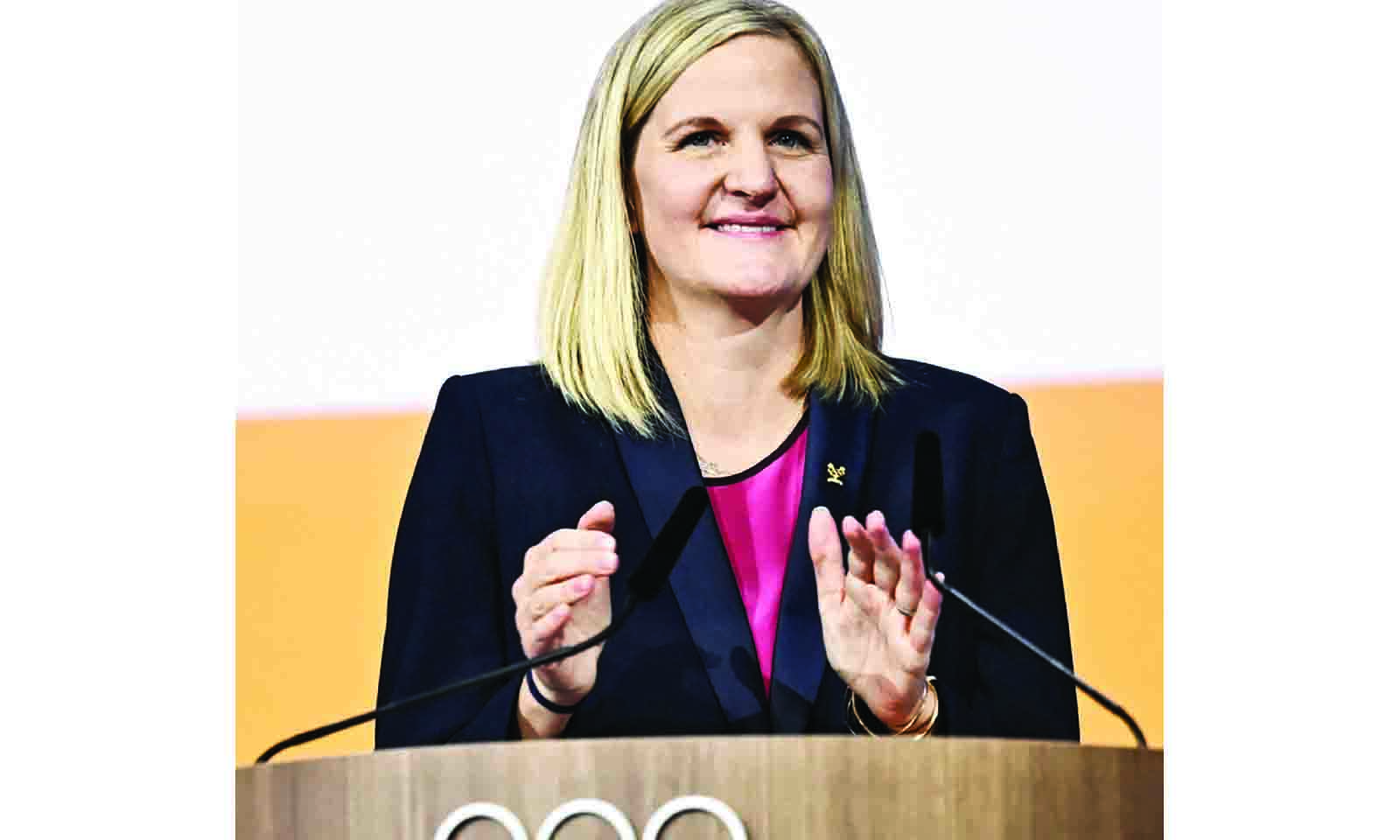
WITH 172 days until the Milano Cortina 2026 Winter Olympics, it remains unclear if Russian and Belarusian athletes will compete or under what conditions, posing an early and significant test for IOC president Kirsty Coventry’s leadership.
In an interview with L’Équipe, the newly elected IOC chief was cautious but unequivocal: “We have not made a final decision. Regarding Milano Cortina, I will not pre-empt the executive board’s decisions in September and December, but I anticipate that we will likely make a similar decision to that made for Paris.”
At Paris 2024, 15 Russians and 17 Belarusians were allowed to compete as neutral athletes, stripped of flag, anthem and national symbols.
Participation was conditional on sporting qualification, proof of no active support for the war in Ukraine, and no links to Russian or Belarusian military organisations. Zimbabwean Coventry has repeatedly defended that stance, telling The New York Times that “what we saw in Paris was, in my opinion, very fair”, stressing that the IOC’s duty is “to ensure that all athletes can participate.”
A COI spokesperson, quoted by the Russian outlet Vseprosport, reiterated that the “admission of neutral athletes” remains the baseline scenario for Milano Cortina. However, the official also pointed to ‘external factors’ that could influence the outcome. A final ruling is expected before the end of the year, following two key meetings of the International Olympic Committee Executive Board.
The route to the Games is further complicated by the position of international federations.
The International Ski Federation, which oversees more than half of Winter Olympic disciplines, continues to bar Russian and Belarusian athletes, as do biathlon and luge. figure skating, however, has not followed suit.
This fragmented stance makes qualification particularly difficult for many athletes from the two countries.
Michael Payne, the IOC’s former marketing chief, told AFP that Coventry faces a true “baptism of fire”.
“No matter what decision you take, there will be strong views and opinions. Various politicians will seize upon it, and not always in a complimentary way. You are walking on thin ice,” he warned, urging caution and consensus.
Terrence Burns, another former IOC strategist with long experience in Russia, said the country had yet to confront its actions, “There’s been no admission, no accountability. Zero. That leaves the IOC in a tough but manageable position. If Russia wants to rejoin, it’s going to have to demonstrate its willingness to change.”
Yet Burns also underlined Russia’s weight in the Olympic Movement. “The Olympics need Russia at the Games, just as they need the United States or China. The true Olympic ethos is “we all belong, or no one does’. That works in theory, in speeches and in marketing campaigns — but translating it into the geopolitical world is far harder.”
For Coventry, only weeks into her presidency, the stakes could not be higher. Balancing the universality of sport with the political realities of war is now at the core of her mandate.
As preparations accelerate in Italy, the question of Russian and Belarusian participation hangs heavy over the Winter Games, with clarity unlikely until the IOC delivers its decision later this year. — insidethegames.com