Chronicle Editor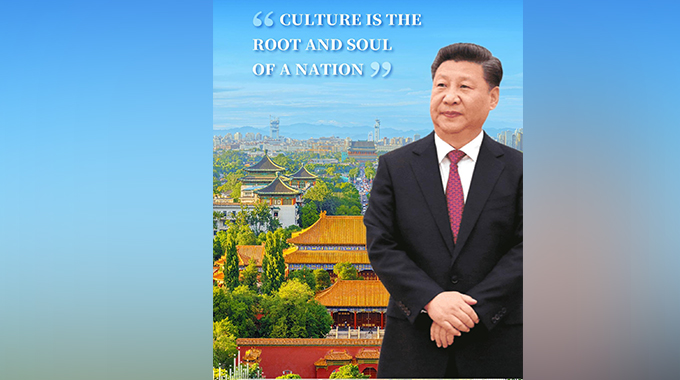
“Historical and cultural heritage belongs not only to us but also to future generations”
In summertime, the view from the top of the Jingshan Hill to the north of the Forbidden City is stunning. The deep red walls and royal golden tiles of the ancient Chinese palace under the blue sky form an image both powerful and solemn. Stretching southward are the Golden Water Bridge, Tian’anmen Square, and the Temple of Heaven…all quietly telling the grandeur and magnificence of the Chinese capital. From the Bell and Drum Towers in the north to the Yongding Gate in the south, this 7.8-kilometer-long Beijing Central Axis is recognized as the “soul and spine of the old city of Beijing,” and it’s also people’s deepest impression of the city.
At the 46th session of the UNESCO World Heritage Committee in July 2024, the “Beijing Central Axis: A Building Ensemble Exhibiting the Ideal Order of the Chinese Capital” was added to the UNESCO World Heritage List. In his congratulatory address to this event, Xi Jinping called for efforts to further strengthen protection of cultural and natural heritage and bring out the best of the ancient treasure for people today.
The construction of the Beijing Central Axis began in the 13th century. Much has it witnessed over the past 700 years, both the physical changes to the ancient capital and the uninterrupted inheritance of Chinese culture from one generation to the next. On many occasions, Xi Jinping strolled down the bluestone walks, following the central axis into historical alleys and courtyards. And while he did this, he chatted with residents in the neighborhood and encouraged better protection of the old city amid modern urban development. He said, “Our city has many historical structures, especially some old districts with a long history. These most precious things should not be destroyed due to rash decisions or ignorance.”
The UNESCO listing of the Beijing Central Axis is an epitome of Xi Jinping’s emphasis on the protection of cultural heritage. Over the years, his footprints have spanned the length and breadth of China, as he visited cultural heritage sites and explored the roots of Chinese civilization. He said: “Historical and cultural heritage not only vividly tells the past but also profoundly affects the present and future; it belongs not only to us but also to future generations.”
In August 2019, Xi Jinping visited the Jiayu Pass at the western end of the Ming Dynasty Great Wall on his inspection tour of Gansu Province in northwest China. The majestic Great Wall, like a giant Chinese dragon, runs through the millennia-old cultural roots of the Chinese nation. As he scaled the Jiayu Pass, and spotted the fortress and city walls beneath, Xi Jinping said: “When people mention China, they think of the Great Wall, and when they talk about Chinese civilization, they also think of the Great Wall. We must salute efforts to keep our history and culture alive and strong, and strive to preserve our roots for a prospering Chinese spirit.”
As the largest existing cultural heritage site in China, the Great Wall is a towering symbol of Chinese civilization and a window to appreciate China’s traditional culture. Between 1954 and 2022, the Badaling Great Wall in Beijing alone welcomed more than 520 leaders from various countries around the world. In 1984, then-US President Ronald Reagan climbed up the Badaling Great Wall during his first visit to China, after the establishment of diplomatic relation between China and the United States. Reagan later wrote in his memoirs: “Standing there and watching the Great Wall disappear between the mountains, I found there was hardly any word to describe my feelings. China is just like the Great Wall, great and profound.”
Over the years, Xi Jinping has placed great emphasis on the preservation and exploration of the cultural significance of the Great Wall, and the construction of the Great Wall National Cultural Park is just one example. Under his leadership, various sectors of the society have contributed to the protection of the Great Wall. From 2015 to 2023, a total of 1.06 billion yuan (about 149 million US dollars) were allocated in special subsidies to the protection work, and 289 Great Wall protection and maintenance projects were implemented. Scientific researchers employed advanced technology to break bottlenecks in conservation work, while more than 6,800 volunteers joined the patrols to ensure the preservation of the Great Wall.
In May 2024, villagers from Shixia Village at the foot of the Badaling Great Wall received a letter from Xi Jinping. Over the years, the villagers have voluntarily protected the iconic cultural heritage, and even formed an association for this mission. They picked up litter along the Great Wall and warned visitors of undeveloped sections. Xi Jinping praised their efforts and encouraged them to carry forward the Great Wall culture and keep telling the Great Wall stories. He said, “It is our common responsibility to protect and pass on this historical and cultural heritage.”
“China’s excellent traditional culture is the root and soul of the Chinese nation,” Xi Jinping said, “Only with cultural confidence can a nation stand firm and tall, and traverse great distances.” “Confidence in one’s culture is the most essential, profound and enduring source of strength for the development of a country and a nation. A culture that strives for progress and goodness is an important bond that connects the shared destiny and deep ties of a country and a nation.
“Let the cultural relics, the history and the culture speak for themselves”
Xi Jinping attaches great importance to cultural inheritance and development, saying that a profound understanding of the Chinese civilization helps to promote creative transformation and innovative development of traditional culture. He said, “We should bring to life the cultural relics housed in museums, the heritage spread across our vast land, and the writings preserved in ancient books.”
It is early summer on northwest China’s Qinghai-Xizang Plateau. Rapeseed flowers have come into full bloom, and they highlight the Qinghai Lake like a golden frame to a sapphire.
One day in early June, 2021, a Tibetan carpet production workshop in Qinghai buzzed with activity. Tibetan carpets of different sizes, colors and styles were proudly on display on the walls. On these carpets were woven images of flowers, birds, landscapes and much more, with styles spanning from the realistic to abstract, from traditional to modern.
Xi Jinping, who was on an inspection tour in Qinghai, walked into the workshop and took a keen interest in the carpet weaving process, occasionally touching the carpets to feel their texture.
On the Qinghai-Xizang Plateau, the art of weaving Tibetan carpets has been passed down from generation to generation for more than a thousand years. In 2006, “Jiaya Tibetan carpet weaving skills” were inscribed in China’s list of national intangible cultural heritage.
In the workshop, Yang Yongliang, the intangible cultural heritage inheritor of the Jiaya Tibetan carpet weaving technique, was teaching his apprentices step by step. Xi Jinping started a conversation with Yang and asked, “Is this craft something that’s been passed down in your family? How many generations has it been?” Yang replied, “I’m the seventh generation. I started learning how to wash wool and spin yarn from my father when I was eight.” Xi Jinping then asked, “How long does it take to weave a Tibetan carpet like this?” Yang answered, “It takes about a month for one person.” Hearing this, Xi Jinping nodded and replied, “This skill is precious and highly significant. We should inherit and promote it well.”
Because of its exquisite, unique traditional craftsmanship and high-quality raw materials, the Tibetan carpets produced by this company have traveled from the plateau to the rest of the country and the world. In 2020 alone, their products were exported to more than 40 countries and regions, including the United States, Europe and the Middle East, achieving an output value of 42 million yuan (approximately 6.17 million USD at that time).
Before leaving the workshop, Xi Jinping said to the workers gathered around him, “The Tibetan carpet is a very distinctive industry of our Tibetan ethnic group. Your company has established a brand in this field, perfectly combining traditional craftsmanship with modern technology, while meeting the demands of personalized and diversified markets.” Xi Jinping continued to say, “Developing industries is essentially about creating jobs. From this point of view, the Tibetan carpet industry not only helps to bring people out of poverty and boost rural vitalization, but also promotes ethnic unity.”
Over the years, Xi Jinping has encouraged and supported the revival of intangible cultural heritage, which enriches the lives of locals while promoting its inheritance.
On the eve of the Spring Festival in 2021, Xi Jinping visited a Miao ethnic township in the city of Bijie in southwest China’s Guizhou Province. On his tour, Xi Jinping went into a local Miao embroidery workshop. Miao embroidery was created and passed down by women of the Miao ethnic group over thousands of years. To this day, it continues to play an important role in the daily life of the Miao people.
While appreciating the exquisite handmade embroidered clothing and accessories, Xi Jinping chatted with the local villagers about the production process as well as the development of the Miao embroidery industry. He encouraged everyone to preserve and further develop this traditional cultural heritage. He said, “What’s traditional is also fashionable, Miao embroidery is both a culture and an industry. It not only carries forward ethnic and traditional culture, but also contributes to rural revitalization. Traditional ethnic culture like Miao embroidery must be kept alive and developed well.”
Xi Jinping’s encouragement and expectations inspired more young people to stay in their hometowns and engage in this local craft. In many Miao ethnic communities, intangible cultural heritage workshops and training centers were established, design teams were brought in, and e-commerce platforms were utilized to expand sales channels. The ancient art of Miao embroidery has been revitalized, while ethnic minorities in remote mountainous areas have also found a new path to prosperity.
China is a country rich in intangible cultural heritage. From traditional crafts to rituals and festivals, intangible cultural heritage represents the living expressions of China’s traditional culture in the modern era. With support and encouragement from Xi Jinping, efforts are being made to revitalize and utilize various intangible cultural heritage resources. Traditional ethnic arts, such as paper-cutting, wood carving, clay sculpture, straw weaving, and porcelain painting, have gradually grown into local specialty enterprises, leading to their better preservation and promotion via active learning and application.
“Civilizations have become richer and more colorful with exchanges and mutual learning”
In May 2023, the ancient city of Xi’an, capital city of northwest China’s Shaanxi Province buzzed with energy. At the Xi’an International Convention Center, the national flags of China and the five Central Asian countries fluttered in the gentle breeze.
In his home province of Shaanxi, Xi Jinping welcomed the leaders of the Central Asian countries to inaugurate the China-Central Asia Summit, where they engaged in discussions and drew a blueprint for deepening cooperation and building closer ties. In his keynote speech, Xi Jinping talked about the inheritance and development of the Silk Road. He said, “Xi’an, known as Chang’an in ancient times, is an important cradle of the Chinese civilization and nation. It is also the starting point of the ancient Silk Road on the east end. With the joint endeavors of the Chinese and Central Asian peoples, the Silk Road expanded and prospered throughout hundreds of years, making a historic contribution to the enrichment and development of world civilizations.”
Back in September 2013, Xi Jinping, then newly elected president of the People’s Republic of China, proposed the initiative of jointly building the Silk Road Economic Belt during his visit to Kazakhstan. Later that year, Xi Jinping also proposed the building of the 21st Century Maritime Silk Road during his visit to Southeast Asia, Over the past decade and more, the Silk Road spirit of peace and cooperation, openness and inclusiveness, mutual learning and mutual benefit has led various countries onto a path of common prosperity and opportunity, while promoting mutual learning and appreciation among different civilizations.
During the China-Central Asia Summit, President Kassym-Jomart Tokayev of Kazakhstan celebrated his birthday. Xi Jinping hosted a banquet in his honor, during which he said, “Today is your 70th birthday, I wish you a happy birthday. On this special occasion, your visit speaks volumes about the strength of our bilateral ties and reaffirms your unique bond with China.” “Xie Xie!” Tokayev replied with a much delightful “Thank you” in Chinese.
In his youth, Tokayev studied and worked in China for many years. He enjoyed riding a bicycle through the hutongs of Beijing and was also fond of traditional Chinese snacks. At the banquet that evening, Tokayev was served Shaanxi’s birthday special “longevity noodles” following Chinese custom.
At the Summit’s conclusion, Xi Jinping planted with his honored guests pomegranate trees, which were brought to China from Central Asia along the ancient Silk Road about 2,000 years ago. Today, the pomegranate blossom has become the official flower of the city of Xi’an.
As Xi Jinping has said, “Civilizations have become richer and more colorful with exchanges and mutual learning.” For him, this is not merely a belief, but also concrete actions. He said: “I have visited many places in the world. One of the best things I want to do is to learn about different civilizations, and to find out what makes each of them different and unique. I’m also interested in how the people living in these civilizations view their world, their outlook on life, and their values.”
For many years, Xi Jinping actively engaged in “cultural diplomacy”, and has been passionate about promoting dialogues and exchanges between different civilizations. In Mexico, he strolled through the ancient Mayan ruins of Chichen Itza; at the College of Europe in Bruges, Belgium, he used tea and wine as metaphors to explain the similarities and differences between Eastern and Western civilizations; in Fiji, he wore the traditional Fijian “Bula” and listened to Fijian aborigines express their sincere blessings in songs; and in Saudi Arabia’s “Murabba Palace,” he danced with the locals and guests.
In Greece, a country at the crossroads of the Silk Road Economic Belt and the 21st Century Maritime Silk Road, Xi Jinping spearheaded in person the founding of the Center of Chinese and Greek Ancient Civilizations. In his reply to a letter from Greek scholars in February 2023, Xi Jinping said, “…human civilization has thrived and prospered through inclusiveness and openness…to solve salient problems facing mankind, not only material means are needed, but spiritual strength is also important to nurture a lofty mind and a sincere heart.”
Stelios Virvidakis, professor of philosophy at the University of Athens, shared his joy upon receiving Xi Jinping’s response letter. “That is a very nice feeling, if you can imagine, of being honored by his response. Culture expresses values and these values are the power of the spirit, or soft power. Soft power, which, hopefully, can attract people’s attention and also help them change their lives.”
Ending
“Without an ethos, a person cannot stand firm, nor can a country be strong” Xi Jinping says. For him, the prosperity of a country and a nation is always manifest in the prosperity of culture. “Culture is the root and soul of a country and a nation. Our country will thrive only if our culture thrives, and our nation will be strong only if our culture is strong.”
At a time when the future of all countries is closely connected, inclusive coexistence, and mutual learning among different civilizations not only go hand in hand with the development and progress of each country and nation, but also provide an important driving force for world peace and development.


 Online Reporter