admin
admin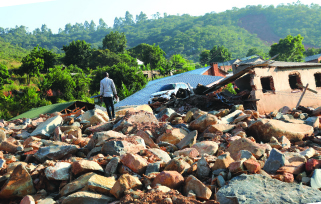
Ray Bande
Senior Reporter
ELEMENTARY development studies teach that recurring disasters have four phases – mitigation, preparedness, response and recovery.
Disaster researchers term this the “disaster life cycle” or “disaster continuum”, meaning that in recurrent disasters, communities are always in at least one part of the cycle.
It is against this background that after the devastating Cyclone Idai of March 15, 2019, the recovery stage of the disaster cycle went in motion.
When Cyclone Idai struck Zimbabwe, affecting about 270 000 people in the process, the storm and subsequent flooding as well as landslides left close to 350 people dead.
Many others went missing.
Agriculture, schools, health facilities and road infrastructure were severely destroyed. Many people lost their homes, with Chimanimani and Chipinge Districts being the worst affected.
Three and half years down the line, The Manica Post looks back and assesses the efforts that have been done by Government, civic society and development partners in the recovery process following the devastating tropical storm.
Provision of decent shelter
Guided by the build back better principle, Government was faced with the cumbersome task of ensuring that the survivors of the tropical storm had decent shelter.
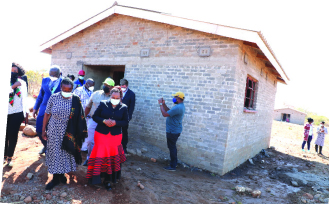
While it took longer than expected for affected families to move from tents to decent structures, Government worked tirelessly and constructed houses for survivors of the tropical storm in Runyararo Village near Nhedziwa Business Centre in Chimanimani District.
Makeshift tents were decommissioned in August last year.
Engineer Tendai Chiwanza, the Provincial Public Works Director for Manicaland said 135 houses have been completed at Runyararo Village.
“We are constructing 40 more houses and procuring of materials for another 20 is being done with an intention to complete them by July. The plan is to construct 40 more houses from August to November. We need to construct 224 houses,” said Engineer Tendai Chiwanza.
Secretary for Manicaland Provincial Affairs and Devolution, Mr Edgars Seenza weighed in: “What is also important to note is that the provision of decent accommodation has been internally funded by the country’s central authority.
“I think we did well. Remember we had partners that had promised us that they would cover the construction of the houses, but failed when Government was already focusing on other facets of the recovery process.”
Education for all
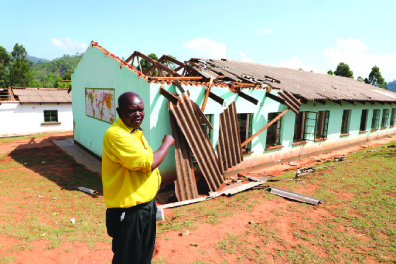
After learning was disrupted for more than six months, several partners came to the rescue of learners.
Acting Manicalad Provincial Education director, Mr Richard Gabaza, confirmed that apart from Government efforts, development partners and corporates helped in restoring normalcy in the education sector after Cyclone Idai.
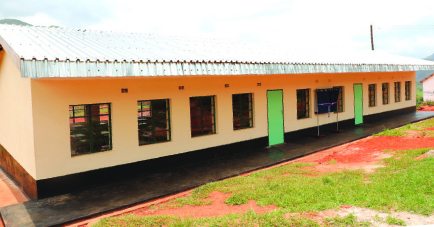
Among other interventions in different areas in Chimanimani and Chipinge, Government has overseen the construction of a new school for the displaced at West End Farm School (now Runyararo Primary), which is now underway with three blocks and a toilet already completed.
The country’s leading diversified media company, Zimpapers, constructed a classroom block at Chikukwa Primary School and provided computers, printers and stationery for the learning institution.
Plans by the company to donate more computers and construct a computer lab at the school are already at an advanced stage.
Development partner, Terres De Homes spearheaded the construction of toilets at Marirwe, Tarka, Tiya, Shinja, Thorton and Cecilton Primary Schools; as well as classroom blocks at Kwirire, Thabanchu, Ndima and Chayamiti Primary Schools and at Mhakwe Secondary School.
They also provided textbooks, stationery and furniture.
At Mutsvangwa Primary School, a semi-detached teachers’ house which can accommodate four families, tiled with flush ablution systems and a ceiling, was funded by United Methodist Church’s Chabadza Programme in partnership with the Norwegian community.
Ndieme Primary School had a classroom block constructed with assistance from UMC’s Chabadza.
While the list goes on and on, what is clear is that in the spirit of leaving no one behind, a lot has been done to see the school children in Chimanimani enjoy their right to education.
Provision of decent burials
One of the ways of measuring the civilisation of any given community is the way it buries the dead.
Zimbabwe is no exception.
The bodies of the victims of Cyclone Idai were buried soon after the tragic event.
However, quite a number were washed away into Mozambique and since March 2019 when Cyclone Idai hit the country, those washed away into the neighbouring country are yet to get a decent burial back home.
While efforts are still underway to accord a decent burial to our brothers and sisters, Mr Seenza acknowledged the need to move with haste to bring closure to the sad episode.
“We are moving ahead with the plans to rebury our departed brothers and sisters who were swept away during the Cyclone Idai disaster. The good thing is that the remains have been kept in one place by our friends in Mozambique. We understand the need to put closure to this matter,” he said.
Mr Seenza said blood samples of relatives in Zimbabwe have already been taken so that they are matched with the remains of the deceased.
“We are at an advanced stage and blood samples of relatives here have already been taken so that they are matched with the remains of the deceased. A team has been put in place to visit Mozambique to do the exhumation. We are looking forward to have that done next month and the whole thing should be through before the end of this year,” said Mr Seenza.
Highway to success
When Cyclone Idai hit the country, Chimanimani District was cut off from the rest of the world as it was left inaccessible after bridges were washed away. Roads were impassable due to mudslides.
Substantial amounts of financial and material resources have been channelled towards restoring the road network in Chimanimani and Chipinge.
Mr Seenza said a number of crucial roads linking different areas within Chimanimani District as well as those linking Chimanimani with the rest of the country have been refurbished.
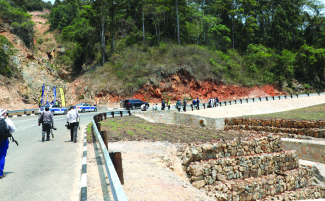
“A lot has been done to restore normalcy in the road network in Chimanimani District in the aftermath of Cyclone Idai.
“We worked on quite a number of roads, including the Kopa-Jopa Road, Wengezi to Skyline Junction down up to Ngangu Township. Bridges that were washed away have since been replaced in a much better way than they were before.
“Most of the roads in urban Chimanimani area were refurbished because when the tropical storm hit the area, most of the roads were left impassable.” Said Mr Seenza.
However, he said there is still more ground to be covered.
“We are aware that there is still more work to be done. Along the Cashel-Chimanimani Road, work is in progress and a contractor has already been identified,” he said.
Life after Idai
From the lessons learnt during the devastating Cyclone Idai, a number of measures have been put in place to ensure that there is minimal damage to human life and infrastructure if such a calamity ever befalls the country again, especially in the south eastern parts which are prone to natural disasters.
For example, the ongoing establishment of community radio stations are part of Government’s disaster preparedness and response plans.
Addressing delegates during a pre-event briefing as Zimpapers handed over computers to Chikukwa Primary School recently; Information, Publicity and Broadcasting Services Minister, Senator Monica Mutsvangwa said community radio stations are a crucial component of disaster preparedness.
“We should always remember that these community radio stations are there to better our communities. In fact, community radio stations are part of Government’s efforts to ensure that we have effective disaster preparedness and response mechanisms after the lessons learnt following events that occurred during Cyclone Idai,” she said.
Apart from the establishment of radio stations, disaster preparedness mechanisms through sound early warning systems have been activated as witnessed during recent tropical storms that were, however, not as devastating as Cyclone Idai.
These are just some of the things that have been done by Government and its development partners to help the people of Chimanimani dry their tears as they traverse the road back to normalcy.


 Online Reporter