Online Reporter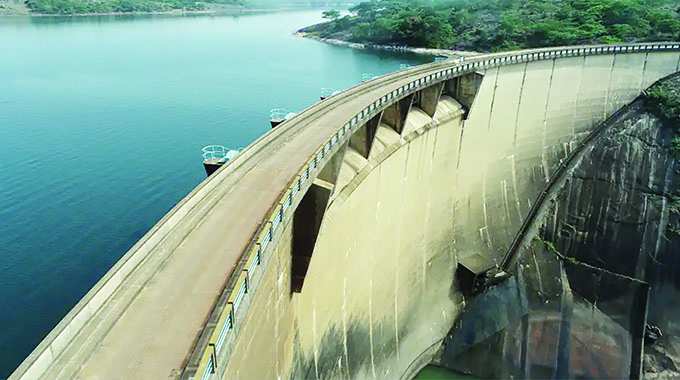
Zvamaida Murwira
DAM construction across the country, embarked upon by the Government, is set to revolutionise the country’s industrialisation and modernisation agenda by turning most rural communities into greenbelts, thus setting the tone for rapid economic development and transformation.
The Second Republic, led by President Mnangagwa, has embarked on dam construction across the country as part of a greater and deliberate effort to contain the effects of climate change that has seen low agricultural yields owing to subdued rainfall, which has not only affected Zimbabwe but also the southern African region.

Over the years, the Second Republic has ushered in life-changing projects and even seen through the completion and progression of some that had been stagnant before the new dawn.
Instead of perennially relying on rain-fed agriculture, the Government has thought outside the box, taking on massive dam construction to harness the much-needed water to anchor its elaborate and various agricultural schemes, including Pfumvudza/Intwasa.
Dam construction works being spearheaded by the Zimbabwe National Water Authority (Zinwa) have been touted as the panacea to economic growth and an anchor of the desire to become an upper-middle-income economy by 2030.
Some of the dams that come to mind are Tugwi-Mukosi, Kunzvi, Dande, Gwayi-Tshangani, Marovanyati, Mbada, Bindura, Defe, Tuli Manyange, Muchekeranwa, Semwa, and Vungu.
Dams can significantly boost the agriculture sector by providing crucial water resources for irrigation, which leads to increased crop yields and agricultural productivity.
They also offer benefits, like flood control, hydropower generation, and livestock watering, making them a key tool for rural development and economic growth.
In an interview, Zinwa spokesperson, Mrs Marjorie Munyonga, said the water utility was preoccupied with full provision of water to communities, given that it cuts across all economic sectors.
“Water security undoubtedly occupied a central place in the attainment of the Government’s broader vision to transform Zimbabwe into an upper-middle-income economy by 2030.
“Water is expected to continue playing an important role in a diverse range of sectors, such as agriculture, food security, urban water supply, energy, health and sanitation, manufacturing, tourism, and recreation”, said Mrs Munyonga. “It is against this background that the Government, through Zinwa, is spearheading the construction of dams across the country.”
She added that water was an enabler whose effect in transforming lives could not be underestimated.
“With water being a vital economic enabler, the completion of these signature and game-changing projects will certainly have a multiplier effect on the country’s economic trajectory. Already, the projects have had a profound impact on communities through employment creation, and provide a ready market for local businesses and farmers,” added Mrs Munyonga.
Harare and Bulawayo have, in recent years, been experiencing water shortages due to continued population growth, which has not been backed by corresponding development in water infrastructure and sources.
The Second Republic has since moved in through the construction of Lake Gwayi-Tshangani for Bulawayo, and Kunzvi Dam for Harare.
At 59 percent completion, the construction of Kunzvi Dam has since gathered pace.
Zinwa resident engineer for Kunzvi Dam, Davison Madondo, said works were going on well.
He said construction of initial houses for families due for relocation had commenced, while resources to relocate the remaining families were being pursued.
Eng Madondo said the Government, through the Ministry of Local Government and Public Works and other ministries and departments, was seized with the issue of relocation under the whole Government approach.
However, the delay has affected work in some areas as the contractor awaits the removal of people in the given areas.
Construction of houses for families in the spillway area has since started, a development that has spawned excavation work after it was stalled owing to health and safety fears.
Each new home will feature a round kitchen, a three-bedroomed house, and a Blair toilet, in addition to a granary, perimeter fence, and access to a communal borehole.
“We are quite excited about the progress. Working on the spillway had been delayed due to the families’ presence”, Eng Madondo said.
“Now that construction of their alternative homes has begun, they are more agreeable to the works proceeding.”
Approximately 450 families will be relocated in phases to ensure uninterrupted progress on the dam.
“We still have families residing in the borrow area — where we get materials, like quarry, and those in the dam basin that ought to be relocated. Our goal is to complete the dam this year, and we remain hopeful that resources will be provided on time,” he added.
Current activities at the site include excavation on the main dam, embankment placement, outlet works excavation and reinforcement, and construction of access roads.
Makomo Engineering manager, Mr Penghui Tang, said they were working around the clock to have the project completed, so that it serves the purpose for which it was established.
“We are working hard to ensure that the job is done. We are committed to completing the project, and we are happy with the support we continue to get from Zinwa and the Government in general,” he said.
Mbada Dam in Muzarabani, Mashonaland Central Province, has also been a source of optimism for local communities as the US$270 million project promises to transform the dry but fertile region into a thriving greenbelt and catalyst for rural development.
The dam excited Special Advisor to the President on Monitoring and Implementation of Government Projects, Dr Joram Gumbo, who toured the site and emphasised how it dovetailed into the National Development Strategy 1 and the Government’s thrust for an upper-middle income economy by 2030.
The pace at which the Second Republic is spearheading dam construction demonstrates that Zimbabwe is slowly turning the corner to become a greenbelt, ensuring food security.