Online Reporter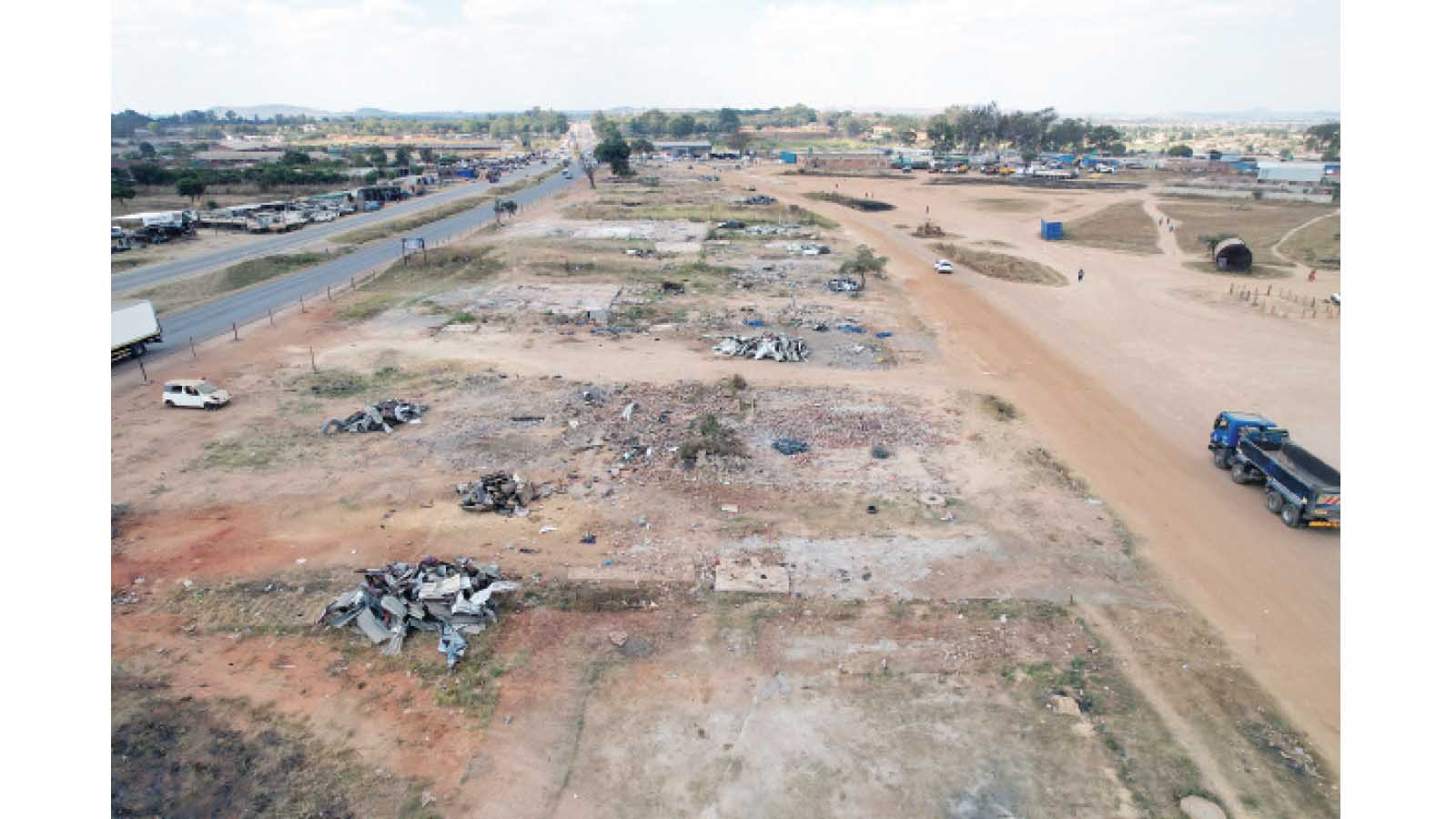
Roselyne Sachiti
Day Editor
THE Messenger of Court, escorted by the police, arrived with a court order on the morning of Thursday, May 28. Within hours, more than 300 illegal structures and tuck shops along Bulawayo Road and Ordlands Road in Whitecliff had been reduced to rubble and twisted metal.
For Eddies Pfugari Properties Pvt Ltd, the lawful owner of stand number 10139, Whitecliff, the eviction was a long-overdue victory against land barons.
The court order, granted by Harare magistrate Talent Mutasa in January last year against Rodgewene Mubaiwa and six accomplices, had gathered dust for over a year until it was finally enforced.
“They had invaded the commercial area, the stretch along Bulawayo Road and Ordlands Road. Over 300 structures had been built and were controlled by a few people who were collecting rentals from every stall, purporting to be given authority by the Ministry of Transport just to tarnish the image of the Government,” said Percy Chitima, general manager of Eddies Pfugari Properties Pvt Ltd.
Each tenant, he told The Sunday Mail Society, paid between US$250 and US$300 per month to the land barons for a container shop with no water, no toilet and no lease agreement.
This meant the land barons pocketed approximately US$90 000 per month.
Other shops were illegally built a few steps from the road on the turn-off into Whitehouse, using thin metal roofing sheets and some plastic and poles, making the area an eyesore.
It was organised chaos. While the demolition restored Eddies Pfugari Properties Pvt Ltd’s rights, many are asking whether this is the last cycle of demolitions of illegal tuck shops at Whitecliff and other areas in Harare and Norton that face a similar problem.
Same script, different lines
The Whitecliff eviction followed a familiar script. Many court papers had been filed in the past with no success.
However, the structures remained.
The land barons continued collecting rent. By the time the Messenger of Court acted, over 300 containers and makeshift tuck shops had transformed a five-hectare servitude into a bustling — but illegal — commercial hub.
“It is so unfortunate how those guys managed to scam people with no papers, but you see structures being erected,” Chitima said.
“The Government has been making efforts to fight land barons but the people sometimes slip through.”
The affected tenants, many of whom claimed ignorance of the illegality, were the sole losers.
“You are operating a shop and you do not pay to the council for licensing or anything? There is no water, no toilet and you would wonder where one goes to relieve oneself.
“You are just in a container. You are there and calling it a shop. Your shop should be proper; it should be built properly,” he said.
Others, Chitima noted, later approached his company, saying they knew what they were doing was illegal, but were now seeking to be accommodated by the firm.
“Some even started approaching us as early as yesterday (May 28) after the demolitions to say, ‘Why can’t you do something?’
“We trust that if we have a point of convergence where we meet and set out our ideas, we come out with something nice that will benefit both affected and new entrepreneurs.
“As you know, we have always been supporting the President’s Vision 2030. We support the empowerment of everyone — that is how our nation grows. We are happy with the Government’s intervention so that things can be done in an orderly manner,” added Chitima.
“We have home industries for the purposes of such empowerment. We can lease them out properly where the facilities are there.”
The developments at Whitecliff reveal a critical policy gap.
The traders were willingly paying land barons. The situation could be the same in many areas where illegal tuck shop owners are operating.
A city under siege
Whitecliff is not an isolated incident.
Across Harare and Norton, a multi-front battle is being waged against illegal structures.
Land barons operate with impunity.
In Westgate, organised individuals occupied a Windmill (Pvt) Limited property using purported Government offer letters, illegally parcelling out industrial land despite contradictory court orders.
Along Kirkman Road, opposite the Madokero Mall, the informal sector is booming, with tuck shops and tyre traders among the common features on the road servitude.
The land barons are cunning. They have weaponised a provision in the country’s Constitution that demands a court order before any demolition.
They rush to build permanent structures, secure interdicts and tie up landowners in litigation for years — collecting rent from unsuspecting tenants.
Council enforcement is relentless but reactive.
In April 2026 alone, the City of Harare bulldozed illegal tuck shops at the Mabelreign Shopping Centre and cracked down on makeshift shebeens in Borrowdale and Mandara.
The Mabelreign shops, built in a space reserved for a car park, were put up by a councillor who claimed he had legal authority to do so.
It took residents’ complaints to demolish them.
In Katanga, Norton, several tuck shops built illegally have been razed several times but mushroom again months later.
The pattern is consistent.
There is a cycle of demolition and illegal reoccupation. The process starts with illegal occupation, a court order, demolition, displacement and then reoccupation elsewhere. The cycle never ends because the underlying policy gaps remain unaddressed.
Spatial town planner Shingai Kawadza said the ongoing demolitions highlight a broader spatial planning challenge confronting Harare and many African cities, which has seen the rapid growth of informal economic activities without a corresponding increase in legally designated and serviced trading spaces.
He said the issue is not merely one of enforcement, but of spatial planning, economic inclusion, public safety and urban governance.
“Local authorities must acknowledge the fact that informal trading is a permanent feature of Zimbabwe’s urban economy rather than a temporary phenomenon.
“The challenge is, therefore, to regulate and accommodate it rather than continuously remove it,” he said.
Many cities, Mr Kawadza added, have introduced specific zoning categories such as informal trading zones, mixed-use corridors and market overlay zones.
“The City of Bulawayo is a typical example closer home. There is also considerable need to provide fully serviced markets in the form of shared ablution facilities, waste collection points, water access points, portable kiosks, et cetera.
“The objective should be planned informality rather than unregulated informality — something that I am sure the recently completed master plans across the country captured and recommended for such initiatives,” he said.
Special economic zones (SEZs) alone, he said, cannot solve informal trading pressures in Harare’s central business district (CBD) and residential areas.
“However, strategic economic growth nodes could reduce excessive concentration of employment opportunities within central Harare. A polycentric urban model creates multiple employment centres, reducing migration pressure and demand for informal trading space in the core city,” he explained.
He suggested moving from demolition-led enforcement to planning-led management.
“I am on record saying demolitions address symptoms rather than causes. A preventative planning model should include informal economy forecasting, land reservation policies, data-driven enforcement rather than indiscriminate demolition. The objective should be regulation first and demolition as a last resort.”
He added that road servitudes exist to protect current and future transport functions.
It is believed that structures built within servitudes create numerous risks related to traffic safety, emergency access, infrastructure protection and future road expansion.
“Illegal structures can impede maintenance and increase infrastructure failures. Normally, occupation of servitudes raises future compensation costs and delays strategic road upgrades.”
Zvimba Rural District Council (RDC) chief executive officer Mr Enias Chidhakwa said the problem of tuck shops was addressed during the 2005 Operation Murambatsvina following a Government directive to clean up cities.
In Whitecliff, he said, people set up tuck shops on road servitudes without permission from the landowner and also ignored council by-laws.
He confirmed that some of the people whose tuck shops were razed at Whitecliff have moved on and are now operating across Bulawayo Road.
“The people who were evicted by Pfugari immediately moved opposite Bulawayo Road, the Whitecliff Garikai side. Pfugari Properties could no longer develop their land as a result of the invaders. Accessibility had also become difficult,” he said.
He said normal processes are used to obtain legal trading licences for small businesses from the Zvimba RDC.
These, he added, include an approved plan, permit and occupation certificate.
However, he noted, these processes happen under normal circumstances.
“In the Whitecliff case, we heard people were paying rentals to land barons; we do not know who these are. There were people who claimed to have raided the area and were allocating space to people. Council was not involved in the whole process. We could have made them pay penalties. Under normal circumstances, they were supposed to apply to council, get permission to operate from the property owner, then apply to council for a temporary permit. They were supposed to have temporary permits because that area is reserved for roads. There is no way they would have had permanent occupation of those areas,” added Chidhakwa.
He also said the council negotiated for land with Eddies Pfugari Properties, who had committed to clear land designated for flats.
“The land was cleared, but the traders refused to move there. Council is willing to assist. The developer can develop a state-of-the-art informal trading centre, where we do licensing and he collects rentals from traders.
“He can build cubicles where these people can work from. The problem is people do not want to pay formally. If the property developer comes and provides space, then we plan to accommodate as many people as possible.”
He said the Whitehouse evictions were overdue.
“Informality is there, but it will involve being chased each time the space is due for formalisation. The recent evictions were long overdue.
“As council, we are going to pursue where they are now operating from and penalise the property owners, but those on road servitudes will be removed.
“It is dangerous — imagine if there is a road traffic accident or a fire like those that happen in the Glen View area. No one can be compensated, and no one will insure something that is on a roadside.”
What the SADC region
teaches us
Zimbabwe’s neighbours have faced similar challenges.
South Africa is overhauling its regulatory framework, according to SABC News.
The Business Licensing Bill (2025) empowers local councils to issue preferential licences, simplifying entry for small businesses. Crucially, courts do not only enforce the law; they also enforce accountability on municipalities.
Namibia offers the most progressive shift.
The Ministry of Urban and Rural Development is revising municipal bylaws to protect street vendors’ rights and dignity, the Windhoek Observer reported in September last year.
The City of Windhoek is moving from control-orientated enforcement to a supportive approach.
According to Kawadza, experience across Africa and Bulawayo in particular suggests that informal traders can succeed when located near customer flows.
He said the markets should be affordable to traders, supported by infrastructure and developed in consultation with traders.
“Many designated markets fail because traders are often relocated to peripheral areas with low foot traffic. Successful examples in Southern Africa include Durban and Lusaka, where street trading has been integrated into urban management systems and municipal markets accommodate thousands of traders, respectively,” he added.
He said Durban, Cape Town, Johannesburg, Lusaka and Windhoek have all developed designated open markets and, small and medium enterprise (SME) trading facilities linked to economic development strategies.
“The spatial development framework for Harare does not need to reinvent the wheel. It must include recognising informal trade as a land use category, mapping current and future trading hotspots, allocating land for neighbourhood markets and developing urban economic corridors linked to public transport routes,” Kawadza said.
Micro-enterprise special economic zones
Several successful initiatives across Africa have also demonstrated how designated trading zones for micro-enterprises and informal traders can work.
According to Urbanet, South Africa’s Galeshewe Trader’s Hub, built from recycled shipping containers, offers lockable shops with electricity, water, sanitation, storage and WiFi, linked to a small, medium and micro enterprise (SMME) incubation programme. The project shows how sustainable design and business support can revitalise a township’s economy and draw traders from informal taxi ranks.
The New Times reported that Kigali built 28 mini-markets for 4 200 former street vendors, offering free first-year stalls, low-interest loans, licence fee waivers, financial literacy training and savings groups.
In 2024, the Chiredzi SMEs Centre — a public-private partnership between the Chamber of SMEs and the town council — provided 300 SMEs with decent working spaces, enabling formalisation, Zimbabwe Revenue Authority (ZIMRA) registration and tax payments that now contribute to the national economy.
The Government’s positive steps — the reconstruction of Mbare Musika and the National Social Security Authority (NSSA)’s US$5 million initiative to build formal market stalls — must be rapidly scaled across all high-density suburbs and commercial nodes. Each demolition should trigger a parallel construction of legal trading spaces within a two-kilometre radius.
As Chitima pointed out, convergence is important. It is precisely what policy must enable.
Zimbabwe does not need fewer demolitions. It needs smarter demolitions, which are preceded by a plan, accompanied by an alternative and followed by formalisation.
The rubble in Whitecliff offers a lesson that without policy reform and implementation, the bulldozers will return, again and again, to clear structures that should never have been built in the first place.
Feedback: roselyne.sachiti@ zimpapers.co.zw