Online Reporter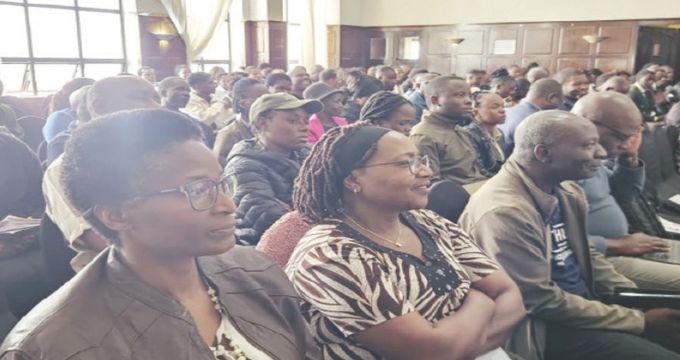
Judith Phiri, [email protected]
THE Government has called on local universities to develop Zimbabwe rangeland solutions that focus on sustainable management, restoration and protection, capitalising on heritage-based education 5.0.
This comes at a time when Zimbabwe’s rangelands, the backbone of national livestock production and rural livelihoods, have become heavily degraded.
This degradation has been driven by overgrazing, periodic droughts, uncontrolled veld fires and illegal artisanal mining. The degradation severely threatens rural livelihoods and national food security.
Spanning predominantly across the semi-arid and arid agro-ecological zones (natural regions 3, 4, and 5), these vast grazing lands support over 1,5 million smallholder farmers and sustain the country’s wildlife-based economic systems.
The Deputy Minister of Agriculture, Mechanisation and Water Resources Development, Davis Marapira, has called for the improvement of rangelands across the country.
“We need more research and innovation, not on paper but on the ground. We can have brilliant ideas on paper, but if we do not implement them, it will be a waste of time. Celebrating the recent International Year of Rangelands and Pastoralists (IYRP 2026) should be a clarion call for us to do something on sustainable management, restoration and protection of our rangelands,” he said.
He called on the National University of Science and Technology (NUST) and Chinhoyi University of Technology (CUT), among other tertiary institutions that were present for the IYRP 2026 commemoration, to go out, gather information and develop research that will yield practical solutions.
The Deputy Minister said for generations, agro-pastoralists have been portrayed as marginal or backward, while this narrative overlooks their incredible resilience, complex resource management systems and vital role in food security as well as climate adaptation.
He added: “I recently had a chance to go to the Nyozani rangeland regenerating site in Ward 18, Insiza District of Matabeleland South Province. They are regenerating a rangeland and there is also a wetland there. We can see that Zimbabwe has good natural resources which we want our children to inherit and understand why they are still kept like that.”
Deputy Minister Marapira said if enough research and innovation are put into practice, the Nyozani rangeland regenerating site can be improved.
He said Government intends to set up one of the best demonstration plots for grasses in the country in that area, while also incorporating a Village Business Unit (VBU) which will benefit three villages that make use of the area.
“There is a need to collaborate to make it what we want it to be. Include the youth as well so that they learn and are able to pass on the information to the next generations on how to preserve and manage rangelands and wetlands that play a critical role in the ecosystems central to both rural incomes and national food security.”
Food and Agriculture Organisation of the United Nations (FAO)’s Assistant Representatives-Programmes, Ms Tendai Munyokoveri called for urgent global action to protect rangelands and strengthen pastoralist livelihoods.
“Climate change, droughts and land degradation threaten ecosystems and food systems worldwide. Rangelands are critical for livestock production, biodiversity and climate resilience and we applaud community-led restoration successes in Ward 18, Insiza District,” she said.
Ms Munyokoveri said globally, rangelands cover nearly half of the earth’s land surface and support about 2 billion people, while they contribute significantly to food systems, biodiversity conservation, carbon storage and water regulation.
She said in Zimbabwe, the rangelands are the backbone of the livestock sector, providing over 60 percent of feed requirements as well as supporting rural livelihoods through ecosystem goods such as water, timber and non-timber products like mopane worms and thatch grass.
“They are also rich in indigenous knowledge systems that remain critical for sustainable livestock and ecosystem management. However, we all know these ecosystems are under pressure and we understand the effects of climate change through drought, floods and increasing variability,” said Ms Munyokoveri.
This, she said, had accelerated rangeland degradation, reducing grazing resources and threatening livelihoods, livestock and wildlife.
“We also acknowledge that rangelands are a present solution. When sustainably managed, they enhance soil health, sequester carbon, protect biodiversity and support resilient livelihood systems”, said Ms Munyokoveri.
She said pastoralist communities play a critical role in maintaining this balance and, as FAO, their message was to emphasise that rangelands are a vital ecosystem for food security, biodiversity conservation and climate resilience.
The acting dean of the Faculty of Agriculture Science and Technology at NUST, Professor Allan Sebata, said they were backing the drive with field research to identify drought-tolerant grasses suited for different agro-ecological regions.
“As tertiary institutions we do a lot of work on rangelands, so when we are at this function we are trying to share knowledge on rangelands. This is an opportunity to reflect on the state of our rangelands, how good they are and how best we can improve them so that we increase our livestock production activities,” he said.
Prof Sebata said they have conducted research on the management of rangelands, and one of the works that they have done is on holistic grazing management, where they have researched a project called short-duration overnight cattle kraaling.
He said they have worked with the Shangani Holistic and the Nyozani community on their concept, which aims to improve the productivity of rangelands using livestock.
“Normally we view livestock as the cause of grazing degradation, but we are saying let us look at it from a positive perspective where we use the same livestock to improve rangeland productivity. So that is the
work that we are trying to work on, and trying to make farmers understand that you can use the livestock to actually improve the rangelands.”
The International Livestock Research Institute (ILRI) Zimbabwe country representative, Professor Sikhalazo Dube, called on the Government to strengthen rangeland governance to empower local pastoralist communities and implement participatory management frameworks.
“They sustain livestock, support rural livelihoods, conserve biodiversity, and strengthen food and nutrition security. For Zimbabwe, in our semi-arid and drought-prone areas, livestock are a critical source of income, savings, nutrition, manure, draught power and resilience. Yet these benefits depend on the health of the grazing lands that feed our animals,” he said.
“The Government must continue strengthening extension support, rangeland governance, climate-smart livestock policy, and investment in restoration, water systems and livestock feed resources.”
He said when rangelands are degraded, farmers feel the impact immediately: pasture becomes scarce, animals walk longer distances for feed and water, body condition declines, reproduction suffers and drought losses increase.
Prof Dube said climate change was intensifying these pressures through more frequent dry spells, erratic rainfall and higher temperatures.
“This is why rangeland rehabilitation must be seen as a national resilience investment. Restoring degraded grazing areas, strengthening community grazing plans, improving water-point management, protecting key grazing resources and supporting fodder and forage production can help livestock systems recover and withstand climate shocks,” he added.
He said ILRI’s work in Zimbabwe has consistently emphasised this connection between healthy landscapes and productive livestock.
Prof Dube said through partnerships with Government, communities, universities and development actors, ILRI has supported approaches that link grazing management, community-based natural resource planning, livestock feed improvement, and climate resilience.
The IYRP 2026 commemoration and conference was convened under the theme: “Regenerating shared landscapes – integrating emergent outcomes from pastoralist lifestyles for prosperity, sovereignty and resilience.”
The event was jointly organised by Grazing Concepts, Shangani Holistic, the FAO-Zimbabwe Office, in partnership with the Government of Zimbabwe, and NUST through the Faculty of Agricultural Science and Technology.
It also builds on initiatives taken across Southern Africa by other organisations, including initiatives from ILRI and other organisations.