admin
admin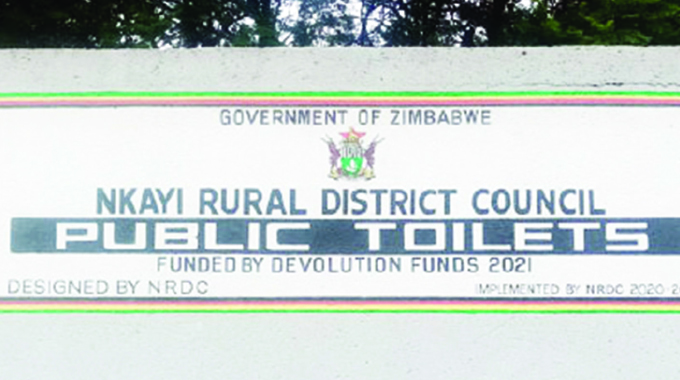
Judith Phiri
Bulawayo Bureau
BEFORE the inception of the Second Republic led by President Mnangagwa Nkayi District in Matabeleland North Province was recording few developmental projects in terms of infrastructure provision.
The actualisation of devolution by the Second Republic, however, saw the district leap frogging into development as it embarked on a number of milestone projects which have transformed lives following the disbursement of the funds.
The devolution implementation by the Second Republic has been one of the greatest achievements for rural development.
Apart from providing the funding which local authorities so much require to provide rural infrastructure, it has also greatly improved the planning and prioritisation of social development thereby deepening good governance.
Over the last five years, Nkayi Rural District Council has been allocated Z$2 130 913 269 and it has channelled funds towards the construction of clinic staff cottages, school blocks, rural health centre and staff cottages, among other devolution projects.
In an interview, Nkayi RDC chief executive officer (CEO) Mr Silibele Mpofu said they have completed the Sebhumane Rural Health Centre staff cottages that will go a long way in serving the clinic staff with shelter and piped water. The project was carried out at the total cost of Z$8 260 610.98.
He said: “We also completed the Sesemba Primary School block rehabilitation. The classroom block was badly damaged by bad weather and could in no way be considered an appropriate learning area. Roofing, flooring, mending of cracks, reinforcing the wall, plastering and panting works were done at a total cost of Z$4 343 533.
Among other projects, Mr Mpofu said the Faniya-Mloyiswa Rural Health Centre project was at 97 percent as much work was done in 2022, moving from 30 to 70 percent.
He said Z$45 601 461.21 was used in 2022, while currently they were polishing up plumbing and glazing, with the health facility to be commissioned by mid-August.
Mr Mpofu said Faniya-Mloyiswa now has solarised water supply as well as Mjena Rural Health Centre.
He added: “We have also completed 2.7km gravelling of Kwesengulube Clinic Road and a section of the Hompane-Singeni is being attended to under the Road Emergency Road Rehabilitation Programme (ERRP).”
Mr Mpofu said public toilets have been constructed and a solarised water system setup at Nkayi Business Centre that has helped in addressing sanitation issues therefore reducing water-borne diseases in the area.
He said the RDC has also acquired an ambulance and trucks which will go a long way in addressing and speeding up infrastructural development in the district.
Mr Mpofu said they were currently waiting for approval of a layout plan with over 700 stands which is inclusive of high rising buildings.
He added: “Other Nkayi future development plans include procurement of more capital equipment such as TLB excavator, grader, roller compactor, borehole drilling rig and departmental service vehicles.
There will be construction of sewer ponds and reticulation as well as construction and rehabilitation of schools and clinics such as Mjena and Kwesengulube Rural Health centres among others.”
Mr Mpofu said through the budget consultation process, communities were able to identify the projects that were of high priority and the council through the relevant committees came up with final priorities for a given financial year.
He said some of the projects were implemented jointly by council and communities who provided locally available resources thus cementing their ownership of the projects.
Local authorities have been emancipated through devolution projects as they are able to address motions brought forward by ward councillors and respond to emergencies.
Looking at the developments by Nkayi RDC, such as the construction of clinics, these have given the local authorities the power to help, preserve and uphold human rights such as the right to access adequate health services, also leading to the betterment of the society.
While, acquiring the ambulance has proved to be of significance in capacitating the local authorities as they are now able to quickly respond to emergencies without much of a struggle.
The rehabilitation and revamping of school blocks have catered for children who can now learn in safe environments and adequately access their education. The new blocks also cater for learners with disabilities.
Devolution is enshrined in the 2013 Constitution, but its implementation began in earnest with the coming in of the Second Republic under President Mnangagwa when growing sums were budgeted to top up the funds local authorities raise themselves to fund essential infrastructure in their areas.
The Second Republic is scaling up the devolution thrust consistent with President Mnangagwa’s mantra of leaving no one and no place behind.
Aligned with the National Development Strategy 1 (NDS1), a five-year economic management masterplan running from 2021 to 2025, the Government is keenly focused on building, expanding and restoring key enabler infrastructure such as roads and energy.
These ambitious infrastructure development efforts are propelling the country towards its goal of attaining an upper middle-income economy by 2030.
The Second Republic continues to up-scale the implementation of various developmental projects across the country, as witnessed in terms of development in the last five years after the completion of signature projects to further accelerate the modernisation of Zimbabwe.
The Government rolled out a total of 6 869 developmental projects across the country of which 4 984 have been completed while 1 885 were ongoing as of December 2022, according to the “Compendium of projects implemented by the Second Republic (2018-2022)” issued by the Office of the President and Cabinet.
Notwithstanding the Covid-19 pandemic-induced lockdowns, the continued imposition of illegal Western economic sanctions, climate change-induced disasters, and negative geo-political factors, the Second Republic achieved numerous development programmes and projects, which vary in scope, from national, provincial to community-based, empowerment and strategic projects were implemented across the country.


 Online Reporter