admin
admin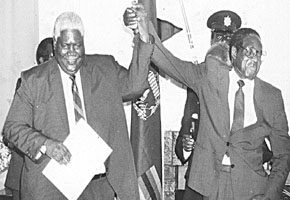
The populace in most areas such as Masvingo, Midlands, Bulawayo, Matabeleland North and South, Manicaland and Mashonaland provinces are alleged to be pushing for devolution of power as the solution to what they call the marginalisation of some parts of the country as a result of a centralised government. This is a more complex issue than is often thought by many people.
My understanding of devolution implies the transfer of power to sub-national units, that is, provinces and local authorities, so as to give them autonomous discretionary decision-making power within their geographical areas of jurisdiction. Deconcentration in contrast is the delegation of authority to sub-national units to act as agents responsible for the implementation throughout the national policies laid down by national government.
In practice, local units typically perform both functions — but there is no question of such units constituting the discretionary element. From a Zimbabwean point of view, devolution is good but not applicable since the country is still licking its deep wounds brought by the Western imposed sanctions on the country. The economic meltdown period has brought about a plethora of challenges to the people with unemployment topping the list.
Devolution of power is only acknowledged as beneficial in all Western countries and maybe South Africa. However, since it is apparent that the West brings problems to developing countries in the form of sanctions, they would as well advocate for devolution. In some cases politicians in this country who would want to gain in terms of political mileage must forget and smile on this issue. The reason being that at this moment in time one cannot stand up and say there is a need for devolution. Will it bring employment? Is it going to bring development to this country? It will be wise for us to objectively focus on more important and current issues that will leave all Zimbabweans smiling. So whether local government delivers in practice depends on the nature and extent of devolution. The problem is people are clamouring for devolution basing the arguments on wrong reasons.
I do not totally seek to disagree with ardent proponents of devolution, but to clearly outline the benefits in theory will not be fulfilled in practice. Therefore, if devolution is to occur in Zimbabwe, it will bring serious effects since we are united in terms of interdependence in natural resources. This is a very complex issue which needs not be treated as a “marriage affair” where one will divorce the “original wife” opting for a new one. When the new queen messes up, one will obviously lament the first. In the Zimbabwean , unlike in South Africa, devolution of political power is not feasible. People in various areas of this nation must cry for deconcentration of authority such that essential services are obtained from their respective areas such as the registration of birth certificates, identification cards, licences and passports.
It will not be a solution to Zimbabwe in that the local units to which power is devolved must have an adequate revenue base. The sources of revenue available to it should be buoyant in the sense that the yield from taxation should automatically increase national income. It has to be free to set up the level of spending. Devolution to local units lacking revenue base is largely meaningless. It also undermines cost efficiency.
Secondly, the units to which power is devolved must enjoy political legitimacy or acceptance. By this devolution too some units cannot work if they are fundamentally discredited in the eyes of their community. In this case, devolution will be meaningless since a few individuals understand it. This is Zimbabwe not Botswana or South Africa.
The last factor that will automatically hinder devolution is the macro-economic policy and fiscal principles. The economic role of the government — to stabilise, distribute and allocate resources — must be performed at national level not local setup. Central government must determine money supply and control foreign exchange for the country at large. It must set up tax parameters and expenditure for the whole country because local efforts at redistribution might lead to wealthy individuals “voting with their feet” by leaving the locality. Local government may nevertheless play an important role as regards the allocation of public goods and services.
The above reasons are apparent indicators that Zimbabwe cannot be divided into political areas through devolution. This will violate the gains fought for by only two liberation movements Zipra and Zanla, which is why they resorted to peace and unity than devolution. Any efforts towards devolution will nullify the Unity Accord signed between the two parties. At this moment devolution will be a wrong move which will otherwise result in communities lacking resources most affected. Well, devolution is a noble idea which is only out of context. My grandfather Cde Pasipanodya Pasipanodya who fought rampant colonialism under the Zipra wing will not buy the idea. More so, there is an interdependence of industries, what will happen to businesses which depend on other areas? Who will be in charge of the financial gains in this corrupt generation?
I strongly believe that devolution is complex and not feasible. Central government remains able, through manipulation of macro-economic policies, to limit drastically or facilitate generously autonomous governance at local level. This is only a question of will on the government which is not the solution to Zimbabwean problems. Most proponents of devolution would want to use it to promote their corrupt initiatives.


 Online Reporter