Martin Kadzere
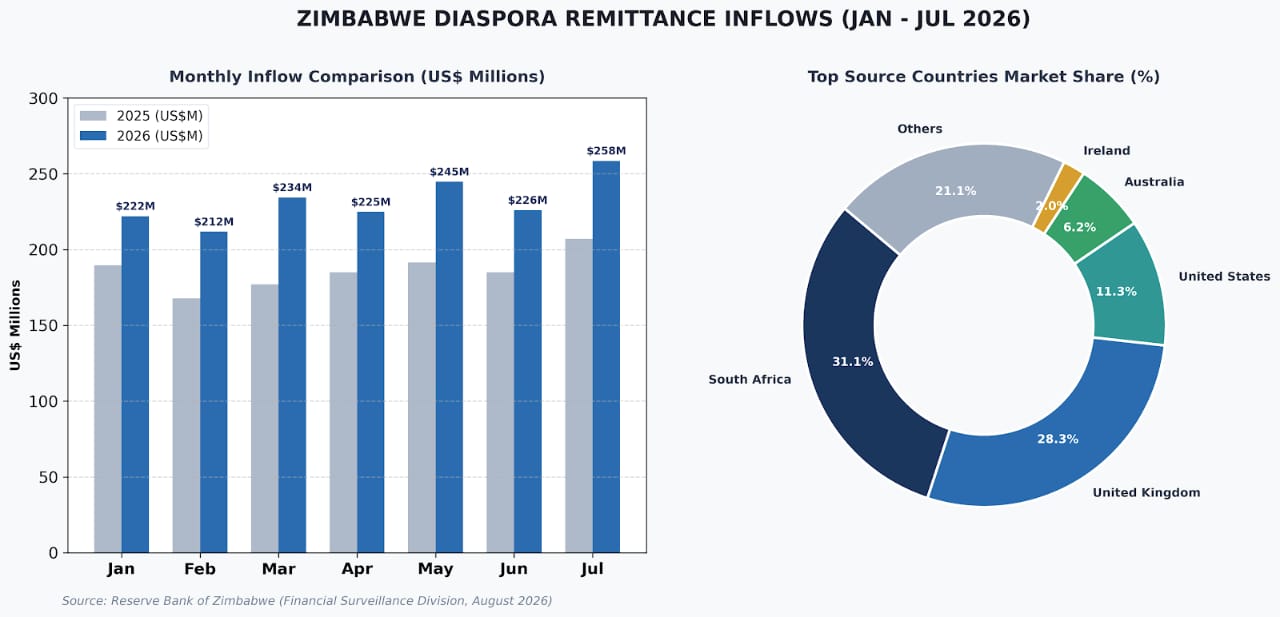
Formal diaspora remittance inflows into Zimbabwe jumped by 24 percent to reach US$1,62 billion during the first seven months of 2026, up from US$1,30 billion recorded in the corresponding period in 2025, according to official data released by the Reserve Bank of Zimbabwe.
Inflows opened the year at US$221,98 million in January—a 17 percent increase over January 2025—before peaking in July at US$258,50 million, representing a 25 percent surge year-on-year.
March also recorded significant growth, rising 32 percent to US$234,34 million, compared with US$177,07 million over the same month in the prior year.
A breakdown by source country reveals that non-resident Zimbabweans living in South Africa and the United Kingdom accounted for nearly 60 percent of inbound remittances between January and July 2026.
South Africa retained its position as the primary source market, generating US$504,14 million, or 31,1 percent of total inflows.
The UK followed closely behind, contributing US$458,60 million, which represents 28,27 percent of total funds transferred home.
The United States ranked as the third largest source market, remitting US$182,86 million, or 11,27 percent of total inflows.
Australia and Ireland rounded out the top five source markets, contributing US$101,47 million (6,25 percent) and US$32,05 million (1,98 percent), respectively.
Overall, the top 30 source countries generated US$1,45 billion, accounting for 89,22 percent of total remittance flows into the country.
Other global territories generated the remaining US$174,93 million, representing 10,78 percent of total receipts.
Economists note that the steady rise in remittances provides critical support to the central bank’s overall external receipts buffer.
Because the diaspora channel serves as a vital, non-debt-creating source of hard currency, these funds continue to directly finance domestic consumption, healthcare and education, among other things, while easing demand pressure on formal banking liquidity.