admin
admin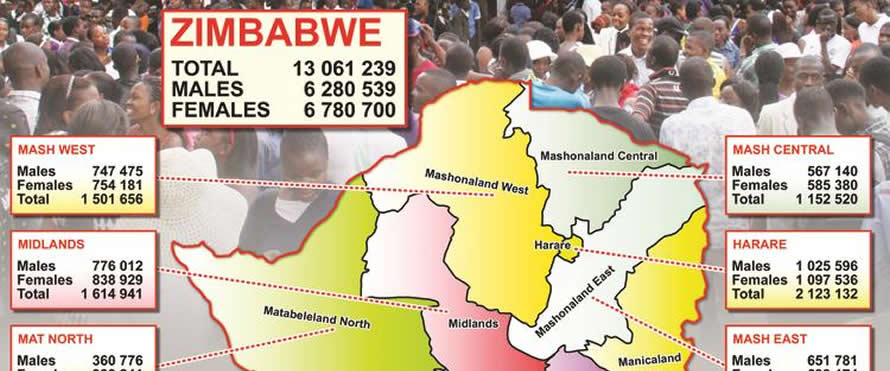
 ZIMBABWEANS in the Diaspora will be counted for the first time this year during a census that will be conducted by the Zimbabwe National Statistics Agency (Zimstat) in partnership with census agencies in other countries, this paper can exclusively reveal.
The move comes against the backdrop of an outcry over the exclusion of Diasporans in a number of key activities in the country, chief among them being developing the economy and voting during elections.
Zimstat last week finally made public the final national report of the country’s 2012 national census and the glaring omission of the data about Zimbabweans living in the Diaspora raised eyebrows, considering the varying figures which are usually thrown around.
According to the report, the national population of Zimbabwe has increased by 10,9 percent over the past decade. Zimbabwe now has a total population of 13 061 239 people, compared to 11 634 663 in 2002, representing a marginal increase of 1 426 576.
In December 2012, Zimstat only presented a preliminary report with information on the sex and geographical distribution of the population.
The final results now show detailed information on population size and structure, population distribution, ethnicity and citizenship, marital status and fertility, among other variables.
Province wise, Harare has the largest population of 2 123 132 while Bulawayo has the lowest population at 653 337.
In terms of the ratio of males to females, females remain more than their male counterparts as there are 6 280 539 males and 6 780 700 females.
“The total population of the country was 13 061 239. There were 6 280 539 males and 6 780 700 females. This total is 0,7 percent more than the initial figure of 12 973 808 released in the preliminary report in December, 2012.
“It should be recalled that the earlier figures were compiled manually at the provinces immediately after the census count, and were therefore subject to clerical errors. The population was relatively young with 41 percent of the population being below age 15 years and about four percent age 65 years and above,” reads part of the report.
Census information on education revealed that 12 percent of the population age between three and 24 years had never been to school. However, the larger proportion of this figure were below the age of six years, with 58 percent of the population currently attending school.
In terms of school dropouts, of the population aged between three and 24 years, 30 percent had left school at the census time, with 54 percent being female and 46 percent being male.
The literacy rate was pegged at 96 percent.
The omission of the Diasporan community continues to haunt Government which in the past has come under fire over this oversight, this despite acknowledgement of the huge numbers of Zimbabweans who left the country to seek greener pastures, especially at the height of the country’s economic challenges.
Last year Zimbabweans in the Diaspora were denied the right to participate in the July 31 harmonised elections when the Constitutional Court dismissed an application by a South African-based Zimbabwean who wanted some sections of the Electoral Act that bar postal voting struck off the statute books.
In an interview with Sunday News, Zimstat director-general, Mr Mutasa Dzinotizeyi confirmed that despite the challenges associated with coming up with an accurate figure of Zimbabweans living outside the country, it remained important to work towards coming up with the best possible estimated figure.
He said while they had initially done a pilot study in Tsholotsho and Chivi where they questioned families on their relatives living in the Diaspora, they discovered that this was an unreliable survey as in most cases the results were overstated and had a high margin of error.
“During our pilot study we used what is called the siblings and biological parents approach, where we were questioning people on their siblings or children who are outside the country. We, however, discovered that this is a highly unreliable strategy because at the end of the day the figures can easily be distorted and overstated.
“We were left with two other options that were open to us, the first being having our officers going to specific countries and work with our embassies but this is very expensive, the second being for us to work with fellow census agencies in other countries where during their collection of data they also try to gather how many Zimbabweans are in that country, which is a much cheaper method and is the one that we are now pursuing because it is much cheaper and feasible,” said Mr Dzinotizeyi.
He said what was dangerous was for them just to estimate the figures, hence the need to come up with a strategy that would help them get the best possible figures.
“We don’t want to guess or postulate, we want figures that are close to accurate that is why we are taking this avenue. So at this moment, I can safely say that before the end of the year we can have a possible estimate of our people staying outside the country,” said the director-general.
Independent analyst Dr Lawton Hikwa lauded the move by the agency, noting that this showed Government’s change in thinking as denoted by the Zimbabwe Agenda for Sustainable Socio-Economic Transformation (Zim Asset) economic blueprint, where there is more of forward thinking.
“The role of any census or statistical agency in any country is mainly keeping up to speed in terms of demographic information so that it can be used for various plans. In this case, I believe Zimstat noted the need for them to have an overview of Zimbabweans outside the country so that in future it becomes easier for them to be included in certain key national activities like the electoral process.
“My view is that this shows the level of proactive thinking, as we are now thinking of the future rather than about the present. In the past I believe the country was faced with a number of logistical problems that prevented us gathering this data but with the advent of ICTs, I believe we can now easily bypass this,” said Dr Hikwa.
Affirmative Action Group (AAG) national deputy president Mr Sam Ncube said what was required was for the country to develop more deliberate policies meant to encourage Zimbabweans living in the Diaspora to not only feel free to come back to the country but to also plough back to the economy.
He said it was essential to appreciate the figures of people in the Diaspora as this could go a long way in assisting the nation plan for future activities.
“These people left the country to seek greener pastures and this does not by any way rob them of their identity, therefore it is essential that we come up with such deliberate policies that will see them appreciating that they are also needed in the country.
“We must bear in mind that these people have been out there for many years and have learnt a lot in terms of how those countries are surviving. We need these people to come back and share their expertise in assisting in the country’s economic revival endeavours. We need a spirit of reconciliation and not treat these people like foreigners,” said Mr Ncube.
He said the interest Government was now showing towards people in the Diaspora was encouraging, noting that it was surprising that they had been previously ignored.
Over the years there have been disparities in the estimated figures of people living outside the country, with the foreign media reporting that over four million Zimbabweans were working outside the country.



 Online Reporter