Online Reporter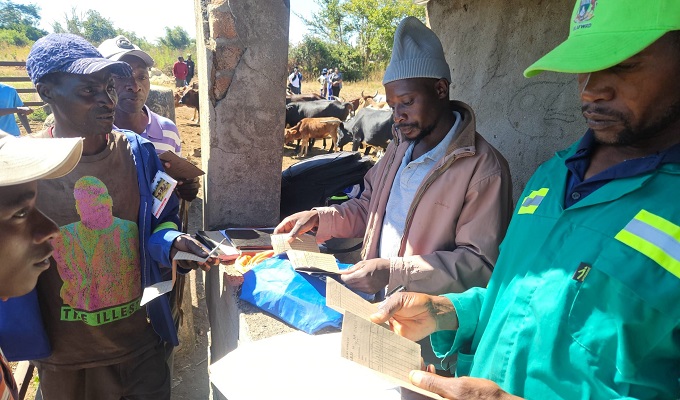
Theseus Shambare recently in BINDURA
IN the heart of Chidziva village, under the shade of mopane trees and the watchful gaze of cattle, a revolution is unfolding.
For generations, communal farmers in Bindura, Mashonaland Central province, have relied on flimsy, handwritten stock cards to record the details of their livestock — births, vaccinations, treatments and sales.
The dog-eared pieces of paper, which are vulnerable to the elements and time, have long been the only proof of ownership and animal history.
At the Guwa dip-tank, cattle owner Mr Tobias Moyo reached into his satchel and pulled out a battered stock card, its faded entries barely legible.
The card’s edges were frayed and the handwritten entries had all but faded.
“This card has been a curse as much as it has been a blessing,” he told The Sunday Mail. “A sudden downpour and the ink runs like tears.
“A moment of carelessness and it is snatched by the wind, lost to the dry bush. How do you prove your cattle are truly yours, their history clear, when the very proof melts away?”
His story echoes those of many farmers in rural Zimbabwe.
“Last year, I tried to sell my prize bull — Muguti — to a buyer from Harare,” she recounted. “He wanted every detail, but my card was so old some entries were nothing but smudges.
“The buyer scoffed and drove away, leaving me with a bull I had hoped would pay for my grandchild’s school fees.
“All because a piece of paper could not tell its own story properly.”
Adding to the farmers’ headaches, the fragile paper-based system also hampers disease control.
“When there is an outbreak, like anthrax, the veterinary officers try to trace movements, but it is like looking for a needle in a haystack,” said Mr David Ndaramba, a seasoned farmer from Glendale.
“We try to remember every movement, every calf born, but with so many animals, it is impossible. And then the disease spreads, swift and silent, and we lose our animals, our livelihoods.
“If only there was a way to know exactly what’s happening, where and when, especially when we’re so spread out!”
A digital lifeline
Today, a new chapter is being written, not with ink, but with data.
Last week, the Ministry of Lands, Agriculture, Fisheries, Water and Rural Development, through the Directorate of Veterinary Services (DVS), launched the digital livestock card, a development expected to modernise cattle farming across Zimbabwe.
Imagine a digital passport for every animal — a centralised, secure record of ownership, health and movement, accessible via mobile phone or at local dip-tanks.
In an interview, DVS chief director Dr Pious Makaya said the livestock digital cards were a game-changer.
“The livestock digital stock card is not merely an upgrade; it is a fundamental shift in how we manage our precious livestock assets, especially vital in regions like Mashonaland Central,” he said.
“It is a robust combination of a physical card, embedded with a unique identification code, seamlessly linked to a comprehensive digital platform.
“This system, accessible through both mobile applications and web platforms, ensures that farmers, veterinary officers and all stakeholders can manage livestock data with unprecedented efficiency and transparency.”
The digital cards are being distributed through veterinary extension officers at ward level.
Farmers can collect them during regular dipping sessions, a smart integration into routines they already follow.
Smart farming through data
Unlike the old paper cards, the new digital version offers robust and wide-ranging features.
“The digital stock card is a comprehensive, living record,” added Dr Makaya. “It meticulously records animal identification and ownership, vaccination and treatment history, calving information, movement permits and sales history.
“This empowers farmers to track animal health trends, plan treatments and vaccinations precisely, improve breeding decisions and prepare their animals for market with verifiable, well-documented history.”
He said communal farmers in places like Chidziva could now operate with the same level of insight and professionalism as those in commercial zones.
The system also provides secure identification, thanks to watermarks and unique serial numbers, which curb fraud and theft. Crucially, the platform allows collection of detailed, ward-level data across livestock types, including cattle, goats, poultry, donkeys and even dogs, enabling targeted disease control interventions and resource allocation.
For farmers like Mr Moyo, the change is more than welcome.
“Imagine having all the health records of my cattle on my phone, or even on a small card that can’t be easily damaged,” he said.
“I can see when a cow was last vaccinated, when she had her last calf and even her movements. No more relying on old, smudged notes or trying to remember everything.”
Mrs Chibanda sees it as a gateway to better markets.
“With verifiable digital records, buyers will have no reason to doubt my animals’ history,” she said.
“This means better prices, fairer deals and a stronger market for my livestock.
“It is about building trust, and trust brings better business, connecting our village to bigger, more lucrative markets.”
From local kraals to national vision
The initiative is part of a broader national plan to grow Zimbabwe’s livestock industry into a US$2 billion sector, according to Permanent Secretary for Lands, Agriculture, Fisheries, Water and Rural Development Professor Obert Jiri.
“The livestock industry in our country is a potentially US$2 billion industry,” he said during the launch. “From the last assessment, we had 5,7 million cattle. It is imperative that we look after such an industry, particularly in a cattle-rich region like Mashonaland Central, where we see so much potential for growth.”
He underscored the critical need for accurate data.
“Firstly, it’s important to be able to keep records of our number of cattle,” he said. “Secondly, what is happening within our cattle industry? What is the level of our diseases? How are we dealing with it? All those things need to be recorded. This is not just for the individual farmer, but for the health of our entire national herd.
“We have been using a physical stock card. But now we are digitalising that card to ensure that it moves with the times. We are now able to track and analyse at the click of a button.
“What we are launching here, in Chidziva, is the same stock card, with improved features.”
As part of the rollout, the DVS has launched training and awareness campaigns at grassroots level.
“We are conducting extensive training for our staff, familiarising them with the new system and online registration procedures,” Dr Makaya said. “Awareness programmes will be rolled out at dip-tank level, to educate farmers on the benefits.”
Though the digital card system is still in its early stages, excitement among livestock farmers is building. In Chidziva, conversations at the dip-tank are already shifting — from frustration and uncertainty to curiosity and cautious optimism. For farmers like Mr Moyo and Mrs Chibanda, the digital stock card is a step towards stability, recognition and growth.
They both reckon that with better records comes better business.



 Online Reporter