

 Online Reporter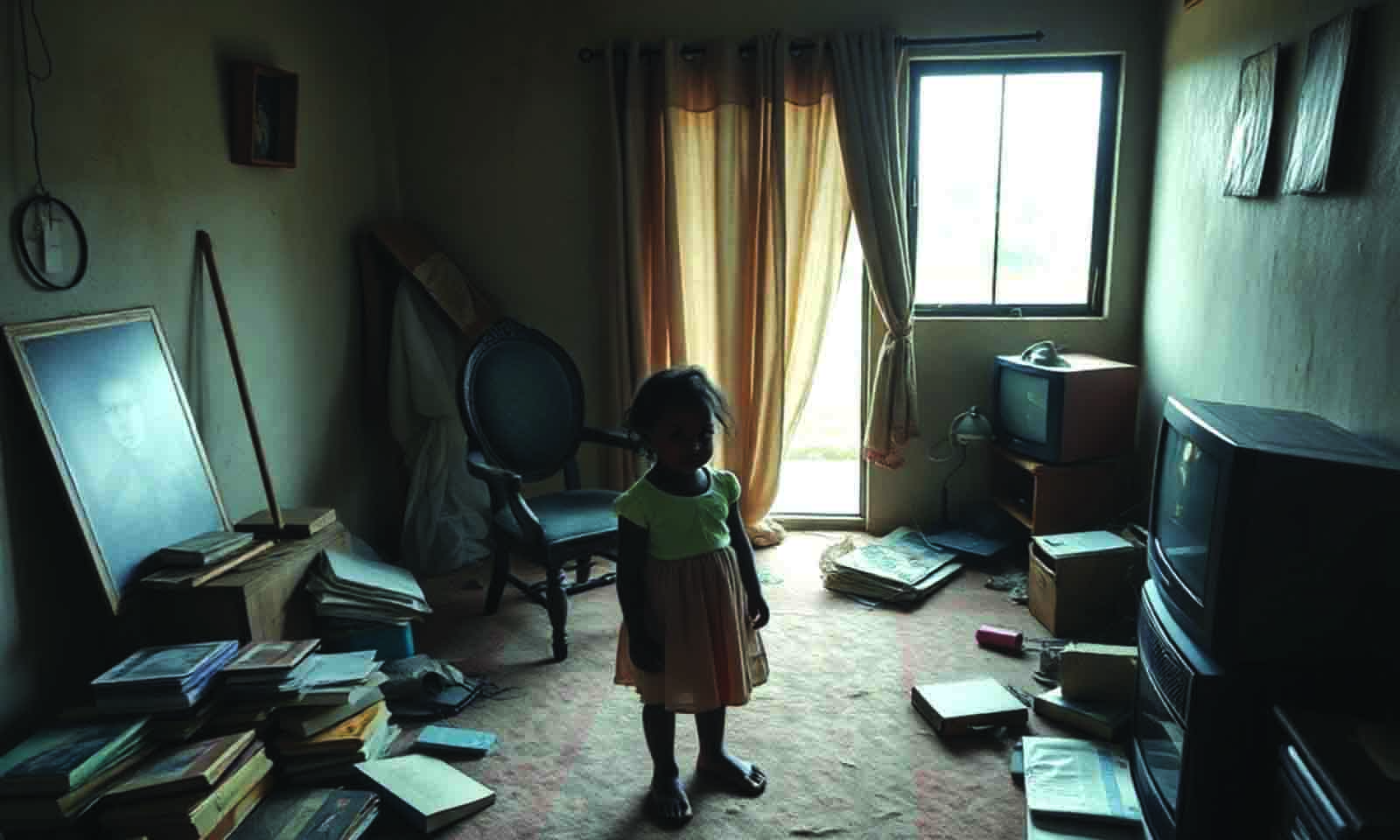
Emmanuel Kafe
Check Point Desk
When Sibongile Maruta’s mother left for the United Kingdom seven years ago, she promised that life back home in Mufakose, Harare, would finally change for the better.
For a while, it did. School fees were paid on time, groceries filled the shelves and a new television set became the centre-piece of their small lounge.
But as months turned into years, the calls from her mother grew less frequent — and the remittances that once arrived like clockwork started coming late.
When her grandmother fell ill, Sibongile, then 15, began moving between relatives. No one kept track of her schooling.
By the time she was in Form Three, she was missing classes to help with household chores. Soon, she stopped going altogether.
At 17, Sibongile was pregnant and quietly married off to avoid community gossip.
“If she had someone to talk to,” her grandmother says, “maybe it would have been different.”
Her story is heartbreakingly common.
For thousands of children across Zimbabwe, the promise of a better life built on diaspora remittances has become a silent crisis of abandonment, loneliness and lost childhoods.
Data from the Reserve Bank of Zimbabwe (RBZ) shows that diaspora remittances reached US$1,09 billion in the first half of 2025, up from US$1,01 billion over the same period last year.
That accounts for roughly 15 percent of the country’s total foreign currency inflows, a crucial economic pillar keeping families afloat.
But while the dollars sustain households, the emotional and social fabric is tearing.
Behind the glowing figures lie stories of school dropouts, teenage pregnancies, abuse and emotional neglect.
“The money helps with survival,” says Ms Anesu Gwatidzo, a Harare-based social worker, “but it cannot replace presence, guidance or affection.”
Just like Sibongile, in Harare’s Kuwadzana 1 suburb, 18-year-old Tafadzwa wakes before dawn to prepare breakfast for his two siblings.
Their mother left for South Africa three years ago.
Their father, once a cross-border trader, vanished long before that.
Each month, money trickles in through a money transfer agency — enough to pay rent and keep the children in school. But the home remains hollow.
“I try to be the man of the house,” Tafadzwa says, “but sometimes I just want my mother to come back.”
Across the country, thousands like Tafadzwa are forced into premature adulthood, parenting their siblings, navigating adolescence without parental guidance and surviving emotional solitude behind closed doors.
The Government says that nearly 50 000 learners dropped out of school in 2024 — including 15 000 from primary and 33 000 from secondary education.
A 2024 ZIMSTAT annual statistical report shows that nationally, about 22 percent of school-age children are not enrolled at all.
While poverty remains a major factor, educators point to another: parental absence due to migration.
Teachers say children left behind often miss classes, pay fees late or lack supervision to complete homework.
Child psychologists warn of deeper scars — rising cases of substance abuse, depression and antisocial behaviour among unsupervised adolescents.
“We are raising a generation of emotionally displaced children,” says Dr Sipelile Mayenga, a family psychologist and part-time lecturer with the Zimbabwe Open University.
“They live between two worlds, one that feeds them and one that forgets them.”
For girls, the vulnerabilities are even greater.
The Zimbabwe Gender Commission and several NGOs have recorded an increase in child marriages and sexual abuse in communities where parents have migrated.
“We’re seeing cases where relatives or neighbours exploit these children,” says Advocate Mutsa Chirindo, a Harare-based gender rights officer.
“Parents send money, but they’re too far away to see the damage.”
Dr Mayenga calls it “a silent social emergency” — one that rarely makes it into the country’s migration or economic policies.
“Remittances bring relief, but they also conceal pain. For every child in school because of remittances, another is emotionally breaking under the weight of separation,” she says.
Deputy Minister of Primary and Secondary Education Angeline Gata acknowledged that most dropouts in 2024 were linked to teenage pregnancies and long commuting distances.
She said the ministry, working with UNICEF, has also launched an Early Warning System to identify and address causes of dropouts.
“Teachers are being trained to spot at-risk learners and communities in need of support. The programme has been running for six months,” she said.
She added that the Government is addressing distance barriers by ensuring schools are built within a five-kilometre radius of learners’ homes.
Other contributing factors, Deputy Minister Gata noted, include lack of motivation from parents and school fees challenges, which are being mitigated through the Basic Education Assistance Module (BEAM) programme.
The Zimbabwe Livelihoods Assessment Committee (ZimLAC) notes that while remittances improve household consumption, they do not necessarily improve child welfare.
“Economic gains,” the report warns, “are not translating into better social outcomes.”
Despite the clear warning signs, there is no national framework to track or support children left behind by migrant parents.
Social welfare officers remain understaffed; schools lack counselling capacity and community leaders often dismiss such issues as “family matters.”
Experts are calling for a shift in how Zimbabwe views its remittance economy, not just as a financial asset but as a social responsibility. Some propose community-based support networks for guardians caring for left-behind children, while others call for safe spaces in schools where children can report neglect or abuse.
There is also growing support for channelling part of remittance inflows into family counselling, after-school programmes and youth mentorship projects.
“We need to invest in the emotional economy,” said Dr Mayenga. “Otherwise, we’re feeding bodies while starving souls.”
Zimbabwe’s billion-dollar remittance boom is celebrated in economic reports and budget statements as a sign of resilience. But in homes like Sibongile’s and Tafadzwa’s, the narrative is far darker. It is a story of survival wrapped in separation — of children growing up too fast, of grandparents too frail to cope and of parents who send love in cash but not in person.



It’s a double edged sword. Life in the diaspora is not rosy either. It is indeed very hard for the parents who work almost nonstop in order to send something home. Studies have shown that most diasporans come back home to die if they are lucky to come home alive. If families they leave back home end up dysfunctional and then they too come back home just to die, what then is the advantage of going into the diaspora? And besides most of these diasporans do serious menial labour that totally destroys their physic and health besides eroding their self respect and esteem. So what is the benefit of rushing into the diaspora for those with no skills?