admin
admin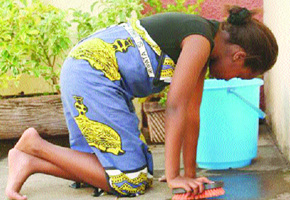
She had worked for five months, and it so happened that one day she prepared a meal badly. She apologised for the mistake, but the employer came down heavily on her with fists. In attempting to defend herself she overpowered her employer. At that moment, the empolyer’s husband arrived from work and found his wife on the ground. That is when the battle intensified. The husband teamed up with his wife to assault the maid until she broke one of her ribs.
At around 7pm, she was ordered to leave her employer’s house. Penniless and in pain, she spent part of the night in the cold. At around 11pm she was picked up by the police for loitering and without being given a chance to explain her story, she spent the rest of the night at a police station.
Saziso could not proceed with her education because her parents could not afford to pay school fees so she opted for employment. Unfortunately her work ended abruptly and in pain, forcing her to return to her rural home. She is now in Manzasiya village in Binga, and dreads working as a domestic worker ever again.
Many domestic workers have to endure such difficulties because there is widespread abuse of domestic workers in the country. Due to ignorance of their rights, domestic workers are vulnerable to sexual, verbal, physical and psychological abuse. Many are also paid wages that are well below the Government minimum wage threshold. Employers take advantage of that to exploit and short-change them. This is despite the fact that domestic workers play a critical role in homes and the economy at large.
Research has shown that most domestic workers are:
l Not aware of their rights and do not even know legal instruments protecting them.
l Not happy with their salaries that can be as low as $30 monthly.
l Some domestic workers complain of verbal abuse.
l At times they work extra hours especially when there are visitors or special events like parties and traditional ceremonies without additional pay.
l Some only have leave or off days when they get sick or have serious problems.
l Some are denied freedom of religion, since they are not given the time to go to church or attend their family gatherings.
l Domestic workers suffer from an unpleasant treatment especially from male employers who are drunkards.
l In rural areas domestic workers combine their normal duties with agricultural work but still earn a general wage. In towns some do all the tasks but still receive the initially agreedwage.
l If a domestic employee misses a day from work, the employer usually deducts a fraction of their pay.
The International Labour Organisation (ILO) in its 2010 report, Decent Work for Domestic Workers says:
“The widely reported cases of abuse of domestic workers are of special concern to the ILO. Live-in and migrant domestic workers are particularly vulnerable to various forms of mistreatment at the workplace, which in the worst cases have led to their death. Verbal abuse such as shouting, insulting the employee’s nationality or race and using inappropriate language, is frequently reported. Physical abuse of various kinds has also been identified, which in some instances is carried out with impunity in front of third parties in order to humiliate the worker or exact submission.
Sexual harassment and abuse also appear to be prevalent and this, like all abuse, can have serious long-term repercussions of the domestic workers’ health, especially when the victims are young girls.”
Considering the foregoing, there is need for organisations that deal with workers’ rights to provide information on domestic workers’ rights. The Government also ought to play a leading role in this regard. It is worth suggesting that there should be clear guidelines setting out standards for hiring, employment, and handling of domestic workers. The working environment should be mutually beneficial for both the worker and employer. In case of a problem, domestic workers and employers should have clear avenues of seeking recourse against abusive employers.
Labour associations for domestic workers should be formed, and if they exist, must be strengthened to enable them to fight for their rights more effectively.
In developed countries, domestic work has been formalised, a route which we must also take, led by the Government.
In the end, laws can be there but if they are not enforced strongly, the plight of domestic workers would still remain dire. Law enforcement agents need to enhance their surveillance in homes and policing to make sure housemaids are safe.
*Jonah Nyoni is a development journalist and motivational speaker. E-mail: [email protected]. Web: www.jonahnyoni.blogspot.com. Tel: 0772 581 918.



 derick.khumalo