
Obert Chifamba-Agri-Insight
IT has been an unusual cropping season. Most dry land crops have since succumbed to the harsh effects of the prevailing El Nino-induced drought at their various stages of growth.
And the blazing drought has inevitably extended its tentacles to livestock where it is wreaking havoc, especially in the country’s perennially dry regions where forage is always difficult to find.
So heart-broken are the bulk of farmers surviving on rain-fed agriculture that some may even consider gathering the dry crop residue and burn it. Some have gone to the extent of ploughing it into the ground to make sure the painful reminder of the failed season is not always there to madden them each time they cast their glances in the direction of their fields.
Of course, it has always been a bitter pill to swallow for the farmer to just accept that her crop has failed and move on to find ways of making the best out of the situation or at least salvage something positive.
In this case, the residue from the failed crop can at least be used for something productive in the not-too-distant future.
Today’s offering will try to explore some of the ways in which farmers can deal with the crop residue currently littering their fields after the rains abandoned the crops to die a premature death.
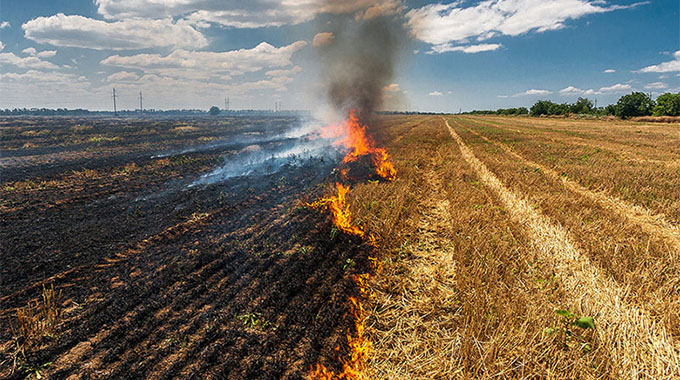
There is this group of farmers that will decide to set the residue on fire to clear their fields.
This option comes with some negative impact on the environment and on the soil as well. Burning crop residues increases the soil temperatures to undesirable levels in most cases and decimates soil micro-organisms to a depth of about 2, 5 centimetres.
Experts in soil science believe that besides damaging the environment, burning crop residues also impacts the monetary cost involved in recovering the soil fertility the season after the burning. It also increases the potential for further pollution through the increased use of fertilisers to help the soil recover its lost nutrient content.
Many farmers burn crop residue because they believe it helps control weeds and pests through direct destruction or by altering their natural habitat. I guess the debate on the efficacy or shortcomings of the method is a story for another day.
There is also this group of farmers that believes that burning residue brings soil nutrient gains in terms of potassium in the ash for the next crop cycle. This may be true in the short term but the consequences of loss of other important nutrients and organic carbon will eventually outweigh the short-term benefit.
It is also believed that crop residue burning helps improve plough preparations for the next crop for those farmers that use draft power.
The other option for dealing with crop residue, which is feel is the most appropriate for the times the country is going through is for the farmers to harvest and store it.
They will later use it as supplementary feeds when the little green matter that is currently available gets exhausted or dries up.
Farmers, however, need to appreciate the fact that not everything on their fields can be swept into windrows and fed as hay for livestock to eat.
They need to research the chemicals applied to crops before converting them to feed or forage. Farmers must also appreciate the fact that they could have used different chemicals either as pesticides, herbicides or fertilisers from their neighbours so what the next farmer does to ascertain the safety of crop residue may differ from what farmer B needs to do.
One stubborn fact is that farmers may have used the same chemical but for different crops with different ways of assimilating and using the chemical.
This means that each farmer must seek guidance from experts on the best way to proceed and do away with the ‘one size fits all mentality’ that allows them to throw caution to the wind and bring harm unto themselves.
I will not single out any chemicals for special mention but the best way forward is for farmers intending to use the current crop residues as feed to seek guidance from extension officers in their localities and be honest in identifying chemicals they would have used before the crops met their untimely demise.
It is a fact that almost any crop residue – maize, sugar cane, sorghum, soya bean and vegetables can be fed to livestock but before giving it to livestock, farmers must make sure they prevent losses orchestrated by the presence of toxins and poisons.
Poisoning can range from acute cases where animals die when ingesting the poison, to very low levels of poisoning where the consequence of ingesting a deleterious substance can only be measured as a negative effect on performance.
The other farmer category is that, which decides to plough the crop residues into the soil. This naturally helps mix the residue with the soil to improve decomposition and enhance nutrients in the soil.
Turning over the soil not only mixes the organic waste but also enhances oxygen in the soil by exposing it to the air and sun. This is also essential to speed up the decomposition of the leftovers of previous crops and get more oxygen for the plant roots.
Ploughing loosens the soil and allows air and water to pass through soil particles easily. It also makes space for seeds and enables roots to get nutrients from the soil easily, which boosts plant growth.
Some farmers can still decide to just leave the crop residues on the fields and allow processes of nature to take care of them before land preparations for the next planting season can get underway. Leaving crop residues on the land has the advantages of reducing the risk of erosion, as old crop materials can catch and retain moisture, mitigate soil temperature fluctuations during extremes and contribute to soil organic matter. These benefits are hard to measure and often lose out to short term gains whose results can easily be measured through various observation methods.
However, the biggest cost of residue removal is the loss of carbon held in the residue. Carbon is one of the largest components of soil organic matter. The decomposition of old crop residue is part of the building process in soil organic matter. Higher levels of organic matter in soils correlates to improved soil structure, resilience, nutrient availability and water holding capacity.
One interesting observation is that experts in the field of soil sciences always argue that the carbon held in crop residue cannot be replaced through fertiliser applications like other nutrients. It has to be produced through the process of photosynthesis, residue decomposition and other biological processes, all of which take time. This, in a nutshell, indicates that they are not for the removal of crop residues using whatever method farmers may deem appropriate.
They want crop residues to be left in the field to allow the full cycle of building soil structure.
The quality of the soil is not always easy to measure and landowners and producers are not always able to see the benefits immediately but after some time.
Building and maintaining soil quality is tied to long term profit and to the farmer’s ability to produce competitively and meet consumption requirements and surplus requirements for the market.
Whatever farmers do, they must always keep it in their minds that there are multiple positive contributions that crop residues provide, hence the need to keep soils covered.