admin
admin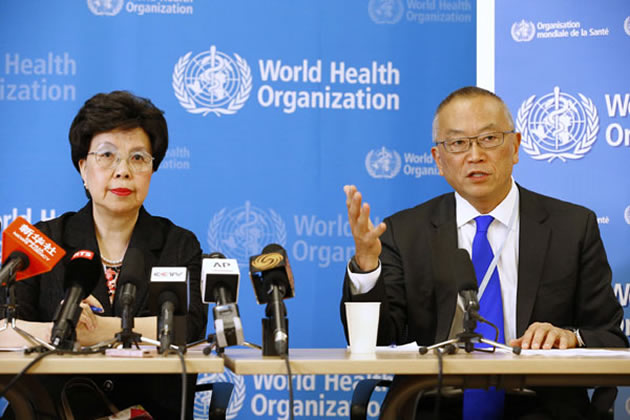
 The World Health Organisation (WHO) has declared the Ebola outbreak in West Africa to be an international public health emergency that requires an extraordinary response to stop its spread.
WHO declared similar emergencies for the swine flu pandemic in 2009 and for polio in May.
The WHO chief, Dr Margaret Chan, said the announcement yesterday is “a clear call for international solidarity” but acknowledged that many countries would probably not have any Ebola cases.
“Countries affected to date simply do not have the capacity to manage an outbreak of this size and complexity on their own,” Chan said at a news conference in Geneva.
“I urge the international community to provide this support on the most urgent basis possible,” she added.
The agency had convened an expert committee this week to assess the severity of the ongoing epidemic —the largest and longest in history.
The current outbreak of Ebola began in Guinea in March and has since spread to Sierra Leone and Liberia.
The WHO said the situation is likely to get worse in the coming months.
There is no licensed treatment or vaccine for Ebola and the death rate has been about 50 percent.
The impact of the WHO declaration is unclear; the declaration about polio does not yet seem to have slowed the spread of the virus.
During a WHO meeting last week to reconsider the status of polio, experts noted countries had not yet fully applied the recommendations made in May, that there have been more instances of international spread and that outbreaks have worsened in Pakistan and Cameroon.
In the United States, the Centres for Disease Control and Prevention have already elevated their Ebola response to the highest level and has recommended against travelling to West Africa.
On Thursday, CDC director Dr Tom Frieden told a Congressional hearing that the current outbreak is set to sicken more people than all previous outbreaks of the disease combined.
“I don’t know what the advantage is of declaring an international emergency,” said Dr David Heymann, who directed WHO’s response to the SARS outbreak and is now a professor at the London School of Hygiene and Tropical Medicine.
“This could bring in more foreign aid but we don’t know that yet,” he said.
Meanwhile, soldiers clamped down on people trying to travel to Liberia’s capital on Thursday from rural areas hard-hit by the Ebola virus, hours after the president declared a national state of emergency.
Reports have emerged of families hiding sick relatives at home and of abandoned bodies being left in the streets.
Similar efforts were underway in eastern areas of neighbouring Sierra Leone after officials there launched “Operation Octopus” to try and keep those sick with Ebola in isolation.
While the outbreak has now reached four countries, Liberia and Sierra Leone account for more than 60 percent of the deaths, according to the World Health Organisation. The outbreak that emerged in March has claimed at least 932 lives.
In announcing the 90-day state of emergency, Liberian President Ellen Johnson Sirleaf said the worst recorded Ebola outbreak in history requires “extraordinary measures for the very survival of our state and for the protection of the lives of our people”.
“Ignorance, poverty, as well as entrenched religious and cultural practices continue to exacerbate the spread of the disease especially in the counties”, Sirleaf said late on Wednesday.
She warned that some civil liberties could be suspended as needed, and by Thursday soldiers already were restricting movements on the roads to the capital, Monrovia, witnesses said.
Some soldiers were deployed to the crossroads town of Klay about 40km west of Monrovia in an effort to stop people from three Ebola-infected counties from coming closer to the capital.
Yet even as authorities tried to keep more people from reaching Monrovia, the capital already has been hard hit by the virus.
National Health Workers’ Association president Joseph Tamba said the state of emergency is necessary. But he says people should have been given advance notice to buy food ahead of the movement restrictions.
Previous outbreaks of the Ebola virus were limited to parts of Congo and Uganda, far from the capital cities in those countries.
The World Health Organisation is holding talks this week on whether to declare an international health emergency. – AP


 Online Reporter