admin
admin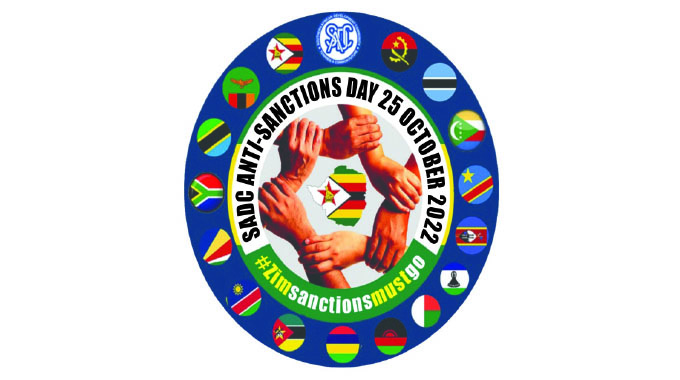
Today is the SADC Anti-Sanctions Day, when our neighbours join us in urging those who imposed sanctions on Zimbabwe more than two decades ago to lift them on the grounds that they are hitting everyone.
This diplomatic pressure will help, and if those who imposed the sanctions in the first place were sticking to the reasons they still give, that pressure would probably be decisive.
The stated aims were to encourage full democracy in Zimbabwe and good governance, basically an efficient and open administration with no corruption and no one using their Government positions to enrich themselves.
Those conditions have been met, with a major change in 2013 when a Constitution agreed by all parties in Parliament was then agreed by a large majority of Zimbabweans.
That Constitution widened the rights, including political rights, of Zimbabweans and most of the law that then needed to be changed to be aligned with the Constitution, including the Electoral Act, were amended or replaced.
The Electoral Act, in fact, was amended with the agreement of all parties. The Second Republic has been, with Zimbabwean support rather than external pressure, upgrading many governance issues from developing better systems for more transparent and efficient administration that also make corruption a lot harder and a general policy that the corrupt need to be hunted down.
So if what was said 20 years ago was all that was involved, sanctions would have been lifted some time ago, or at least suspended.
That did not happen in the US, has not really happened in the UK and while the EU continues to erode its sanctions, some still exist.
No one else seems willing to impose any sanctions on Zimbabwe, which is why they are all unilateral since it is dubious that a motion could get a simple majority in the UN Security Council, let alone escape opposition from all five permanent members.
Unfortunately, the sanctions go far beyond what was said at the beginning and what is said now. They were imposed in reaction to land reform, and have been continued because the opposition parties, or at least those liked and supported by the countries that imposed sanctions, have been unable to win elections pronounced as free and fair by SADC and the AU, and generally accepted as reflecting the will of the voters.
Some of those parties, and some of the figures in those parties, are supporters of sanctions for political reasons, agreeing with one of the fundamental if unstated reasons for the sanctions being the change of Government in Zimbabwe.
Even after the last election one prominent opposition figure with good ties to the Republican leadership in Congress made it clear that because his candidate for President lost there would be no relaxation and no ordinary aid.
The evidence for this “regime-change” agenda is long. Right at the beginning US Assistant Secretary of State for Africa, Chester Crocker, made it clear that he hoped the US Congress would support the legal basis of sanctions against democracy so that Zimbabweans would understand that they would suffer so long as Zanu PF was forming the Government.
He was remarkably blunt, and that was the last burst of real honesty we have heard from the sanctions movers. This is understandable. In the 21st Century it is generally considered unacceptable to tell other countries who they should or should not elect as their Government, although it is still permissible to press for those elections in the first place.
But deliberately creating conditions for a change of government are not permitted.
This is a major advance on older systems where the CIA would actually organise coups, such as in Guatemala where a government nationalised unused land owned by the American United Fruit Company, a major banana producer and exporter, or in Iran where a centre-left government was partially nationalising a Anglo-American oil company, or in Chile or in a host of other countries.
Of course nothing official about regime change is ever said. The official version of the US sanctions is that they are targeted against a small number of people and entities, and that is all. This is nonsense.
Even the Congressional law passed in 2001 makes it clear that there are actions against the country as a whole, such as the instructions to American representatives to multi-lateral finance bodies, such as the IMF and World Bank, to block any support for Zimbabwe. And the USA is easily the largest shareholder in both.
That cutting off Zimbabwe from access to international agencies is a serious and untargeted sanction, unless you see the entire country as the target.
And while the official line is that there are no embargoes on business-to-business dealing or bank-to-bank dealings, and there is nothing on paper, the fact remains that American banks and businesses in particular, along with anyone else who pushes money through the American banking system, has to make a large number of expensive checks to prove they have no dealings, even vaguely, with the targeted people and entities.
It is this over-compliance with the law, or perhaps those enforcing the law going so far beyond direct dealings, that causes the bulk of the rest of the damage after the blocking of action by multi-lateral institutions.
The sanctions are primarily financial, although arms sales and sales of other equipment to the defence forces and police are banned.
But this is why they are so potentially damaging, since trade with a lot of other people is affected to some degree and it does dry up Zimbabwe’s external lines of potential credit and bank support, and these days that sort of support oils a lot of trade and investment. Investors keep coming into Zimbabwe, and they are welcome, while few are American, because they find the need to prove they have not breached sanctions so expensive, they would be welcome along with everyone else.
Should Zimbabweans decide to change their Government, and they show little sign of doing this soon, they can easily do that if they have the votes. Our elections open and transparent and whoever gets the most votes in a ward or constituency or the nation as whole, when it comes to the Presidency, wins.
Those who believe that the US must continue a harsh sanctions regime to help them win the votes seem to have a weird view of Zimbabwean voters.
Why should anyone vote for someone who wants to destroy their livelihood? More likely even some of those leaning to these sort of people will unlean and look elsewhere.
Perhaps they need to join our neighbours and make the whole opposition to sanctions unanimous.


 Online Reporter