daniel chigunwe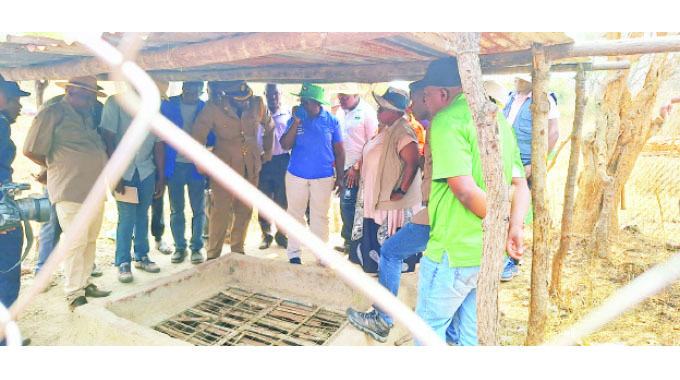
THE decision to end efforts to recover the remaining 16 bodies in the rubble of the underground workings of the Bay Horse Mine near Chegutu will be a major blow to their families, who had hoped they would be able to pay their last respects to loved ones in a formal funeral.
But the Government took the correct decision. Almost a fortnight after the major collapse, there was no longer any possible hope that anyone else was left alive, and the 22 pulled out of the rubble alive when 42 artisanal miners were trapped by rock falls were the only survivors. Four bodies had been recovered.
A major effort to shift the rock falls and rescue any further survivors had now become an effort to recover bodies.
This effort was backed not only by the resources of the Ministry of Mines and Mining Development, and the Civil Protection Unit of the Ministry of Local Government and Public Works, but involved teams and equipment from the two major mines in the area as the private sector showed their solidarity.
The general agreement of all the technical experts was that there was a high and increasing risk of death, or at least very serious injury, to those trying to penetrate and clear the rock falls.
That risk may have been acceptable if there was any chance of any of the 16 remaining miners being still alive, but there was no sign of life and after two weeks no chance of any more survivors.
So any further effort would simply add to the death toll without saving any lives. That must have been a hard decision to make, but it was the right one.
So we now have Bay Horse Mine as the grave of the remaining 16. The families can still be helped. There must be a proper funeral service and proper traditional funeral rites at the mine, and a declaration of the underground workings as a cemetery that may never be disturbed. In any case the workings need to be sealed off for safety reasons.
It should be possible for the families of those who died, the survivors who worked with them and the local chief to work out what sort of funeral arrangements are required and then the Government can step in with its assistance.
Gravestones can be erected, or perhaps a single joint memorial, to help give closure and the families can be helped.
The worst ever mining disaster in the country, the Hwange disaster of 6 June 1972, when 427 miners were killed when gas explosions destroyed the Number two Colliery, provides a suitable template.
The 424 miners whose bodies could not be recovered lie underground forever, but the colliery is sealed off and no coal mining can ever come close to that grave, a condition that miners respect to this day.
The loss of 20 miners at Bay Horse Mine, while smaller in numbers, is still one of the worst mining accidents in Zimbabwean mining history and we must learn the lessons, and then apply them.
Details are a bit sketchy, but it appears that the artisanal miners had some sort of arrangement with the mine owner, but that the mine owner was not in charge of the mining operations.
So the 42 were not just digging where they liked, but neither were their mining operations regulated and being done in accordance with the laid-down safety standards.
Artisanal mining has provided a livelihood for many Zimbabweans and opened a lot of opportunities. But there have been safety problems, with every year seeing a few deaths, and other regulations besides the safety rules being flouted.
We have had miners digging up railway reserves, putting train traffic at risk of derailment and worse; we have had a primary school in Kwekwe abandoned when artisanal miners hollowed out the land under the school and a classroom collapsed into the resulting hole. There are many other examples.
Government policy is to allow artisanal miners to operate, but under the regulations of the Ministry of Mines and Mining Development, from registration of claims through adherence of safety standards and generally in accordance with mining law.
At a conference in Mudzi this week, Minister of State for Provincial Affairs and Devolution for Mashonaland East Dr Aplonia Munzverengwi made the sensible intervention, that these miners should form the desired syndicates so they can be allocated claims and these can be registered, and then the mining law can be applied.
Once the Ministry of Mines and Mining Development knows who is mining, whether it is a giant mining company or a syndicate of artisanal miners, it can inspect the arrangements made and can ensure that proper safety standards are in place.
It is a fact that almost all fatal mine accidents are caused by unregistered artisanal miners, with the mines inspectors having no idea that they are mining, let alone where and how.
The Government mines engineers have found some exceptionally risky practices, including the chipping away of the support pillars in underground workings until these become too thin to support the weight of the earth above and collapse.
Even small mines in the formal sector are registered and inspected, and these miners do have access to the advice of the Ministry engineers.
This is one of main reasons, along with their adherence to safety regulations, why there are so few fatal accidents on these mines. The owners do not want to build their businesses on dead bodies.
We can have it both ways, openings for a lot of ordinary Zimbabweans to engage in mining as artisanal miners, but doing so on registered claims and doing so with far higher safety standards than we all too often see.
The proper Government policies are already in place, the problem is to get the artisanal miners to implement these policies, and here the input from local leadership, including traditional leadership, appears critical.



 Online Reporter