

 Online Reporter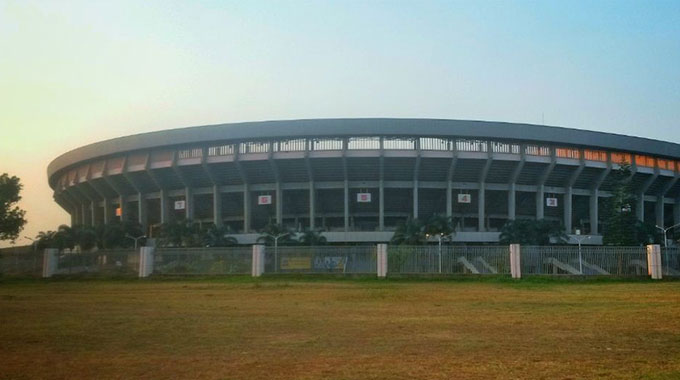
SO, the football match came and went. The goals were scored, debates were subsequently held and the photographs were taken. The memes flooded social media.
And yet, if the conversation around the recent Scottland versus CAPS United fixture at the National Sports Stadium begins and ends with football, then we will have missed the bigger story.
Because the match was never the story. The stadium was.
The National Sports Stadium is more than concrete, steel and bucket seats. It is where generations of Zimbabweans have celebrated triumph, endured heartbreaks and been united behind the national flag. It is where Winnet Dube on the athletics track, Peter Ndlovu against South Africa, Agent Sawu and Vitalis Takawira against Cameroon brought excitement and lasting memories. It is joy, heartbreak, sorrow and pain all rolled into one.
Thus, its reopening is the restoration of a national stage upon which future sporting memories will be made.
For the first time in years, Zimbabwe’s largest sporting facility came alive under real match-day conditions. Turnstiles opened. Spectators flowed through entry points. Security systems were tested. Seating arrangements were exercised.
Of course, it is work in progress and the media facilities would need some reviewing, particularly the media tribune and the security around it in the heart of the stadium’s bays that are famed for fan notoriety.
Emergency procedures were also put under scrutiny, the pitch hosted a competitive fixture. In fact, the entire venue was subjected to the type of pressures that only a live event can create.
That was precisely the point.
The Ministry of Sports, Recreation, Arts and Culture, working largely through the Sports and Recreation Commission (SRC) deserve commendation for taking the deliberate decision to conduct a full operational test before declaring the facility fully ready for business.
It would have been easier to rely solely on inspections, paperwork, and technical reports.
Instead, the authorities to their eternal credit chose a more practical approach: put the stadium into operation and see what works, what needs improvement and what still requires attention.
That is how major facilities around the world are commissioned.
A stadium can look impressive in photographs. It can satisfy many technical requirements on paper. But there is no substitute for observing how thousands of people interact with the facility in real time.
How quickly do spectators enter? How effectively do access control systems function? How do emergency response procedures perform? How efficient is crowd movement? How do media operations integrate with stadium management? How does the venue perform under the pressure of an actual event?
These are questions that cannot be fully answered inside a boardroom. They require a live environment.
And the Scottland versus CAPS United PSL fixture provided exactly that opportunity.
Predictably, there were issues. There always are.
No large-scale test event anywhere in the world is expected to be flawless.
We believe that the purpose of a test event is not to prove perfection. Instead, it is to identify gaps before the stakes become much higher.
What matters is not whether challenges emerged. What matters is that those challenges can now be measured, analysed and addressed well before even the Confederation of African Football (CAF) inspectors are invited for an assessment tour.
For years, Zimbabwean football has paid a heavy price for the unavailability of a compliant National Sports Stadium. Home matches have been played away from home. National teams have been deprived of home support. The country has suffered reputational damage as questions were repeatedly raised about infrastructure readiness.
The consequences have been sporting, financial, and psychological none more than to the Zimbabwe Football Association (ZIFA) who have had to bear the brunt of the huge expenses associated with staging national team games in a foreign country and without even recouping much from gate revenue.
When you do not have your own infrastructure, it is associations like ZIFA who take a knock on revenue but players’ financials won’t take a knock.
That is why the reopening process must be viewed through a broader lens. This is not merely about one stadium. It is about restoring confidence in Zimbabwe’s ability to host major sporting events.
It is about rebuilding credibility with international governing bodies such as FIFA, CAF and World Athletics. It is about creating an environment where athletes can perform before their own supporters and about strengthening the foundations upon which future sporting success will be built.
Most importantly, it is about progress.
The National Sports Stadium today is not where it was five years ago. The checklist that once seemed daunting has steadily been reduced through investment, planning and commitment. While work may still remain, the trajectory is undeniable.
The stadium has moved from being a dormant national asset to an active facility undergoing final operational refinement. That distinction is important.
Constructive criticism remains essential. Stakeholders must continue to identify shortcomings and advocate for improvements. Standards should never be compromised.
However, criticism should also be balanced with perspective.
The objective now should not be to ridicule every imperfection that emerges during a test phase. It should be to ensure that lessons are learned and improvements implemented. Zimbabwean sport gains nothing from cynicism. It gains everything from continuous improvement.
As the National Sports Stadium moves closer to full reopening, the conversation should therefore evolve. Less focus on the memes. More focus on the milestones.
Less attention to isolated moments and more attention to the broader journey.
Because when the stadium eventually welcomes international football back onto Zimbabwean soil, the significance will extend far beyond 90 minutes of play.
It will represent the restoration of a national sporting symbol. And when that moment arrives, history is unlikely to remember the jokes.
It will remember that a nation took the necessary steps to rebuild, test, improve, and ultimately reopen one of its most important sporting infrastructure.



