admin
admin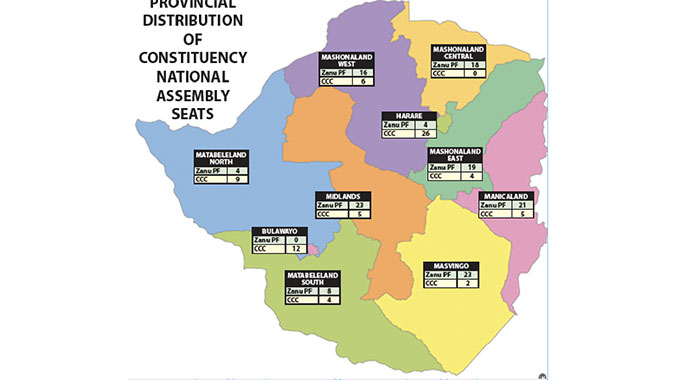
The just concluded elections have produced few changes.
President Mnangagwa of Zanu PF won a second term with an increase in his majority and Mr Nelson Chamisa of CCC once again came second, with the parties splitting the constituency seats in the National Assembly 136-73 with one constituency still to hold its poll.
This gave the CCC a small increase in constituencies won, partly the result of a new delimitation and partly the result of better luck when it came to flipping extreme marginal seats.
The Presidential vote showed some real change, with President Mnangagwa gaining extra support.
As before the major divide in support was between the urban and the rural areas. CCC won the two metropolitan provinces and most seats in the other eight that had an urban majority, while Zanu PF won the popular vote in the eight non-metropolitan provinces, although in Matabeleland North came second in seats won to CCC.
At first glance of a map of constituencies won by each major party, or just looking at the provincial tables, it could be assumed that there is also an east-west divide on top of the rural-urban divide, this is not really so.
CCC does have a larger percentage of the rural vote in the Matabeleland provinces than it has in the rural areas of the centre and east, but it is still a minority party in those western rural areas.
The rural urban divide, while dominating Zimbabwean politics, is not absolute by any means.
CCC has support in some rural constituencies although it needs some urban centre included before it becomes a threat to Zanu PF. Zanu PF in turn has support of varying degrees in every urban area.
This spread of support by both parties into areas where the majority votes for the other party means that both will win some of the proportional representation women’s seats in provinces where they came second, and will have representation in the Senate from those provinces.
In fact the Senate will see at least one senator from each major party coming from all 10 provinces.
The special women’s seats and the Senate ensure that both parties will retain a national outlook, despite concentrations of support, and this should help ameliorate the rural-urban split.
In addition, Zanu PF did manage to win four Harare Metropolitan seats, mainly in the areas where new settlements are concentrated plus Mbare.
CCC possibly thought winning three constituencies in Mashonaland Central might be the start of a rural flip, but those three are largely populated by Harare Metropolitan overflow.
Ruwa is obviously urban but Goromonzi South holds a lot of the better-off “land baron” settlements, as does the northern half of Seke.
The extent of the dominance Harare has in the CCC Parliamentary caucus is shown by the fact that 26 of the 73 seats the party won are in Harare Metropolitan, or more than a third, and once you add in the three overflow seats on the east and south and Norton, where Harare’s western edge is about to touch that town, the party has 30 of its seats from the greater Harare conurbation, or 41 percent of the party total.
This sort of dominance of its support coming from in and around the capital city has the danger of creating a mindset that what happens in Harare is the norm and anything that is different is the result of something underhand and evil.
Certainly those who live in Harare Metropolitan and do not support CCC are often nonplussed to find it is assumed by their neighbours and friends that they are also “against the Government”.
This general attitude helps explain why so many of the self-appointed civic groups also assume that everyone automatically supports CCC and that when it does not win everywhere then someone has manipulated the vote.
The danger needs to be recognised.
Zanu PF, with its far greater national spread of support, usually does recognise that respectable people can differ, and that there are multiple views on almost every topic.
One important result of the strongish split in political support, although it is far from universal despite the fact that local authority councillors will tend to belong to the same party as the local MP, is the need for all councillors and Members of Parliament to fulfil their duty of representing all the people in their ward or constituency.
Although almost all are sponsored by one of the two major parties, their responsibilities go far beyond just being a measure of support of a party or its presidential candidate.
They have the job of interacting with all in their constituency, and with all communities, however those are made up. In other words, they have to represent those who did not vote for them, and perhaps will never vote for them, as well as those who enthusiastically support them.
The other danger, that the central Government might ignore the urban areas and let them stew in their own juice, will not happen under the watch President Mnangagwa or his Government.
In his first term, the Government took on extra responsibility as emergency measures when urban local authorities failed dismally in provision of important local services.
And this was not done as some sort of quid pro quo for future support, but rather the President seeing his job as ensuring all Zimbabweans gained from national development and that his Government had the job of protecting all Zimbabweans.
That attitude, that if you are a winner of an election you treat those who voted against you in the same way as those who voted for you, needs to permeate the whole political spectrum.
In this way we can avoid the worst effects of the rural-urban divide, and perhaps in our diversity be able to generate more interesting ideas on how we can move forward, together.


 Online Reporter