

 Online Reporter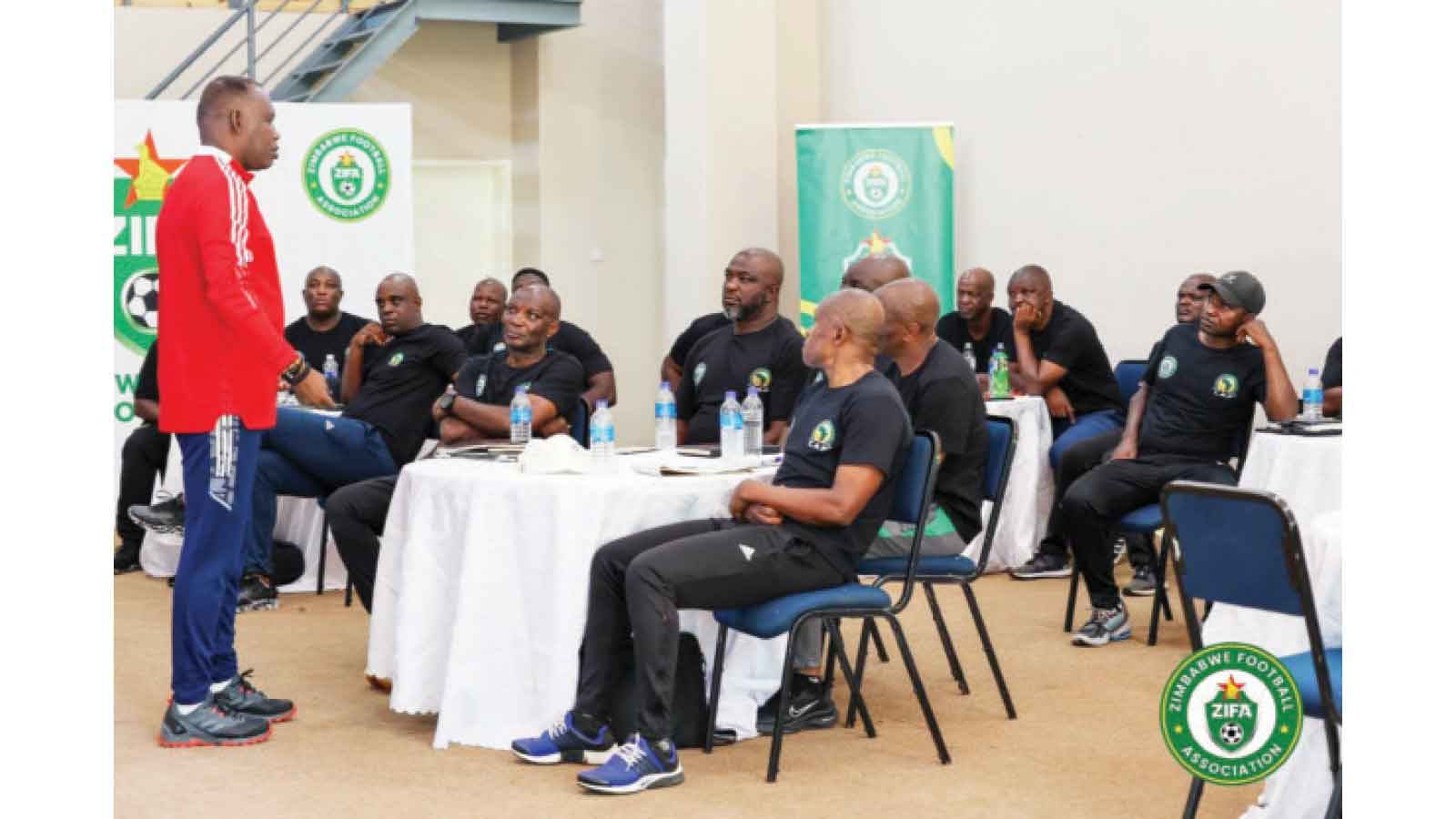
THIS week, the Zimbabwe Football Association quietly did something profoundly important.
The association hosted a CAF A Licence coaching refresher course at ZIFA Village in Mt Hampden — the first-of-its kind in nearly a decade.
To some, it may have seemed routine. To those who understand the trajectory of Zimbabwean football, it was significant.
The last time such a course was held under strong technical direction was during the tenure of the late Nelson Matongorere, a respected football mind whose contribution to coach development remains noteworthy.
Matongorere’s passing in 2024 marked the end of an era. For a period thereafter, technical progression in local football appeared to have become stagnant.
Local coaches had literally forgotten about going back into class.
However, this week’s course presided over by CAF instructor and ZIFA technical director Dominique Niyonzima signals movement again.
We note that football like any other sporting discipline is not static as the laws evolve. Interpretation of those laws also shifts.
Sports science advances, tactical systems change and data analytics increasingly shape decision-making.
Thus, a coach, who qualified 10 years ago but has not been exposed to modern developments is competing at a disadvantage and taking his team backwards with him.
That disadvantage has been visible.
For years, Zimbabwean clubs have relied almost exclusively on local coaches, a fair decision, although, often driven more by comfort and familiarity than by rigorous professional standards.
We believe that there is nothing inherently wrong with backing local expertise. In fact, national development demands it.
However, backing local coaches without continuous upgrading of their competencies is a different matter.
The results have been painfully clear each time our clubs venture into CAF inter-club competitions. Zimbabwean teams have too often been exposed — tactically naïve, physically underprepared, strategically reactive rather than proactive.
Against North African sides, West African tacticians, or even well-structured Southern African outfits, the gulf has been evident. As a nation we cannot ignore that reality.
The English example provides a sobering lesson. English football is arguably the most resourced domestic league structure in the world.
Yet, for more than a decade, the most successful Premier League managers have predominantly been non-English. Pep Guardiola. Jürgen Klopp. Arsène Wenger before them. Antonio Conte and José Mourinho.
England, the birthplace of modern football, realised that romanticism cannot replace competence.
Zimbabwe must confront a similar truth. Passion for the game, former playing glory, or club loyalty cannot substitute for structured, internationally benchmarked coaching qualifications.
This is why ZIFA’s recent directive requiring Premier Soccer League head coaches to hold CAF A licences — and assistants CAF B licences — is structural reform and not just administrative grandstanding.
Critics may argue that the move is abrupt or burdensome. FC Platinum, for example, now find themselves in a difficult position following the appointment of Joel Luphahla, who currently holds a CAF B licence. Luphahla is a promising coach and was among the few to pass his previous CAF course when many did not.
His ambition to attain the CAF A badge is clear.
But systems cannot bend indefinitely around individuals.
If the standard is CAF A, then the standard must hold. Otherwise, it ceases to be a standard at all.
The cascading requirements through Division One, Division Two and the women’s leagues show that this is about building a coherent technical ladder across the entire football ecosystem.
Registration on the FIFA Connect platform further aligns Zimbabwe with global governance systems, closing administrative loopholes that have previously undermined professionalism.
The urgency of such reform becomes even clearer when one looks at continental developments.
At the 2025 Africa Cup of Nations in Morocco, Zambia suffered a major setback when CAF ruled that only holders of CAF A or Pro licences could coach at the tournament. The regulation was not new — enforcement was.
The lesson was harsh but instructive: African football is raising its technical bar and those who do not adapt will be locked out.
Zimbabwe cannot afford similar embarrassment at either club or national level. Our coaches must not find themselves ineligible at the very moment the nation qualifies for a major tournament.
Therefore, the ongoing week-long refresher course under Burundian tactician Niyonzima becomes even more meaningful and strategic.
It signals alignment with modern football demands and recognises that certification is not a once-off achievement but a continuous process. This is how credibility is rebuilt.
However, reform must be supported. If ZIFA demand higher qualifications, they must simultaneously ensure accessibility to courses, transparent selection of candidates, and financial support mechanisms where possible. This creates a full package for elevation and inclusion, otherwise it may create barriers.
Clubs, too, must invest. Hiring a coach is appointing the chief architect of performance culture. A CAF A licence should not be viewed as a regulatory hurdle but as minimum assurance of competence. Zimbabwean football has long struggled with structural weaknesses — administrative instability, financial fragility and inconsistent development pathways.
A modern football nation is built from the technical area outward.
When coaches are properly trained, players are better developed. When players are better developed, clubs perform competitively.
And when clubs perform competitively, national teams benefit. The cycle reinforces itself. If we aspire to see Zimbabwean clubs compete seriously in the CAF Champions League and Confederation Cup competitions, then we must begin with the coach.
This week’s CAF course may not generate headlines like a major player transfer.
But in the long term, it could prove far more consequential.
ZIFA have drawn a line. The question now is whether the entire football fraternity will step forward to meet it.
Professional football demands professional standards. Zimbabwe cannot afford to settle for less.



