admin
admin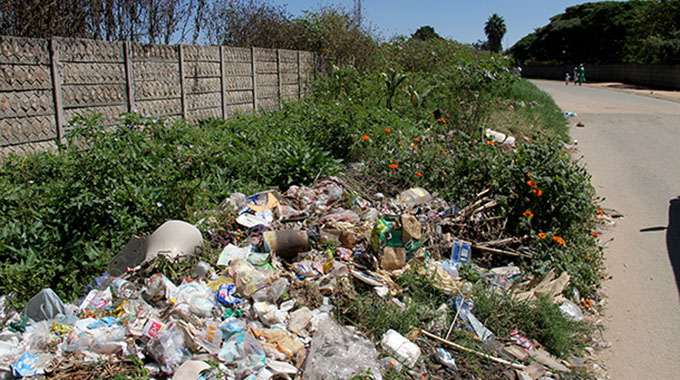
The major problem of rubbish piling up in streets and in poorly designed dumps has institutional backing as well as the pressure from President Mnangagwa leading the effort to have less garbage to start with and then clean up what we ourselves generate.
The Auditor-General in her 2018 report brought up the problem that while solid waste management is a local government issue, many councils do not have the right equipment, or enough of it, to collect the rubbish in the first place and do not have the at the very least the managed landfill sites.
She wanted to see both, plus far more recycling and the problems highlighted in the report have now come under the spotlight of the Parliament’s Public Accounts Committee which is physically checking what authorities, basically urban authorities, are doing or not doing.
“Progress” has seen packaging becoming far more resistant to decay and rising in bulk as more items are packed in plastic and other materials that do not decompose and more people can afford to buy these products and their single-use packaging.
The result has been a lot more solid waste is generated and the overwhelming bulk of this solid waste will not rot, or at least not in the next couple of decades.
Litter becomes an ever greater problem and the amount of garbage generated by an average family each week rises beyond the contents of a garbage bin. Yet even where a council is reasonably efficient, the equipment and the dump still follow many of the ideas of more benign times.
Sixty years ago all drinks, from squashes via soft drinks to beers, were sold in recyclable glass bottles. These were heavier and more expensive than the single-use polyethylene terephthalate (PET) bottles now ubiquitous.
These are fine for both producers and consumers since PET does not decompose, does not add or subtract from the flavour and generally is a very safe product.
The problem is that when it eventually ends up in the environment, either as litter or as part of a dump it still does not decompose. It can be recycled, not as a bottle but as the raw material for plastic manufacturers; the technology exists but costs of collection mean they are not often applied.
Drink cans, now less common than they were, are another source of litter and rubbish. Again these can be recycled and there is an informal market for aluminium scrap that does see informal sector collectors gathering these up for resale.
Japan charges a modest deposit on drink cans. Most people still throw them away rather than keep them and claim a refund, but again there are people, in Japan mainly the elderly on modest pensions, who will look for these so they can claim the deposits.
The same system would work in a country like Zimbabwe with PET bottles. All it requires is a law.
Take aways, a new product in the last few decades, produce a lot of garbage and a lot of this is litter dumped where people stop and eat or even worse hurled out of the windows of a car, because the driver wanted a snack but did not want any mess in the car, although was quite happy to make that mess outside someone else’s gate.
There has been some effort to control the packaging. Expanded polystyrene was banned. Some converted to cardboard and some to PET containers. Cardboard in theory will biodegrade, but again with the oily printing inks this takes a bit of time and the PET containers have the same problem as drink bottles.
One suggested solution is a small charge on the take-away. The packaging cannot be easily recycled but those small charges will add up and can be allocated to rubbish collection, perhaps being used to manage a landfill or buy garbage trucks. At the very least they can buy bins.
Some countries have very sophisticated recycling, starting at household level. In many Swiss and German cities households will have five garbage bags for different types of garbage, separating out glass, sometimes by colour, plastic, paper and cardboard, metals and organic waste.
In the end only the organics, the leftover food and the banana skins and the like, go into a dump where they rapidly decompose. The other stuff, properly separated and reasonably clean, is collected, bulked up and sold as an industrial raw material.
We are quite a long way from this in Zimbabwe, since we find it hard to even pack our rubbish into one bag. The cost of bags is high in Zimbabwe, despite the makers carefully labelling their products as made from recycled materials.
And, as everyone has noticed, many local authorities cannot even collect this one bag and when they do it is just hurled on a dump, not even an engineered landfill.
Harare is now looking at implementing a deal to incinerate its rubbish, and using the heat to generate steam for a generator, but it still needs to collect that rubbish efficiently and perhaps needs to have the rubbish at least partly sorted between the things that burn and the things that do not.
Other councils need to find US$500 000 for a single cell of an engineered landfill and do not have the money. The suggestion by the Parliamentary committee that the central Government pays these bills is not really satisfactory.
A better solution would be to look at systems that generate less rubbish to start with and with more of that rubbish biodegradable or recyclable.
This all fits in with the anti-litter campaigns launched near the start of the Second Republic by the President. If everyone disposed of their rubbish properly then at least it would start off bulked up and easier to move to dumps or recycling plants.
Most of the by-laws that the committee was complaining had not been approved are the standard anti litter by-laws. Some cities, such as Harare, have them and simply do not enforce them, or even pretend to enforce them.
Garbage is not the sort of topic that enthrals the average person, but generates a lot of complaining when other people dump theirs outside our gate or when the local council does not collect our bags or when toxic smoke rises from the local dump.
We need to fix it.



 Online Reporter