admin
admin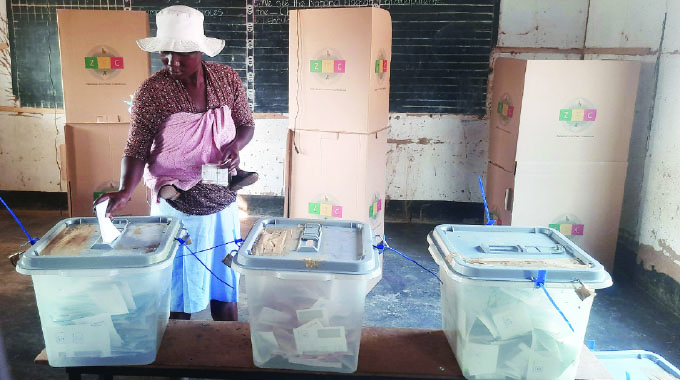
ZIMBABWE’s harmonised election last week and the results that came out over the weekend have been accepted as standard by a growing number of observers, including important neighbours and the Commonwealth.
Generally, this means that the results that were announced at constituency, provincial and national level by the Zimbabwe Electoral Commission have been accepted as accurate and they reflect the way Zimbabweans voted in a peaceful and open election that was considered free and fair.
The missions, even those who had some doubts over the poll such as the European Union, did report the lack of violence and the national peace during the polling process, while others such as The Commonwealth were extremely positive about the prevailing peace.
The Commonwealth observers, who appear to have gone the extra mile in talking to voters at random and physically checking how voting took place at many stations, were extremely impressed not just at the peace, but the lack of any tensions among those who were voting. No one was looking over the shoulder.
The SADC Preliminary Report needs to be put into perspective. It was the opinion of one person, admittedly the leader of the mission who therefore had the opportunity to make the first public statement, and there are strong reasons to doubt the neutrality of that mission leader.
Already national missions from several SADC countries, including South Africa, Botswana and Namibia, have endorsed the election.
The final SADC report will need to reflect the views of other members of that observer mission.
Considering the statements and congratulations already given by other SADC Presidents or the reports of national observer teams from SADC countries, it is unlikely that their views will coincide with the views of the SADC team leader.
The delay in delivery of ballots for the local government elections in a small percentage of the wards, and the consequent late start in voting, or even deferment of voting to the following day, has been seen by many, including Zimbabweans who had to wait in line or return the next day, as a bit of black mark.
But the Commonwealth team put this into perspective and praised the rapid action taken by President Mnangagwa to use his powers under the Electoral Act to issue an urgent proclamation to allow voting in the affected wards the next day.
This, as the Commonwealth team noted, allowed all Zimbabwean voters who wanted to cast their ballots to do so. In other words there was a prompt and effective action taken to make sure the delay did not affect anyone’s rights to choose who they wanted as councillor, National Assembly MP or President.
Thus the delays, irritating as they were for those affected, did not affect the final result. The European Union brought up the delay, and also complained strongly about the arrest of two small groups of activists well after polls closed. The arrests therefore could not have affected the voting in any way.
The police are having the two groups charged with attempting to breach the Electoral Act by issuing unofficial and unverified results drawn from numbers presented to them possibly by election agents, presumably from opposition parties.
The two groups were granted bail fairly promptly so while they could not issue unofficial results before the official results were announced, they were still at liberty to check these with the sources they hoped to use earlier. They were not out of communication for very long. It still seems strange that the CCC did not use the opportunities that national broadcaster ZBC made available for them to reach a wider audience.
ZBC have been careful to list when their invitations were rejected, and have brought up the frequent statements by CCC candidates that the party would have nothing to do with ZBC as a matter of policy. There is a spread of daily, weekly and Sunday newspapers so the print media offered a lot of variety in coverage.
These days, with the near universal ownership of mobile phones, no one going to cast their vote could be unaware via social media platforms, if nothing else, about who was standing for election.
The CCC did have some polling stations where it could not field an agent, or the full team of three it was permitted at every polling station, and in some cases even when it did have agents present they left early complaining they had nothing to eat. This is an internal party matter.
Considering the popular vote of the CCC, and remembering Nelson Chamisa won 44 percent of the Presidential poll, it seems absurd that the CCC could not find the small group of agents, less than 30 for the average constituency, to have three at every polling station.
Even in the constituencies where Zanu PF had its largest majorities, there were still more than 2000 CCC voters.
Zanu PF itself had no problem fielding the 5 500 or so agents it needed nationally for the three at every station, even in Bulawayo Metropolitan where it had the lowest percentage of its vote.
But the CCC is not a proper party with formal membership and a structure. It is a small group of self-appointed leaders plus some supporters.
There were reports, even on polling day, that some of its agents were reluctant to sit around a station until they received their promised party allowances.
This lack of structure has reportedly caused Mr Chamisa to send out messages asking candidates in the Parliamentary poll to send him copies of their V11 forms.
This is the form that is used to record the count from each station and is normally signed by all agents present.
Mr Chamisa is now desperately trying to find some evidence he can use if he wishes to approach the Constitutional Court, but considering that CCC agents did sign off on a lot of results, this will be difficult.
He needs to accept his loss.
There are still those who rather dumbly assume the rural voters who gave Zanu PF its popular majority are stupid stick in the mud people. There are not.
During President Mnangagwa’s first term, the value of agriculture output more than tripled. A good slice of this went to fertiliser and seed companies, and a smaller slice to the contractors and merchants dealing in farm produce, but the farmers received a very large slice.
President Mnangagwa and his economic advisors saw the smart way to grow the Zimbabwe economy was to transform a largely poverty-stricken rural majority into the drivers of growth by having enough extension staff, ensuring that all farmers could obtain inputs or finance for inputs, doing research on climatically appropriate farming, and guaranteed markets.
This did not cost much and gave the greatest social and economic return on investment.
The first years of better incomes, or even some income, have seen farmers first going for better clothing, better housing and a second-hand car.
Unfortunately most clothes and all fabric is imported, as are the cars and much of the hardware such as the small 100W solar panels and batteries that have become so popular and the steel roof sheets.
While urban cement plants are expanding fast and looking for sites for new plants, much of the other initial spending is going to the growing non-farming rural population, the builders, brick moulders, welders of door and window frames and local carpenters and furniture makers. The second term should see more spending on what manufacturers are already making as the farmers continue to drive national growth.


 Online Reporter