

 admin
admin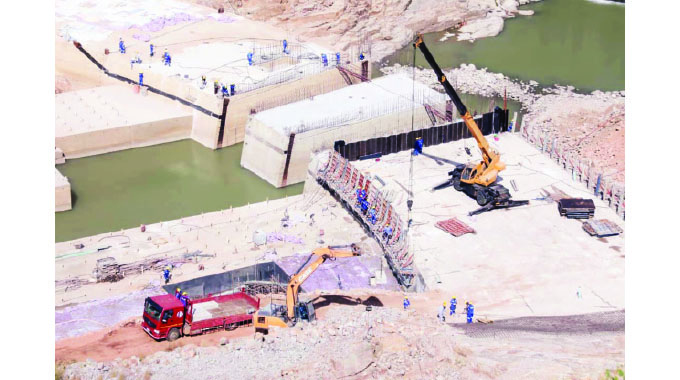
As the Second Republic moves forward, converting plans on paper into something concrete on the ground that people can use to live better or create wealth, a modest number of partially completed and effectively abandoned older programmes have come alive.
Matabeleland North, a province which is outside the Hwange coal belt and Victoria Falls, never really moved to the top of the list, has been a major beneficiary of Government-development efforts as a determined effort is made to help the province catch up and be an important and critical part of the new Zimbabwe and share in the growth of wealth.
For this province, the critical factor is, and always has been, water. And much of the development has to be impounding the water during the flash floods in the rains and then getting it where people can use it.
For more than a century people were talking about getting water to Bulawayo and giving Zimbabwe’s second city an assured supply of water so that what should be a major industrial centre can actually grow and make use of the many resources in its provincial hinterland.
For more than four decades the first stage, the Gwayi-Shangani Dam and the pipeline to the city, were identified as the solution. For almost four decades this has been a topic of conversation.
Come the Second Republic and the finances were organised, work on the dam started and is scheduled for completion at the end of this year, just in time to catch more water although it has started filling, and the work of procurement and contracting the laying of the pipeline is well advanced.
That dam will also start filling the needs for irrigation in the province, with careful calculations reckoning it can supply Bulawayo and some other places and still have enough water to irrigate 10 000ha.
But obviously this is not the only dam for the province, although it is the largest. The Bubi-Lupane Dam was finished almost a decade ago. It was designed to supply Lupane area. But it was not until 2018, again at the start of the Second Republic, that things started moving.
The new town of Lupane, planned as a future city being the capital of Matabeleland North, is already home for the provincial State university, and no doubt becoming a major centre for the private sector. But until there was a decent water supply a lot of this was just paper plans.
Work started in 2018 to convert the paper into something usable, using the water in the Bubi-Lupane Dam. And this weekend President Mnangagwa went up to Lupane to commission the new water supply to the town and future city.
The town board has been busy, and spent its devolution money on laying the pipes to the houses, offices and businesses, but it needed the backing and stability from the central Government to turn its needs list into water flowing out of taps.
With the basic essential in place, the vision of a decent city between Bulawayo and Victoria Falls finally can become a reality.
At the same time the President also commissioned the other half of the output from the dam, a new irrigation scheme, and Lupane is definitely one of those districts where farmers need water if they are to grow very much at all.
Part of the proposed “green corridor” running down to Bulawayo passes very close to the area, so more development can be plugged in quite quickly.
President Mnangagwa prefers to make his speeches when he is opening or commissioning something, rather than making extravagant promises that will be turned into reality in some future era. But he takes the opportunity as he looks over the concrete manifestation of a plan to make his point.
At the weekend he wanted to emphasise that the National Development Strategy was a map for development, but that he and his Government were watching progress very closely and ensuring that what was planned was built and was commissioned, on time. He wants to tick off the work as it is done.
The President decided to travel to and from Lupane by road from Bulawayo. The reason was that he wanted to actually see what a large slice of Matabeleland North was experiencing, and with his farmer’s eye he could see the dust, the dull grass and the other signs, but also see the timber, showing that those soils are potentially extremely fertile if they have the missing factor, water.
So in his speeches in Lupane he did go into some detail over not just the need for irrigation in that province, but also what his Government was actually doing about it. Not only was the Bubi-Lupane irrigation scheme moved to the top of the list in the acceleration programme, and the massive Gwayi-Shangani dam coming up for completion, but already another new dam in the province, with yet another in the equally arid Matabeleland South, now in the commitment stages.
He also reminded the people that development was a partnership. The Government can do a lot on the infrastructure side, building dams, laying the pipelines, opening the irrigation schemes.
But it cannot grow crops, it cannot establish new businesses, it cannot do very much even when it comes to new industries. This relies on the people getting on with it.
What the water and roads mean is that their effort can now be applied.
To a degree, a large part of Matabeleland North was abandoned by the colonial regimes, which saw those areas as a place to dump the people shifted from around Bulawayo, and regrettably many of the promises made by the old dispensation never really moved from the drafting table to the ground.
That has now changed, and in a big way, and no doubt the President will be making more journeys into the provincial heartland fairly regularly as he commissions more of the things that the people need, urgently.
One slogan of the Second Republic is that no one should be left behind as the nation develops, and that is also being made real in Matabeleland North now.



 Online Reporter