

 admin
admin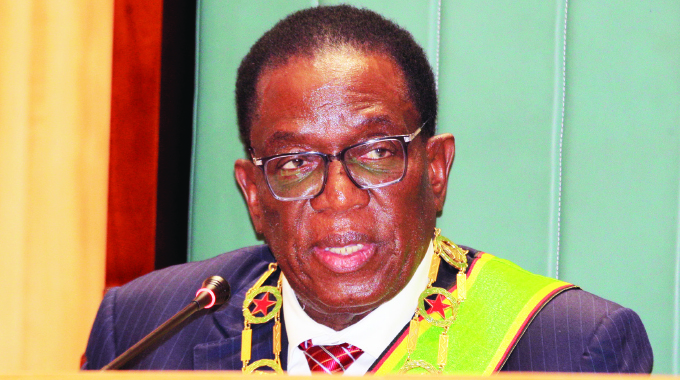
The shift in land tenure on resettled land to the new bankable, registrable and transferable document of tenure announced by President Mnangagwa this week will allow the real farmers benefiting from land reform to be able to access finance and build up their farming businesses.
Bankers and farmers have both pointed out the major problem. Up to now the only real collateral a farmer has is the equipment on the farm, and the livestock and crops on the land.
But very often the only way they can buy equipment is with borrowed funds, and livestock and crops frequently need financing. Often the money is needed before there is an asset to put up as collateral.
There are many intangibles like boreholes, farm dams, fencing, fireguards and the like that add immensely to the value of the farm, but cannot be staked as collateral apart from the land.
A banker cannot move a borehole or a dam or paddocks to another farm. At the same time, to invest in all those assets and the improvement of the land, the farmer needed a higher level of security of tenure than a simple offer letter, the most common present document, and possibly something different from the present 99-year-leases.
So in the end, the form of tenure had to be a bankable document, and that meant the land had to be transferable, which was where the original difficulty arose and where many finer details will need to be worked out by the two committees set up, a technical committee working under a Cabinet oversight committee that will lay down the principles and the policy.
President Mnangagwa must be commended, first for taking the plunge that will see resettled farmers getting something far better when it comes to security of tenure and something that will help them raise finance, and then for realising that this is not a simple off-the-peg solution and will require a lot of hard work and innovative thinking to make sure we get it right.
A couple of conditions have already been set. Any transfers of land holding must be to indigenous Zimbabweans and where possible transfers should be to veterans of the liberation struggle, youths and women, implying that there will be some sort of approval system put in place, along with lists of those should first be approached when a transfer has to take place.
Clearly President Mnangagwa wants to maintain the wide range of positive benefits from land reform, including the return of a finite asset to the indigenous inhabitants and the far wider range of people allocated and holding that land.
At the same time he wants to allow farmers, or at least those taking farming seriously, to be able to raise finance beyond the Government schemes so they can develop their farms.
We think the double objective can be achieved if the scheme has a modest number of strong and tight rules. Besides what has already been set as policy, we believe that the existing rule of one person-one farm, and the fact that farms cannot be merged, must be maintained.
It could well be possible for someone to buy out neighbours less keen on farming, or their relatives who did not want to farm when the landholder dies, and reassemble the sort of vast estate that had to be broken up as part of land reform.
Simply having half the land, and the better half, held by a few thousand indigenous Zimbabweans rather than a few thousand settlers of colonial descent would hardly be considered an advance.
Other countries that have seen radical land reform in the past, everything from the break-up of vast aristocratic estates to the sort of reform we have seen in Zimbabwe, have generated solutions that allow transfers, sell offs and banks having to activate a sell-off, but have maintained the widespread ownership.
Rules on non-merger of farms, one person only having one farm, and in several cases a waiting list of approved landholders who can step in when farms do come up for transfer.
In Zimbabwe, with more people wanting farms than there are farms available, any similar measures would work well, especially if there were mortgage facilities for new farmers.
While we can probably retain the policy that rural land, as land, cannot be sold off, obviously the improvements will have value, and immense value on a highly invested farm.
Even an A1 farm with a high level of irrigation and other improvements will be a rock-solid asset and on transfer the new landholder will have to buy them.
The committees could also examine the sort of finance, what it could be used for, that can be backed by the bankable document of tenure.
Obviously adding improvements to the land must count, and probably equipment and cropping, although the security in these cases should perhaps be the equipment and crops themselves, not the use of the land.
Banks should be barred from lending to a person living in a city and who only applied under land reform for a “piece of land” to hold for weekend picnics or for potential use if unemployed.
That person in any case needs to be eased off the land and the allocation handed over to a real farmer on the Government priority list.
The other area where the President has firmed up land allocation is urban land. From now on urban land can only be allocated to proper developers ready and able to develop the land properly with the required services, and then either build the housing and flats required under Government policies, or sell off serviced stands under such policies, or the commercial and industrial complexes.
The Second Republic is untangling major foul-ups that occurred when such urban policies were not rigidly observed, and quite rightly wants things to be done properly and a lot better in future.
Again the President needs to be commended. He is not blocking urban development, rather the reverse since some of the new policy includes regenerating run-down urban land.
Rather he wants it done exceptionally well so it will last the lifetime of modern development, hundreds of years, and will not generate almost immediate complications such as no roads, no sewers, no electricity, no water and urban sprawl.
We know we can do it right and all it requires is the sort of stand the President has taken, that it must be done right or not at all.


 Bongani Ndlovu
 Online Reporter