Online Reporter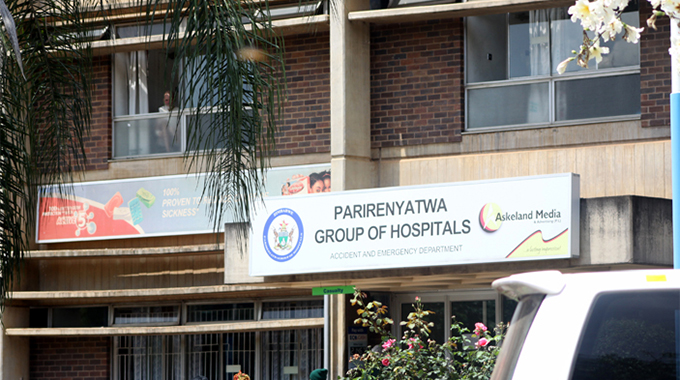
While the main buildings at the Parirenyatwa Group of Hospitals in central Harare date to a rush building job in the 1960s, several parts of the complex are considerably older having been built as add-ons to the original central hospital that still is part of the southern edge of the complex.
The point is that in all these decades there was little or no renovation or rebuilding or seriously disruptive maintenance.
Rather generations of maintenance staff kept the place going, sort of, while the decades took their toll with plumbing, for example, being never designed to last for more than half a century, and with different layouts and different assignments of space being needed as medicine advances.
While plans were in progress for a proper and full renovation, progress was on the slow side until earlier this year when President Mnangagwa took direct action, making a surprise visit to the hospital and thus being able to talk to ordinary staff as well as those in senior positions.
He ordered the required action to be speeded up.
This has been done. The required work, basically sorting out the areas where the old building was no longer functional, was divided into three: the main nurses home part of which is among the oldest parts of the complex, the maternity unit which pre-dates the main hospital and the main hospital building itself.
The first phase was the nurses home and while lay people might wonder why a nurses’ residence needed to top the list, they need to think how a hospital works.
There is accommodation for other staff, the more junior doctors in a complex to the north of the hospital and the senior nursing staff and specialist nurses in blocks of flats to the south and parts of the upper Avenues.
But this accommodation is still functional and while no doubt work will need to be done in time, the serious problem was the residence of the junior nursing staff.
Here there was accommodation for 353 nurses, with undamaged accommodation for just 40. The reason why a decent nurses home had been built in the first place was because, while doctors might supervise the medical treatment and while ward sisters might run the wards, a lot of work is done by the junior nurses, those under training.
They need to be living on site in clean and safe accommodation. It does not have to be fancy, but it does need to meet minimum standards for young people who are paid trainee salaries and who, with the theoretical and practical training, do not have very much spare time.
The actual building shell was in moderate shape, but the plumbing was totally shot and there were changes to how water and electricity were supplied.
The major rebuild and renovation, now 95 percent complete, involved drilling eight new boreholes, installing the very large tank that controlled the central water supply and even restoring the old swimming pool so the young nurses had facilities for their limited recreation.
A 120kW solar electrical system means that the nurses home has a decent power supply, important when the nurses have to share duties over three shifts every 24 hours.
However wonderful, the eventual renovations are to the wards, modern medical care, just like what was needed 70 years ago or 100 years ago, still required decent nursing care, so making sure the nursing staff was physically there and functional is a precondition to having work done on wards.
The second building to be renovated was the Mbuya Nehanda Maternity Home. This pre-dates the main hospital and was built soon after World War II to replace its predecessor in the Avenues.
It ceased being an ordinary maternity home soon after independence and the end of racial allocation of hospital beds, and instead became a specialist maternity home for the more difficult cases, but the general decline after well over 70 years had taken their toll.
Work has already started on this part of the complex, and a lot of what is required is stripping out floors and ceilings and plumbing and modernising equipment and systems as well as replacing deficient equipment. And it has to be done floor by floor so the unit remains functioning. But around a quarter of the required work has been done.
The final and largest part of the renovation and upgrade of Parirenyatwa is the main hospital building of 1 400 beds. This huge complex with its endless corridors was built in a tearing hurry in the 1960s to replace a planned multiracial teaching hospital that was to be largely funded by development partners under Federation and which was dropped as the settlers moved towards UDI.
The fairly simple building, largely single and double storey and with plain finishes, lasted well, and the lack of fancy exteriors probably helped, but even with perfect maintenance was never expected to last as long as it has, hence the need for the huge renovation effort now being planned in detail.
It will have to be done ward by ward, or at least one of those endless corridors at a time, to make sure that most of the hospital can still carry the very large load it must carry. This will require some very complex planning, with equipment being moved around, preferably to its final new position so only one major move is required.
It is obvious that in the modern world direct floor layouts will be required, space rearranged to cope with the modern equipment and services, and this sort of thing. Professionals have also brought up other requirements, including more open wards in some areas, and to fix up design faults in the original building where the professionals had surprisingly little input once the decision for a rapid construction was made.
This time presumably the professionals will have more say on how space is to be allocated and what units need to be next to each other and generally the sort of practical arrangements that make a hospital easier to run and easier to work in.
And we also hope that the maintenance experts are there centre stage to make sure that it will be a lot easier to keep the hospital in perfect condition for many decades with major disruptions.
The work at Parirenyatwa is far more than catching up on maintenance or doing the basic repairs that not even regular maintenance can reach. After so many decades it is also an opportunity to upgrade the structure, making it more appropriate for the modern world and making the hospital what it should be: one of the main centres of the health system for an upper middle income society.