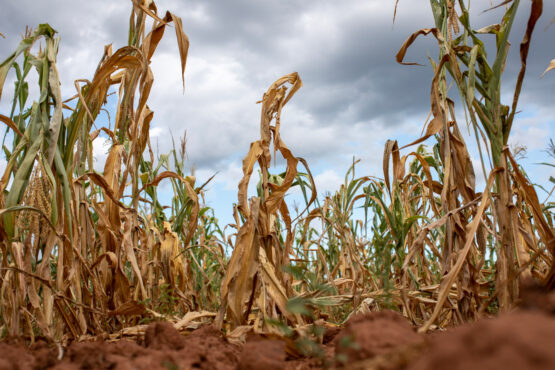
THERE is a growing probability of an El Niño event later this year and that in turn generates a higher probability of a drought over central Southern Africa, which includes Zimbabwe.
So the Government and in particular the Ministry of Agriculture, Mechanisation and Water Resources Development, are now planning how to mitigate the effects of any drought that might arise, both for farmers who bear the brunt and the rest of the country that must cope with lower harvests and the need to tap grain reserves.
The predictability of an El Niño event is still difficult to ascertain.
Changes in the El Niño Southern Oscillation, with shifts in air pressure in the Western and Eastern Pacific Ocean, generate both El Niño events and the opposite La Niña events.
In an El Niño event, air pressure is higher than usual over the warmer Western Pacific, above Indonesia and Australia, and lower in the Eastern Pacific, driving warm winds and currents eastwards to the cooler Eastern Pacific off the coast of Peru.
In a La Niña event, the opposite happens, with higher pressure over the cooler Eastern Pacific than the warmer Western Pacific, driving cooler winds in the other direction.
Records show the world can expect to see an El Niño event every two to nine years, with no regular cycle yet worked out or predictable.
Instead, international weather monitoring and forecasting, generally co-ordinated by the World Meteorological Organisation, continuously monitor the equatorial band in the Pacific and build up probabilities of an El Niño, La Niña or neutral state, and the probability of how strong an El Niño or La Niña event is likely to be.
While probabilities firm up over several months, and the forecast period is well under a year, certainty is only reached when the event takes place.
Global warming introduces additional complications. But records again suggest that El Niño events, if they do not become more frequent — and that is uncertain, as it is the temperature differences rather than actual temperatures between the two sides of the Pacific that are important — are more than likely to become more severe.
Even during El Niño events, there is only around a two-thirds probability of a drought in Zimbabwe, although the more severe the event, the stronger the probability.
So the need to keep ourselves informed is obviously essential.
Cabinet last week examined the latest report from the Ministry of Agriculture, Mechanisation and Water Resources Development and the measures being taken to mitigate the effects of a drought. Mitigation does work. Two very bad droughts occurred in 1991-1992 and 2023-2024.
In the first, we lost around one million herd of cattle; in the last event we slashed those losses to a little under 45 000, thanks to our willingness to learn from history, build up the number of water points, manage pastures better and grow cattle feed crops.
It is apparent that different crops are affected more or less severely, with maize being a particularly dicey crop if rainfall over a maize field falls below a critical level.
We have been breeding shorter-season and more drought-resistant varieties, and that helps, but we still need to think hard.
Traditional grains — the sorghums and millets that were domesticated in Africa early in the agricultural revolution several thousand years ago — cope far better with water stress and are far more likely to produce a harvest in lower rainfall conditions.
We have already taken action to ensure that the Pfumvudza/Intwasa programme does not grow maize in more arid areas, and if such areas are likely to involve more farmers in a drought year, then a larger switch to traditional grains may be required.
When a maize crop can be grown, the yield is higher than for traditional grains, perhaps because for so many years most grain research was on commercial maize rather than self-sufficiency traditional grains.
However, this has been changing, and we need to accelerate our research into crops indigenous to Africa.
Irrigation is of growing importance, and a lot of new and rehabilitated works have been and are being commissioned. That helps, but we have a long way to go before all crops in all places are irrigated. Water harvesting and other measures are important.
These are designed to minimise run-off, or at least slow it significantly, and often involve earth-moving and the planting of protective lines of shrubs and trees.
But a lot can be done with a shovel and wheelbarrow if advice is available.
Conservation tillage can be hard work, as the million who now use Pfumvudza/Intwasa can testify. But it does work and is worthwhile.
Pasture management needs to be continually upgraded. For a start, that provides more pasture, especially in bad years, and secondly, decent grass cover is one of the most effective ways of trapping water and preventing the erosion of organic matter and clay particles, leaving just the sand.
We have also been building up our food reserves so we can weather a drought better.
There is no magic bullet that staves off the effects of a drought, which is why we need a comprehensive and complex set of measures.
Among these is the need to be ready to adjust our cropping and bring in all the other measures, and here Zimbabwe is now thinking ahead far more clearly, renouncing all wishful thinking.
It is much easier to prepare for the worst and then backtrack than to take less effective action later.