admin
admin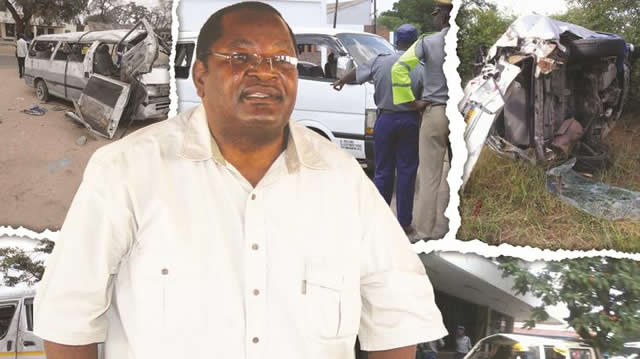
 OVER the past fortnight, Transport and Infrastructure Development Minister Dr Obert Mpofu has been unveiling his ministry’s plans to revamp the transport sector and align it to world standards.
His proposals have elicited mixed reactions from the public with some slating his plans to gradually phase out kombis in big cities and replace them with buses and bigger public transport vehicles to decongest the country’s major urban centres. Plans to increase toll fees by 100 percent have also invited negative reaction from motorists disillusioned with Government’s slow pace of rehabilitating its road network which is appalling to say the least.
In short, the travelling public says it does not a need to pump out money at tollgates to line the pockets of corrupt public officials when the country’s roads are a death trap. We understand the Ministry’s reasoning in coming up with the raft of measures to bring sanity to the transport sector but contend it has a mammoth task to convince a skeptical public of its good intentions. It has a massive public relations job on its hands to sell its proposed changes to Zimbabweans. But we argue, this is not insurmountable because the Ministry is on the right path.
Yesterday, we reported on these pages that nearly 30,000 people were killed in road accidents between 1997 and 2013, according to a report of the Parliamentary Portfolio Committee on Transport and Infrastructural Development. This is a shocking figure which makes the proposed changes to the transport sector urgent. For instance, the Ministry is proposing that the money to be raised from increased tollgate fees be channelled towards road rehabilitation. This is noble provided the funds are directed towards rehabilitating the roads and erecting fences on the country’s highways.
According to the Parliamentary report, 85 percent of accidents in the country were blamed on human error with legislators listing 12 other causes of accidents in the country that include bad state of roads, speeding, drunken driving, fatigue, use of cell phones when driving and going through red robots. The use of second hand tyres, stationary and defective vehicles as well as stray animals on the roads, inadequate road signage and markings as well as lack of traffic enforcement were also cited.
The lawmakers’ report recommended that the government should increase fines charged for traffic offences so that they are deterrent. The authorities were also urged to introduce traffic courts where routine offenders are charged and licenses are endorsed or cancelled.
“The committee learnt that drivers especially of public service vehicles do not follow driving regulations and lack discipline and patience. In Zimbabwe most drivers are driving ‘aggressively’, negligently and without due care or paying attention. This reckless driving by both licensed and unlicensed drivers has resulted in many road accidents,” said the report.
The committee said the corrupt issuance of driver licenses and certificates of fitness by the Vehicle Inspection Department as well as corruption at roadblocks also contributed to road accidents. In order to reduce corruption, MPs said VID and ZRP traffic officers must periodically be transferred, the report said.
We are glad that the Ministry is being proactive in addressing some of the committee’s findings. Government’s review of the Highway Code to raise the minimum age requirement for public transport drivers to 35 years from the current 25 years is one measure that might reduce accidents caused by human error. Records show that most accidents involving public transport vehicles were caused by young drivers.
Reviewing the Highway Code to align it to new SADC road situations is also progressive as the bloc is Zimbabwe’s biggest trading partner and our truck drivers regularly ply routes in the region.
We therefore find very little fault with the Ministry’s plans to roll out a new transport system in the country. In fact, it has been long overdue. Zimbabweans should realise that there is very little appetite for handouts and countries are financing their own infrastructure development.
Tolling is a worldwide phenomenon and has been implemented with relative success in neighbouring South Africa. In the same vein, our neighbours across the Limpopo provide a good example of how to decongest cities with their Rea Vaya buses (which means “we are going” in local street lingo) providing a rapid transit system between the Johannesburg CBD, Braamfontein and Soweto. Complemented by the Gautrain, they provide perfect models for us to copy and emulate.
There is also nothing wrong with encouraging Zimbabweans to adopt bicycles as a mode of transport for short routes especially in big cities. This is the trend in most developed countries where there is emphasis on healthy living and not polluting the environment. Zimbabweans have nothing to fear from the proposed changes as they will bring sanity to our roads.



 Online Reporter